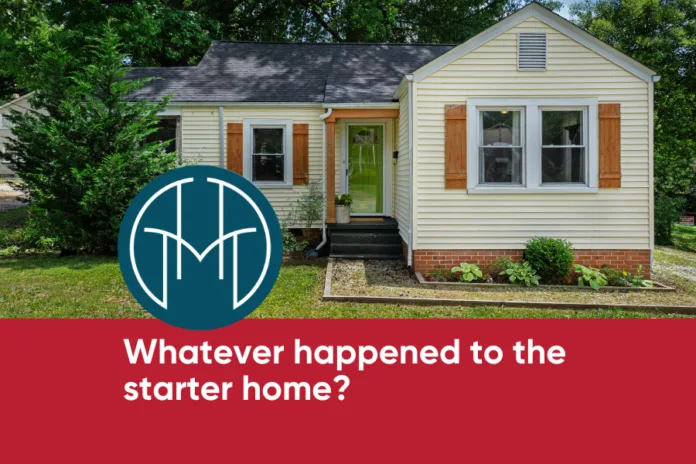
By Chad Taylor, the Taylor-Made Team

Last week I wrote about some of the outside forces making it more difficult for first-time homebuyers to enter today’s housing market. Cash buyers, accumulated equity, and changing market dynamics have all made the climb steeper than it once was.
This week I’d like to explore something different.
What if part of the challenge isn’t just the market?
What if our expectations of a starter home have changed as well?
A few weeks ago I listed a Cape Cod in Prairie Village that I believed represented one of the best values available in the city. It offered more than 2,000 square feet, a two-car garage, something surprisingly uncommon in many Prairie Village neighborhoods, and one of the best price-per-square-foot values on the market. It wasn’t perfect, though. The kitchen was dated. Some finishes needed updating. It wasn’t the kind of home most people would describe as move-in ready.
The home showed constantly.
The feedback was remarkably consistent.
Buyers loved the location. They loved the size. They loved the garage. They just didn’t want to take on the work.
Eventually, the property sold as-is for cash to a parent purchasing the home for their son.
That experience made me stop and think.
Has our definition of a starter home quietly changed?
When I first entered this business more than twenty years ago, most first-time buyers expected to make improvements over time. Wallpaper came down. Carpet was replaced. Cabinets were painted. Bathrooms were updated one project at a time. The first home wasn’t expected to be perfect. In many ways, its imperfections were part of the opportunity.
Today, many buyers understandably hope to purchase something that’s already been renovated. After making a down payment and paying closing costs, they often don’t have another thirty or forty thousand dollars available for improvements. Others don’t have the time, the tools, the contractor relationships, or the confidence to tackle a major renovation. Those are all legitimate concerns, and I certainly don’t fault anyone for wanting a home that’s ready to enjoy from day one.
At the same time, those expectations create another challenge. When every buyer is pursuing the same move-in-ready home, competition intensifies and prices naturally rise. Meanwhile, the home with great bones, an excellent location, and years of untapped potential often gets passed over.
Eventually, someone recognizes that opportunity.
Sometimes it’s another buyer with a different perspective.
Sometimes it’s an investor.
Sometimes it’s a builder.
I don’t believe builders deserve criticism for that. Neighborhoods go through life cycles. Homes that have suffered decades of deferred maintenance eventually need significant reinvestment or redevelopment. Builders play an essential role in keeping our older neighborhoods vibrant by transforming neglected properties into homes that will serve another generation of families. They’re responding to market demand, not creating it.
The unfortunate reality, however, is that many of those homes once represented the classic “fixer-upper,” the first rung on the housing ladder for young buyers willing to trade sweat equity for future wealth.
That rung has become increasingly difficult to find.
Some of that is because builders purchase those opportunities. Some of it is because investors do. But I also wonder whether part of the reason is that many buyers no longer see the value in buying potential instead of perfection.
One of the greatest wealth-building tools previous generations had wasn’t simply market appreciation. It was forced appreciation. They painted walls. Updated kitchens over time. Refinished hardwood floors. Finished basements. Landscaped yards. They created value with their own effort.
Today’s buyers often pay a premium for improvements that someone else has already made.
Again, there’s nothing wrong with that. But it’s worth asking whether we’ve unintentionally convinced ourselves that a first home should feel like a forever home.
Perhaps that’s the lesson.
The purpose of a starter home was never to be perfect.
Its purpose was to get you started.
If buying a home remains one of the greatest opportunities to build long-term wealth, then maybe the smartest purchase isn’t always the one with the newest kitchen or the trendiest finishes. Maybe it’s the home with the greatest potential.
Sometimes the best investment isn’t the prettiest house on the block.
Sometimes it’s the one everyone else walked away from.
Follow Close-In KC on Instagram
Close-In KC is your window into the neighborhoods that define Kansas City’s urban/suburban edge: Prairie Village, Brookside, Waldo, West Plaza, and beyond. Local homes, local stories, favorite hangouts and restaurants, and the everyday vibe of the places that make KC feel like home. Click Here!