Nearly eight months after the Kansas City Chiefs announced plans to move from Missouri to Kansas, work is beginning behind the scenes to relocate the team’s headquarters and training facility to Olathe.
But some big questions remain unanswered.
What will the new facility look like? Will the Chiefs host summer training camp there? And how much local oversight of the massive project will there be?
The Chiefs announced in December that the team plans to build their new $300 million headquarters and training facility near College Boulevard and Ridgeview Road as part of its bigger move to Kansas.
The Olathe project, along with a new $3 billion stadium in Kansas City, Kansas, is set to open for the 2031 season.
The announcement — and the $1.8 billion of public incentives being used to construct the new facilities — has been controversial.
In February, the Olathe City Council unanimously approved the use of STAR bonds to help finance the city’s portion of the project.
Since then, the project’s funding has continued to be a topic of conversation, including on the campaign trail ahead of this year’s elections in Kansas, which features a high-profile race for governor and every Kansas House seat on the ballot.
Construction is still years away, but Olathe Mayor John Bacon said plenty of work is already happening behind the scenes.
“There’s a lot going on right now, but you just can’t see it,” Bacon said in an interview with the Post.
Here’s where the Chiefs’ Olathe project stands.
The team is working with local firms
In July, the team named several Kansas City-area firms to help bring the headquarters and training facility to life.
The Chiefs announced on July 16 that they hired Kansas City-based engineering firm Burns & McDonnell to be the owner’s representative.
In that role, the company, along with national sports development firm CAA ICON, will oversee and manage the project from planning through construction.
According to the team, the firms will coordinate architects, engineers, contractors and consultants as well as provide oversight to help keep the project on schedule and within budget.
Also this summer, the team announced they had tapped the lead architect for the project: another local company, well-known sports design firm Populous.
In a statement, Chiefs President Mark Donovan said the firm has a clear understanding of the needs of an NFL franchise. Populous also designed the new stadiums for the Atlanta Falcons and the Buffalo Bills.
“Populous has long been a leader in designing world-class sports, convention, event, and entertainment venues, and we’re excited to partner with them on the new day-to-day home for our team and staff in Olathe,” Donovan said.
In addition to the headquarters and training facility, Populous will lead the design for the mixed-use development surrounding the headquarters and training facility.
The firm will focus on layout, development phasing, transportation and pedestrian needs and the visitor experience, according to the Chiefs.
The team said renderings for the project will be released in the coming months.
Olathe mayor to serve on oversight board
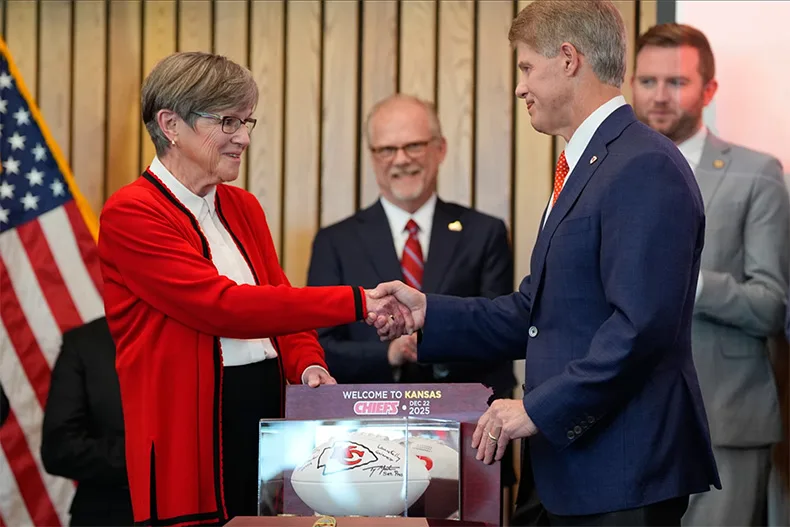
Bacon, as Olathe mayor, will also have a role in the project.
The Kansas Legislature this year created the Kansas Sports Facilities Authority, an 11-member board overseeing the construction and management for the team’s move to the state.
The sports authority will own all of the new Chiefs’ facilities. (If it were privately operated, the bonds the team is using to pay for the project would be subject to federal income taxes.)
A similar entity, the Jackson County Sports Complex Authority, currently owns and operates the Chiefs and Royals stadiums.
The legislation allows the mayors of the two cities where Chiefs facilities are located — Olathe and Kansas City, Kansas — to appoint members to the board, including themselves, as long as their cities approve the STAR bond project and meet other conditions.
For now, Bacon plans to fill Olathe’s seat himself.
“I think it’s a good idea to have, at least, we kind of have an idea of what’s going on and look out for our communities because we are a partner,” Bacon said. “But we also have constituents that we need to look out for too.”
Bacon said he may eventually appoint someone else to fill Olathe’s position, but wants to participate himself initially so he can better understand what the job requires.
“At some point I may select somebody to sit in for me in that role,” Bacon said. “But initially, I don’t know really what’s gonna be involved in these meetings, so I thought it might be helpful. I might be able to pick a better person down the road if I know a little bit more what it entails.”
The authority has 11 voting members, including the two representatives from cities where facilities are located.
Other members include the Kansas commerce secretary, appointees selected by the governor and Republican and Democratic legislative leaders and one member selected by the Chiefs.
Members must undergo state and national criminal history checks before being appointed.
Across county lines

In July, the Chiefs gave the public a first look at the plan for the $3 billion stadium in Wyandotte County.
Initial renderings show an approximately 70,000-seat domed stadium with a translucent roof and 20,000 parking spaces. The team selected Kansas City-based MANICA as lead design architect and HNTB as architect of record.
Despite renderings, the exact location of the new stadium hasn’t been determined. That decision won’t be made by the city.
“We don’t have any input in the work or where they’re actually located,” Kansas City, Kansas Mayor Christal Watson told KCTV5.
Watson said she has to wait for the team and the state to make that decision.
“There’s been nothing definite about the timeline,” Watson said. “When the land moves, when the Chiefs say it’s all done — when the state says we’re ready to talk more. I’m just going with the flow.”
What the stadium will be called also remains a question.
The Chiefs filed trademark applications in June for several names that could be used for the stadium or mixed-use developments surrounding the new facilities, including:
- Arrowhead Sports Complex
- Arrowhead Sports and Entertainment Complex
- Kingdom Commons
- Tailgate Town
- ‘63 Entertainment
- Two-Point Development
A Chiefs spokesperson told KSHB that the team regularly takes steps to protect potential intellectual property and that the names may or may not be used.
Like Olathe, the Unified Government of Wyandotte County approved a STAR bond district in February.
Donovan, the Chiefs president, said at the end of July that the team will continue to use the Missouri Western State campus in St. Joseph, Missouri, for training camp through 2031.
A training facility is used by a team for general practices throughout the year, while training camp is a weeks-long series of intense daily practices and workouts during the summer that NFL teams use to finalize their rosters. Training camps, or portions of them, are open to the public and have become a big draw for fans and media.
“With the training facility being built in Olathe, we as an organization have to look at everything we do with options,” Donovan said. “That training facility is going to be designed with the ability to host a training camp. We have to have that option.”
Several Chiefs fans and business owners told the Post in March that they were looking forward to the possibility of training camp in Olathe.
“I think it’ll be good for business,” Charlie Janssen, a manager at The Rub Bar-B-Que said. “During training camp when people are coming to watch them practice.”
The project has become a campaign issue
As plans for the project move forward, the debate over public financing continues — and has come up during this election season.
Republican gubernatorial nominee and Kansas Senate President Ty Masterson defended the incentives used to attract the team, calling the move a “generational opportunity” for the state, in a candidate survey conducted by the Post.
Masterson said the project will generate construction jobs, long-term employment and new economic activity that will repay STAR bonds.
“The project imposes zero new taxes and does not divert existing state revenue,” Masterson said in his survey response. “This pay-as-you-grow mechanism ensures no impact on essential services and carries no risk to taxpayers.”
In contrast, Democratic gubernatorial nominee Cindy Holscher, a Kansas state senator from Overland Park, has expressed the opposite view.
Holscher originally supported legislation that allowed the state to pursue a deal with the Chiefs but said she is opposed to the ultimate financing package that was approved by legislative leaders last year.
“The deal that resulted is a raw deal, and I couldn’t support it,” Holscher said in her own candidate survey response for the Post. “I am the only Democrat in this race that opposed the Chiefs stadium financing plan because it asked taxpayers to shoulder billions of dollars in long-term risks while negotiations happened largely behind closed doors.”
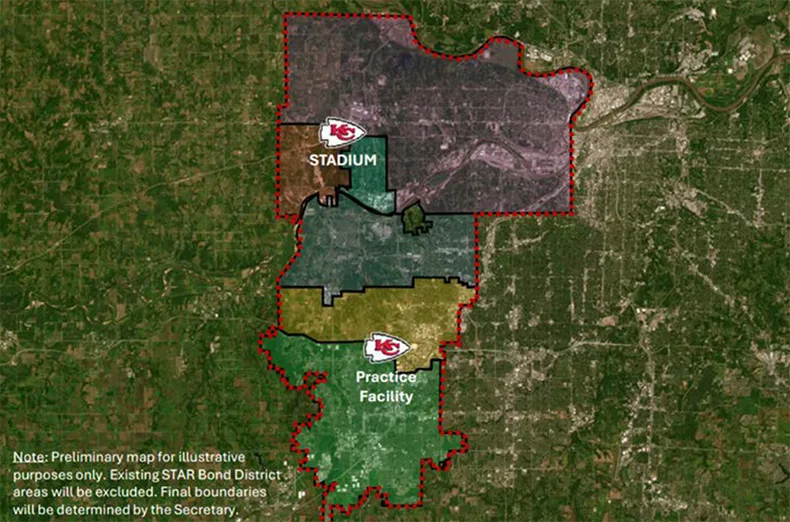
The exact boundary lines for the proposed STAR bond district have also not been finalized.
A map released by the state commerce department last year when the deal was announced showed nearly all of Olathe, as well as Lenexa, Shawnee and Wyandotte County, inside the district.
If ultimately approved, that means a portion of state sales taxes on purchases made in those cities would go toward paying off the debt that is financing the stadium and HQ project.
Looking ahead
In Olathe, Bacon remains optimistic about what the move will do for the area.
“I feel like this is an opportunity for Olathe,” Bacon said. “I think there is a real opportunity around sports event development, sports facility development. And it’s kind of a hot market right now.”
While the Olathe City Council has already approved Olathe’s participation in the STAR bond district, much of the project still needs the city’s approval.
“We are just at the beginning point,” Bacon said. “We’re just at the part where we’re getting started with all the approval process and the reviews.”
Plans for the development will eventually make their way through the city’s planning department, Bacon said.
For now, Bacon said much of the work is happening within the Chiefs organization and among the firms it has hired to plan and design the project.
“The funding and the authority and the approvals up to this point are just the background stuff,” Bacon said. “Now the real work will begin for our community.”