Over the past five months, Johnson County commissioners have stressed that they are searching every nook and cranny for ways to make the budget ends meet without slashing the services residents enjoy.
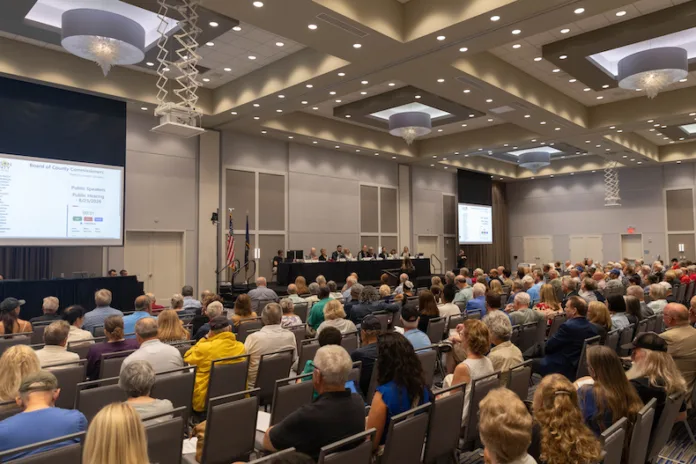
At Tuesday night’s public budget hearing, a mostly dissatisfied crowd of about 175 begged to differ.
Thirty-six people spoke at the two-hour hearing, the overwhelming majority of whom were upset that despite the commission’s cost-cutting efforts, rising property values will mean that the county’s essentially flat property tax rate will still trigger higher out-of-pocket payments.
Speakers called out commissioners for not cutting more, saying the commission used “excuses” when talking about the restraints imposed by the Kansas Legislature.
“You’re just looking at me like a piggy bank,” said Rebecca Renard, adding that her total tax bill, including for other local taxing districts, has increased 300% since she moved to Lenexa 22 years ago. “I wonder every time I get my next tax bill, is it time to move?”
Other speakers talked about the gap between increasing home values that lead to higher taxes and household incomes that remain stalled.
Aaron Haffey, of Olathe, worried that the county may become unaffordable for his children. He said his property tax bill has increased 600% since 2012.
“The county doesn’t get to tell me that a 600% increase in property tax doesn’t matter simply because the increase came from higher property valuations. Because I don’t pay my property taxes with my equity in my home. I pay them with income,” he said in his comments, though he did not make clear whether that increase was for the county taxing district or all city, school and county levies combined.
Tabitha Looper, of Olathe, became emotional as she talked about her husband, a retired county highway maintenance manager, who died in 2021 of COVID-19. She said that the increases in tax payments have prompted her mortgage payment to double.
“And you want to sit up there and look down your noses at us as we ask you to hear our voice. Please for the sake of my husband’s legacy, do not increase our property taxes again,” she said.
A roughly $1.9 billion budget
The budget covers the 2027 calendar year and remains largely unchanged from the one submitted in May by County Manager Penny Postoak Ferguson.
Among its key points:
- A total spending budget of $1.9 billion, which represents a 0.36% change from the current budget. The total budget includes spending from all sources of revenue, including sales tax, dedicated fees and road tax revenue, as well as property taxes.
- The budget can be further broken down into $1.378 billion in expenditures and $532.9 million in reserves. Reserves are budgeted to meet unexpected expenses during the year.
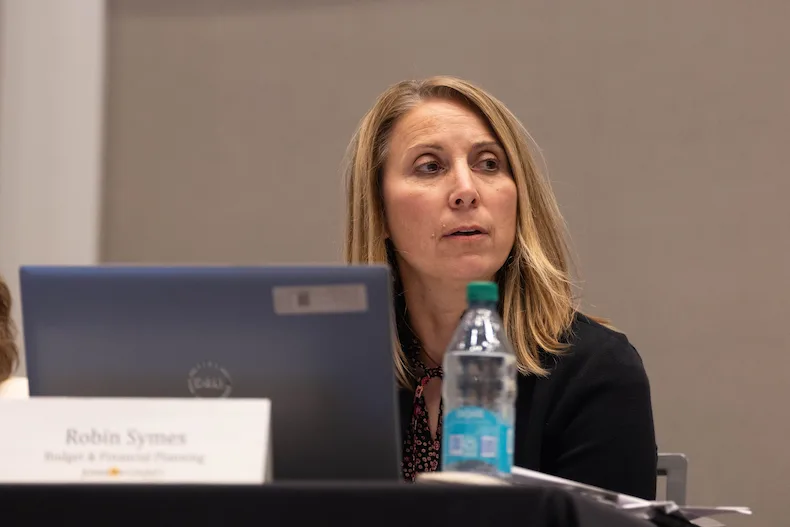
- An estimated taxing rate that remains basically flat from the current year at 24.119. That rate is lower than the originally proposed 24.130 mills. However, the rate will likely be adjusted upwards to 24.130 mills once any challenges to individual property assessments are settled, said Budget Director Robin Symes.
The estimated levy for just the county taxing district is 17.283 mills.
The library and parks districts write their own budgets and have separate levies, at 3.815 for the library and 3.021 mills for parks for next year.
The county commission has approval power over all three taxing districts’ budgets.
(Remember: Your annual property tax bill is determined not only by taxes paid to the county but also to your local city and school district.)
Meanwhile, no new property tax-funded full-time equivalent positions have been added in the portion of the budget covered by the county, parks and library system excepted.
The budget also maintains the 28% of revenue reserve target that county officials say is necessary for a Triple-A bond rating, which helps keep the county’s interest costs down.
Dwindling revenue sources, maintaining reserves
Postoak Ferguson has been warning for the past few years that reserves have been shrinking and will continue to shrink without changes.
Several causes have been mentioned, including inflation and the impending loss of the Public Safety III sales tax, which will expire at the end of March 2027. (That tax was originally instituted to help fund a new courthouse, which opened in 2021, and a new medical examiner’s facility.)
Last year, commissioners tried unsuccessfully to put a version of that tax on the ballot for voters to extend its life, but the proposal was struck down by a district court judge who said it could not be extended under the use the commissioners envisioned.
With fewer options for revenue available from the state and county taxpayers clamoring for property tax relief, commissioners and staff have focused on cost savings in preparing this year’s budget.
For instance, staff vacancies are held open for three to six months while a vacancy review committee evaluates whether or how to fill them. Positions directly affecting the public that are considered critical are exempt from that review.
The reserves were a frequent topic among speakers, some of whom said the county should tap into them to lower the taxing rate.
“People here don’t care about the triple-A bond rating,” said James Lucas, of Olathe. “We would like you to not borrow any money so you don’t have to worry about your bond rating.”
The bond rating determines how much interest a government will pay when it borrows for such things as new buildings.
Gene Senesac, who ran for county chair in the August primary and finished third, said a triple-A rating, which county officials have pointed to as a sign of good budget stewardship, “really just implies we have a lot of money available to pay our bills.”
Two speakers in support
Only two of the speakers on Tuesday night did not voice negative opinions about the budget plan.
Sean Mollet, of Overland Park, praised the county as a “phenomenal place” after having moved in 2017 from Alabama.
“We have fantastic schools, we have fantastic parks, we have great fire and police services. Everything here works. I would like you to pass this and continue keeping it working,” he said.
He was booed.
Another speaker, Ben Harber of Lenexa, simply thanked the commission for spending on aging and human services. Harber is chair of the county commission on aging.
Most speakers who were critical of the county and next year’s budget were met with enthusiastic applause and a few hoots. Several were familiar as candidates for elected office, former candidates and community activists. Some of them urged the crowd to continue to stay involved and vote in November.
Among them were Senesac, Karen Crnkovich, who will face Chairman Mike Kelly in the general election, Ben Hobert of Westwood Hills, who is challenging Commissioner Becky Fast, Bradley Steinmetz, a candidate for Gardner City Council, Marc Vianello who sued Prairie Village over a proposed new city hall, Phil Bauer and Debbie Detmer, who have been Republican precinct committee people, and Charlotte O’Hara, former county commissioner who ran in August’s Republican primary for governor.
Final vote on 2027 budget coming in September
The issue at hand for the hearing was whether the county should exceed the “revenue neutral” tax rate, which is the rate that balances property valuations against the tax levy to ensure that the county doesn’t raise any more money than it did in the previous year.
A hearing on exceeding the revenue neutral rate is required by Kansas law.
Commissioners Julie Brewer and Janeé Hanzlick noted that the Kansas revenue neutral definition does not allow local governments to figure in growth or inflation.
Commissioner Michael Ashcraft said he agreed with many speakers saying, “A lot of people will say, ‘Well, you just have the disgruntled people here today, and they’re a small minority of the vast number of people here in Johnson County.’ Well, you may be a minority, but you’re not that small.”
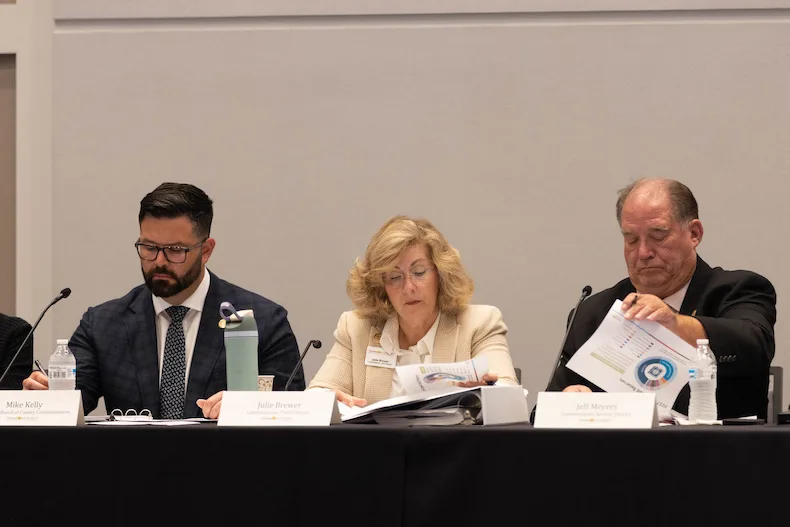
Ultimately, the commission voted 6-1 to exceed the revenue neutral rate, with Ashcraft in dissent. Those in favor were Chairman Mike Kelly as well as Commissioners Fast, Hanzlick, Brewer, Jeff Meyers and Shirley Allenbrand.
Kelly said the commission and staff saved more than $15 million by combining departments and eliminating positions and will continue to seek ways to cut costs and diversify revenues. He said the property tax woes are part of a larger economic struggle that includes inflation and gas prices.
The commission will consider the budget for final approval at its Sept. 3 meeting.