
The Kansas City Chiefs have been assembling the architects, project managers and developers that will create their new headquarters, practice facility and surrounding mixed-use district in Olathe since announcing its move from Missouri last December.
Last month, the team added another company to the growing list.
The Chiefs and Kansas City-based real estate company Hunt Midwest announced they had formed Two-Point Development, a joint venture that will oversee the mixed-use districts around the team’s future facilities in Olathe and the domed-stadium in the Unified Government of Wyandotte County.
Both the Chiefs and Hunt Midwest are controlled by the Hunt family.
Two-Point will serve as the “master developer” for the mixed-use districts surrounding the headquarters and practice facility and stadium. That means the company will oversee the development, including the architects, engineers and land planners working on the project.
Sports economist JC Bradbury, a vocal critic of publicly funded sports stadiums, said it’s common for teams to oversee the development around their facilities. He said it’s a way for them to earn revenue year-round.
“Obviously the Chiefs want to do this because they think they’re going to make more money,” Bradbury said.
Two-Point will oversee the districts
In Olathe, the Chiefs envision a district where the headquarters and practice facility will be surrounded by places where visitors can “live, work and play,” according to the release.
The team hasn’t announced what exactly will be built around the Olathe facility. Still, Kansas’ agreement with the Chiefs identifies several types of developments that could qualify for public financing, including stores, restaurants, hotels, entertainment venues and parks.
As master developer, Two-Point will coordinate how all the developments come together.
Hunt Midwest says it’s developed more than $3 billion in industrial, residential, multifamily, senior-living and other projects over more than 60 years.
The name Two-Point Development is a reference to Chiefs founder Lamar Hunt’s role in bringing the two-point conversion to professional football, according to the release.
The Kansas Legislature this year created the Kansas Sports Facilities Authority, an 11-member board overseeing the construction and management of the team’s move to the state.
The sports authority will own all of the new Chiefs’ facilities. (If it were privately operated, the bonds the team is using to pay for the project would be subject to federal income taxes.)
Olathe Mayor John Bacon is a member of the board.
Team oversight isn’t unusual

Although the new company gives two Hunt family-controlled businesses authority over development surrounding the facilities, that arrangement isn’t unusual, said Bradbury, a Kennesaw State University economist who studies sports and public stadium financing.
Teams typically take a leading role in designing their facilities and selecting the companies that develop the surrounding property, he said.
“Normally, when stadiums are designed, they’re largely designed by the team, even when it’s being paid for largely by the public,” he said. “They’re the ones who take the lead role. They normally have the right to pick who they hire.”
Bradbury argues against public incentives for stadiums, saying they don’t pay for themselves, as many people claim. He published a book earlier this year titled “This One Will Be Different: False Promises and Fiscal Realities of Publicly Funded Stadiums.”
“From a public investment, taxpayer perspective, [it is] an unambiguous money loser,” he told the Post.
He used the Atlanta Braves’ control of the mixed-use development surrounding Truist Park in Cobb County, Georgia, as an example, saying it’s only benefited the team.
“Basically, it costs county taxpayers about $15 million a year,” he said. “From the perspective of the team, it makes a lot more money — probably increased their revenue, on average, about 10% above what it was beforehand.”
The Chiefs announced in December 2025 that the team plans to build their new $300 million headquarters and training facility near College Boulevard and Ridgeview Road, just south of Kansas Highway 10 in Olathe, as part of its bigger move to Kansas.
The project, along with the new $3 billion domed stadium in Kansas City, Kansas, is set to open for the 2031 season.
The announcement — and the $1.8 billion of public incentives being used to construct the new facilities — has been controversial.
In February, the Olathe City Council unanimously approved the use of Sales Tax and Revenue (STAR) bonds to help finance the city’s portion of the project.
Since then, the project’s funding has continued to be a topic of conversation, including on the campaign trail ahead of this year’s statehouse elections in Kansas, which feature a high-profile race for governor and every Kansas House seat on the ballot.
Other Developers
Two-Point joins other companies selected for roles in the Olathe development.
Populous, a Kansas City-based architecture firm, will design the headquarters and practice facility. It will also serve as the planning architect for the surrounding development.
As master developer, Two-Point will oversee the broader real estate operation and coordinate with companies, while Populous will help create the physical design and layout.
Burns & McDonnell was recently named as the team’s owner’s representative for the Olathe project. The company will monitor the project’s cost, schedule, design and construction on the Chief’s behalf.
Olathe Mayor John Bacon previously told the Post that the project is moving forward, even if it’s outside public view.
“All that legwork, all that background is being set right now by the Chiefs organization,” Bacon said. “There’s a lot going on right now, but you just can’t see it.”
More approvals needed
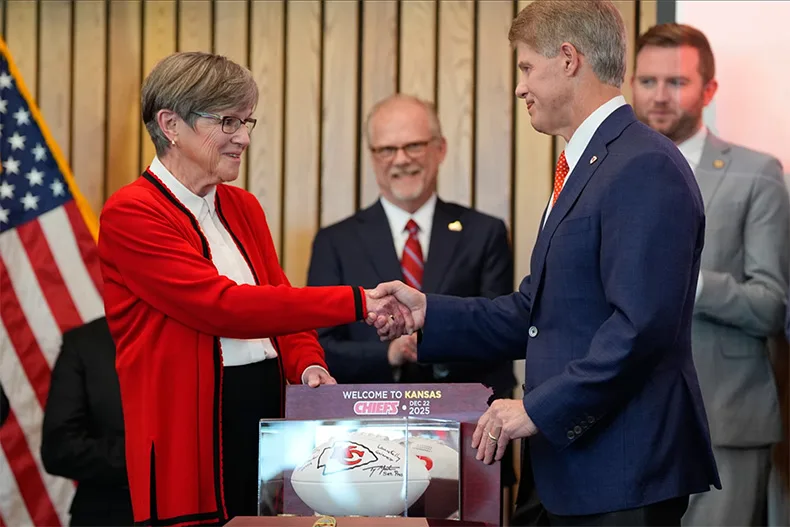
Olathe has pledged certain new sales, use and hotel tax revenues generated within the project area to help repay the STAR bonds for as long as 30 years.
Bacon said the city’s involvement did not end when the Olathe City Council approved its participation in the financing arrangement earlier this year.
“We are just at the beginning point,” Bacon said in an interview with the Post last month. “We’re just at the part where we’re getting started with all the approval process and the reviews.”
“It’s not over by any means,” he added.
Bacon previously predicted that the Chiefs’ move to Olathe would create more interest in development in the area.
“I think that the areas around this Chiefs facility will see a lot of interest that they didn’t see before,” Bacon said.