As Olathe looks to tighten spending to avoid a future budget deficit, city officials have raised questions about the value of aesthetics in major infrastructure projects.
While discussing artwork proposed for the new downtown parking garage earlier this month, Olathe Mayor John Bacon questioned spending more than $200,000 on art for the building. He then asked if a cheaper, standalone art piece could be installed instead.
“What are the other considerations for a nice, quality…treatment you might do on this tower?” he asked. “And then have an art piece be separate.”
The question of aesthetics and cost also arose during the city council meeting prior to that. This time for the city’s largest-ever infrastructure project: the $200 million reconstruction of the I-35 and Santa Fe interchange.
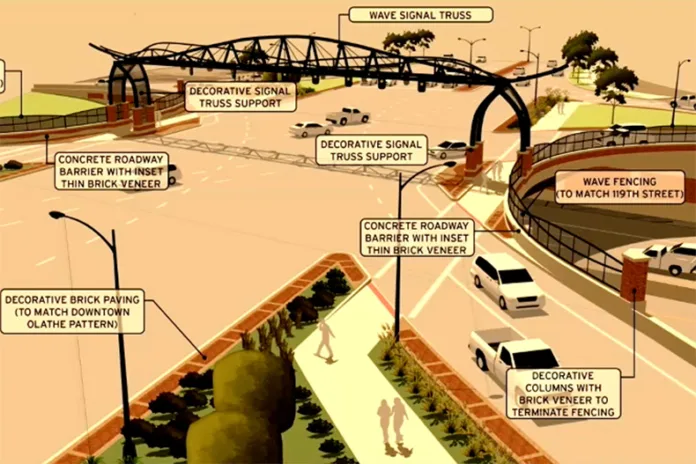
Plans included landscaped medians, decorative fencing, textured walls and lighting.
Councilmember Jeff Creighton said he likes incorporating aesthetics into “useful elements” but would draw the line at something like a sculpture.
“I’m not opposed to it,” he said. “But at a time when budget is on our mind, just wanted to get that out there.”
Project Manager Leslie Donnelly told the Post that city staff is unsure how much the design elements for the interchange will cost, only that it has already been incorporated into the project’s construction budget. She emphasized, however, that aesthetics aren’t a large portion of the budget.
“Construction, especially to this scale, just does cost a lot,” she said. “And there are a lot of aspects to this project that do cost a lot.”
The city’s $40 million portion of the project will be funded through general obligation bonds. Donnelly said city staff doesn’t know the exact breakdown of the city’s contribution, but that it will cover design and utility relocation, among other things.
The Kansas Department of Transportation and federal grants will cover the rest.
Gateway to the city
Donnelly said she wouldn’t consider the project “no frills.”
“There are some frills because it is an entrance to the city,” she said. “We do want it to look nice.”
But most of the added designs are intended to elevate the appearance of necessary infrastructure.
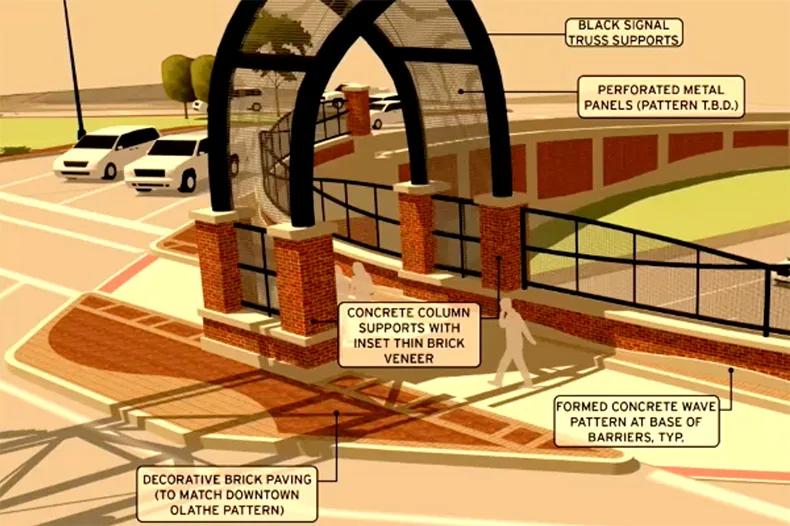
For example, retaining walls could be left as plain concrete. Instead, the city can give the concrete a pattern or texture.
The concepts presented to the city council show a large decorative metal structure spanning the single-point interchange and holding its traffic signals. A wave pattern would stretch across that structure and down its supports.
Similar wave patterns would appear on retaining walls and bridge abutments visible from I-35.
The bridge would feature double-helix fencing modeled after fencing used elsewhere in Olathe, while brick-patterned concrete in the medians would mimic the downtown streetscape.
Assistant City Engineer Theresa Vink told councilmembers that the city positioned sidewalks as far from driving lanes as possible and incorporated landscaping and brick to create additional separation.
City Spokesperson Cody Kennedy said the city wants the project to carry design elements already visible throughout Olathe.
“If you look at other communities, you kind of know where you’re at, whether it be signage or landmarks that carry through a theme,” Kennedy said.
Councilmembers were largely complimentary of the designs at the Sept. 1 meeting.
Councilmember Robyn Essex called the design “beautiful,” while Bacon said it looked “very nicely done, not overly done” and “tasteful.”
Bacon said he didn’t think the bridge needed more elaborate lighting but wanted to make sure pedestrian areas were lighted sufficiently.
Kennedy said safety is the primary goal of the project, but the city also wants to build something residents can take pride in.
“You certainly wanna create something that, A: answers the mail for being a safer interchange,” Kennedy said, “but B: you also wanna have something that residents are proud of.”
The Santa Fe/I-35 interchange is one of the city’s busiest
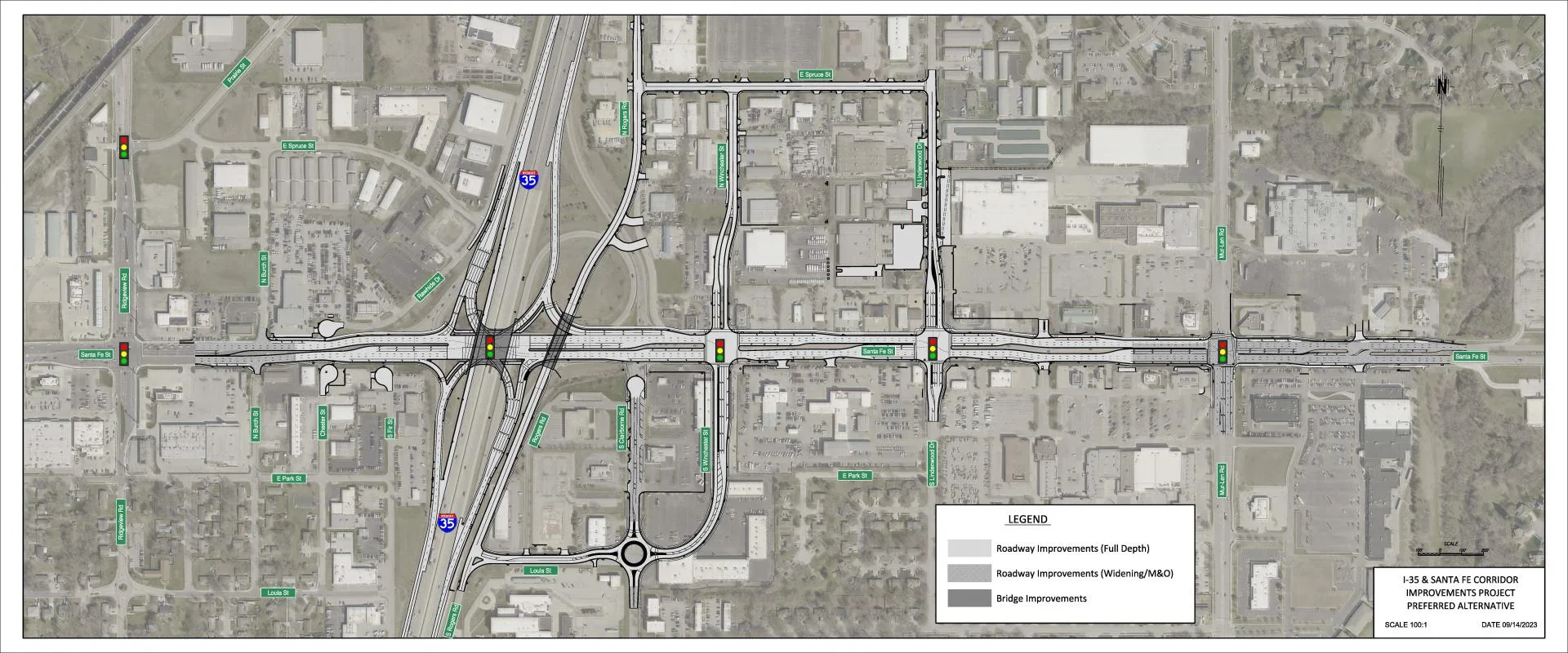
The entire project is intended to address congestion and safety along one of Olathe’s busiest corridors.
The existing I-35 interchange will be replaced by a single-point urban interchange (SPUI) similar to the one at 87th and I-35 on the border of Lenexa and Overland Park to the north.
The full project also includes new bridges, pavement widening and reconstruction, road realignments, signals, medians and sidewalks.
KDOT will separately add auxiliary lanes to I-35 between Santa Fe and 119th Street, reconstruct pavement along I-35 and widen the Old Highway 56 bridge to accommodate two lanes.
Work has already begun
Although major construction on the interchange isn’t expected to begin until 2027, the city has started relocating utilities.
“We are just trying to be clear and communicative with the public that, no, the construction has not started,” Donnelly said. “However, the utility relocations and some of the impacts, such as lane closures, could give that idea.”
Earlier this month, Olathe agreed to reimburse Evergy an estimated $2.4 million for its portion of electrical relocation.
Evergy estimates the full relocation will cost about $7.3 million.
The cost of utility relocation will come from Olathe’s $40 million contribution to the entire project.