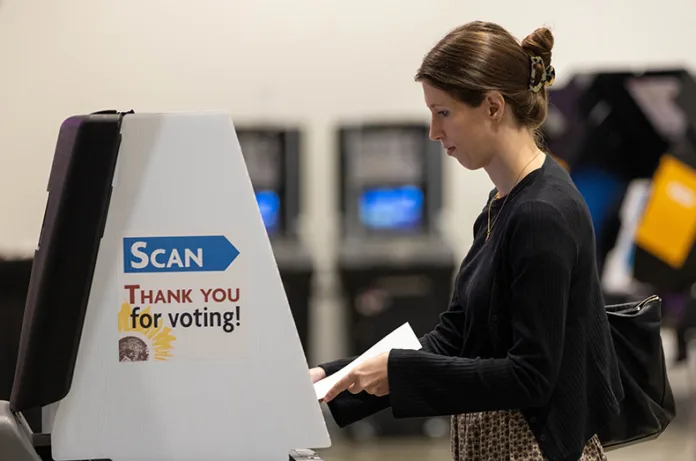
Earlier this summer, the Post asked our readers what issues you wanted to hear candidates in federal, state and local races address leading up to the Nov. 3 election.
Based on that feedback, we developed a five-item questionnaire centering the issues most important to residents across Johnson County.
Each day this week, we’ll publish the candidates’ responses to one question. So far, we’ve published responses on property taxes and county spending.
Today, we’re publishing candidates’ responses to the following question:
The county funds the election office, but the election commissioner is appointed by the secretary of state. After eight early voting sites were cut before the August primary, readers asked what county leaders can do. Do you agree with the decision to close these early voting sites? Why or why not? Is there anything the county commission can do to make future decision-making about elections more transparent?
Below are the answers the Post received from candidates on the issue:
Chair
Mike Kelly (incumbent)
 Convenient, accessible early voting isn’t a partisan value; it’s how we ensure elections work for everyone – busy parents, shift workers, or seniors who want to avoid long lines. This year, without a public hearing and without presenting data to justify it, the Election Office cut that system from 18 sites to 12. Nearly one in five early votes cast in 2024 came from these exact locations. Two new sites opened in Spring Hill and De Soto are welcome additions for those growing communities, but it is no substitute for eight sites serving some of our highest-turnout, highest-density neighborhoods. What makes this decision harder to accept is that funding was never the obstacle. The County Commission had already budgeted funding for all 18 sites this cycle.
This wasn’t a budget decision: It was a choice. A decision of this magnitude, potentially affecting how more than 460,000 registered voters access early voting, should occur only through a transparent, data-driven process with meaningful engagement of the elected body and residents. Under Kansas law, Johnson County is one of just four counties where the election office is run by someone the Secretary of State appoints, not someone voters or the Commission select. The Commission controls the budget – and we’ve shown we’re willing to fund every one of these sites – but we don’t determine who gets to vote where. Regardless, it is important that we use this office, and every tool we have, to continue this conversation with the public for future elections.
Karen Crnkovich
 Yes, I agree with the Election Commissioner’s decision. Eight locations used in 2024 were eliminated, but two new locations were added, resulting in a net reduction of six sites and a 12-site countywide plan.
More importantly, every location now operates on the same days and hours, making early voting significantly easier for voters to understand. Approximately 90% of county voters live within seven minutes of an early-voting location.
This decision belongs to the Election Commissioner. Kansas law gives that office responsibility for election administration and advance-voting locations; the County Commission does not approve those decisions.
The Commission should support the Election Office and its employees, even when individual commissioners disagree with a decision. Publicly undermining the Election Commissioner over a disagreement does not demonstrate strong leadership.
The Commission’s appropriate role is to ensure the Election Office has adequate resources, promote transparency and encourage public reporting on significant operational changes, turnout, wait times and voter access.
District 1
Ben Hobert
 I have prepared, and will file, a Kansas Open Records Act request with the Johnson County Elections Office for: (1) Maps of the Johnson County early voting sites before and after the reduction in number; (2) any analysis of voter accessibility with radiuses of 2 or 3 miles or other chosen radius superimposed on the maps as prepared by the Election Office or any consultant; (3) data showing the number of voters who voted at each early election site for the last general and the last midterm elections in total and each day in the early election period; (4) data as to the cost of gearing up each early election site and staffing requirements for each site; and (5) any memorandum or other record made of the rationale for closing the chosen sites. When I have this data and information I can determine whether I agree or disagree with the decision. I will refrain from debasing public discourse by falling into reactionary outrage mode.. If the analysis was not prepared or it demonstrates incompetence, then I will suggest a response. Citizens must let the secretary of state and the elections commissioner know that failure to disclose rationale for such changes or demonstrated incompetence through a lack of such analysis will be a firing offense, whether at the ballot box or through another legal process.
Becky Fast (incumbent)
 I was profoundly disappointed by Johnson County Election Commissioner Connie Schmidt’s decision to reduce advance voting sites from 18 in 2024 to 12 in 2026. This occurred despite input from the Board of County Commissioners and additional funding included in our 2026 budget proposal to expand early voting access. I joined 20 Johnson County elected officials in signing a letter urging the reinstatement of eight advance voting sites for the general election to improve voter access.
Over 50% of Johnson County voters cast their ballots early. Every eligible voter should have reasonable access to the ballot box. The eight eliminated advance voting sites accounted for 19% of Johnson County’s early votes in the 2025 general election. Following Commissioner Schmidt’s decision, there was a decline in more than 30,000 votes in early voting in the August 2026 primary compared to the 2022 mid-term primary year. Westwood and Leawood both cities within my Commission district lost their early voting sites resulting in 7000 voters displaced by this action. While numerous factors influence voter turnout, reducing convenient voting options raises significant concerns about equitable access and whether it was a contributing factor to the decline.
Last, it’s time for change in Kansas law. In 96% of Kansas counties, the local county clerk serves as the chief election officer. Yet in Johnson, Sedgwick, Shawnee and Wyandotte counties, the Secretary of State appoints the county election commissioner taking away local accountability to residents. Johnson County should have the authority to appoint its own election commissioner to ensure accountability and responsiveness to residents’ concerns.
District 4
Teresa Erb
 I disagree with the decision to eliminate eight early voting locations. Several of these locations served densely populated neighborhoods where residents may have limited transportation options. Closing established voting locations creates unnecessary barriers, particularly for people without reliable transportation and voters balancing work and family responsibilities. I believe we should be expanding opportunities to vote, not reducing them.
I am also troubled by the lack of transparency and public input before this decision was made. Changes that affect how and where residents vote deserve careful consideration and meaningful opportunities for public engagement.
Under Kansas law, the Johnson County Election Commissioner is appointed by the Secretary of State and has statutory responsibility for administering elections, including determining early voting locations. Although the County Commission does not control those decisions, it is responsible for funding the Election Office and has oversight responsibilities relating to its budget and administrative operations. The County Commission, therefore, can use the budget process and public meetings to ask questions, request supporting data, and encourage greater transparency.
I would support regular public presentations by the Election Commissioner, particularly before significant changes to voting locations or procedures are implemented. Those presentations should include opportunities for public comment and an explanation of how proposed changes will affect voters.
Accessible, secure elections are fundamental to our democracy. Johnson County residents deserve an election system that encourages participation and makes voting easier, not harder.
District 5
Greg Mitchell
 I disagree with the decision to close the eight early voting locations. I haven’t heard a strong rationale for this action. The only reason provided is that certain parts of the county had more early voting options than others. The closed locations are in higher-density areas that might otherwise experience longer lines and more delays on Election Day with fewer early voting locations.
While I disagree with the closures, I support opening two new locations in Spring Hill and De Soto because I believe this will make voting easier for people in these areas. We should focus on making it easier for more people to cast their ballots with maximum convenience. In terms of early voting, if access equity is the issue, I do not believe that the solution is through subtraction but rather through addition.
Democracies thrive most when the electorate participates as much as possible. While I concede this does not appear to disenfranchise voters, the loss of convenience may create disincentives to participate.
While the Election Commissioner in Johnson County reports to the Secretary of State, the county taxpayers pay the bills. Therefore, I believe the taxpayers’ representatives should have some sway in these types of decisions. At a minimum, a good rationale needs to be provided to the Commission, and I do not believe that has happened. For these reasons, I do not support the decision.
Michael Ashcraft (incumbent)
 Election Commissioner (EC) independence is a curial feature of the current system. When these particular changes were brought to the BoCCs attention, the current EC offered a reasoned, direct plan to standardize the hours of operation and better distribute advance voting sites. This includes adding two sites – Spring Hill and De Soto.
In a series of press releases, the EC noted that the hours of operation were being expanded at many sites and the drive times for the majority of Johnson countians would now be improved to be under 7 minutes. Admittedly, several sites were closed which will require some voters to travel a few minutes more to the next nearest site.
As in any service delivery effort, transparency is critical and, in hindsight, more exposure and earlier communication would have been welcomed. The EC took special care to encourage voter access via Early In-Person voting, Advance by Mail voting, and On Election Day voting in all her communications.
Coming up:
Tomorrow, we will publish the candidates’ responses to the following question:
Local law enforcement agencies’ use of automated license plate reader cameras has quickly become one of the most talked-about issues in the county, as controversy over the devices and their potential abuses has grown nationwide. According to independent observers, thousands of these devices are deployed in Johnson County, including by the sheriff’s office. What limits, if any, would you set on how county agencies collect, keep and share data from these devices?
 Thanks for reading! If you value having an independent news outlet keeping tabs on local government, schools and taxes, we're asking you to contribute to our Education Reporting Fund.