This campaign season, Post editor Kyle Palmer has extended one-on-one Q&A offers to all candidates running for statewide offices, including U.S. Senate, Governor, Attorney General, Secretary of State, and Kansas State Board of Education.
We will publish videos of Kyle’s full interviews and an edited transcript of his conversations as each candidate responds.
Kyle previously interviewed the other two candidates in the Secretary of State’s race, Democrat Jennifer Day and United Kansas nominee Scott Morgan.
If you value election coverage like this, consider signing up for a trial offer to get the Post for $1/week for six months.
Pat Proctor is the Republican nominee for Kansas Secretary of State.
He’s a Leavenworth state representative who chairs the House Elections Committee, a retired Army colonel and a restaurant owner. He’s also the primary sponsor of a constitutional amendment on the Nov. 3 ballot that aims to clarify that only U.S. citizens can vote.
The secretary of state runs Kansas elections, appoints Johnson County’s election commissioner and oversees business filings.
He faces Democrat Jennifer Day and United Kansas nominee Scott Morgan, both of whom the Post has previously interviewed.
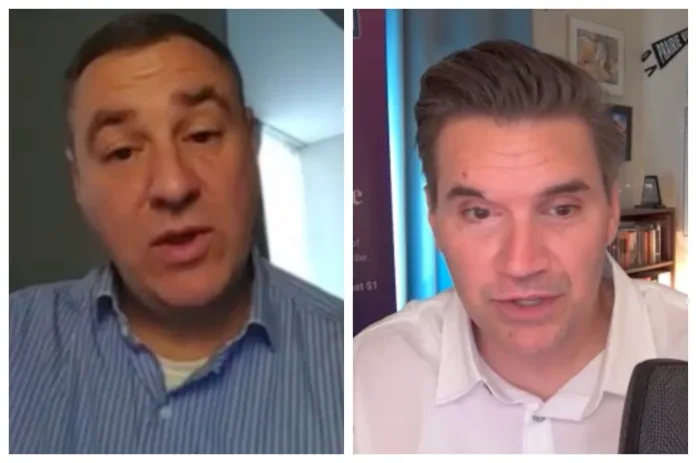
Proctor spoke with Post editor Kyle Palmer via Zoom on Monday, Oct. 12.
Watch the full interview
Read the highlights
The transcript below has been edited for clarity, length and grammar.
Post: I’ve already spoken with your two opponents in this race, Jennifer Day and Scott Morgan. They both happen to have Johnson County ties. You are a state rep and a business owner from Leavenworth. Why do you want the Secretary of State’s job?
Proctor: When you become a legislator, they ask you what committees you want to be on. After I’d been elected, I said I wanted to be on the military and veterans and corrections because that’s what we do in Leavenworth, right? We do army and prisons. And they put me on the elections committee. I’m like, ‘Well, if I’m gonna be on the elections committee, then I better know something about elections.’ So I made an appointment with the Secretary of State’s office, and I spent the entire day just going soup to nuts through elections, and the whole time I was in there, my phone was just blowing up. I was getting call after call and text after text, and I wasn’t gonna be rude because how often are you gonna have all these experts in a room just to feed your head? And so I put my phone away and tried to ignore the buzzing. When I was all done, I walk out, and I look down at my phone. The day I’d been in there was January 6, 2021. So while I’d been in there learning everything there was to learn about elections, January 6 had happened, and it kind of hit me like a ton of bricks. Probably the most important thing I was going to be working on was restoring confidence in our elections. Before I was in the legislature, as you said, I spent 25 years in the army. I was in Iraq twice, Afghanistan once, and a bunch of other spots that I have no intention of going back to. What all those places had in common was that people in those places don’t believe in the ballot box to solve their problems. They don’t believe in civil processes. They don’t believe in the rule of law. The way they solve their problems is they pick up guns, and they shoot each other. I swore an oath all those years ago when I was putting on the uniform for the first time to support and defend the Constitution, to protect our form of government, to protect our way of life. That oath doesn’t end when you take off the uniform. That’s an oath for life. So I went to work, got very passionate about election law, and after a couple of years they asked me, “What do you want to do in the legislature?” And I didn’t hesitate. I said, “I want to be the chairman of the elections committee.” And so for the last four years, that’s what I’ve been doing.
Post: You are raising the of the events of Jan. 6. I think a lot of our readers might take a different lesson from that. You seem to suggest that that was a result of people not having confidence in elections. A lot of our readers might think that was a result of people being misled about elections that were free and fair, and that people who didn’t like the results actually tried to take the election back. I wonder what you you say to that?
Proctor: So I you know people have wildly varying opinions about Jan. 6, but I think what we can agree on is that everybody that went to Washington, D.C., on that day did not believe that the results of the elections reflected their will, and that’s what I’ve been focused on in Kansas. I can’t speak to what happens in Michigan or what happens in California or what happens in Pennsylvania. Our elections here in Kansas are pretty good, but I would say two things: First of all, it doesn’t matter how good they are if people don’t believe it. So there’s a role for educating and making sure people know what we have in place. I’m pretty proud of a lot of the measures that, as the chair of the elections committee, I was personally responsible for putting in place to make our election secure. Second, I would say that secure doesn’t mean impregnable. I’m chairman of the Joint Kansas Security Committee. When I was in the Legislature, I just resigned in May, but I was also a professor of homeland security at Wichita State University, and I’ve also done a lot of of homeland security stuff in the military. The first principle of homeland security is you don’t wait till after the plane blows up to stop the bomb from getting on the plane. So if somebody has identified a concern and it’s a valid concern and we don’t have a mechanism in place, you don’t wait till after it’s exploited. It drove me nuts on the House floor that everybody gets up one after another and says, “This is a solution in search of a problem.” Well, you don’t wait until a vulnerability is being exploited. You plug the hole before.
Post: Your top stated campaign priority is stopping non-citizen voting. You are one of the co-sponsors of the constitutional amendment that will be on the ballot that will clarify the Kansas Constitution that only U.S. citizens can vote, even though it is currently a felony for non-citizens to vote. How big of a problem is non-citizen voting in Kansas to you? I mean, your opponents might say there’s only been a handful of cases, and that doesn’t outweigh the potential negative impacts of maybe preventing people from registering to vote.
Proctor: First of all, right now our constitution is silent on whether non-citizens can vote. What our constitution says is “every” citizen can vote, and this constitutional amendment would change language to “only” citizens can vote. You might be saying to yourself, “Well, that’s a distinction without a difference.” California, Maryland, Vermont have the exact same language that we have in our constitution right now. Every citizen can vote, and all three of those those states allow non-citizens to vote in their elections, so we need to change the language. You’ll hear people say, “Well, this is already illegal.” Yes, it is illegal in the state of Kansas, and I would like to keep it illegal. There was a federal court decision just the other day that found the federal law that says the non-citizens can’t vote in our elections unconstitutional by the U.S. Constitution. What that judge said is that it is up to the states to set qualifications for electors. I couldn’t agree more, which is why we need this amendment. We are one court decision away from some activist judge striking down our laws and saying that non-citizens are allowed to vote in Kansas. I prefer to not leave a question that lofty, that weighty to the tender mercies of the Kansas courts. And then to your final point, which was: the the number is small. First of all, I would say that sort of proves that these laws work right. I passed a law last year that requires the DMV to provide a list of non-citizens to the to the Secretary of State’s office, so we can make sure they’re not in the voter rolls. One by one, my Democrat opponents to the floor come up and say, “Oh, this is a solution without a problem. This never happens. This is a conspiracy theory.” But we passed the law, and I’ll be darned if we didn’t find out that the mayor of Coldwater, Kansas, has been voting for 29 years as a non-citizen. So I would say that these mechanisms are important and they work, and that’s why the number is small because we have a deterrent. The final thing I’d say is that Attorney General Kobach has prosecuted one, and that person’s pled guilty and there are three other people he’s prosecuting now. The Secretary of State’s office tells me there’s about 20 other folks that they’ve identified, and they’re investigating that they may prosecute. That is a relatively small number in relation to the number of people who vote in our elections, but I would just ask, how many is too many? Every time a non-citizen votes, they are canceling out the vote of a valid Kansas voter. They’re disenfranchising you, or they’re disenfranchising me, or they’re disenfranchising some other Kansan. And I personally think that we owe it to Kansans to be able to tell them no non-citizens are voting.
Post: What’s your stance on early voting? I know there have been reports in the past based on leaked audio from a meeting you’ve had with other Republicans, where you said, “if it was up to me, there would be no early voting.” I’m not sure if you still stand by that, or if that was out of context. You’ve also sponsored a bill in the House that’s now on hold because of a judicial challenge about taking away the three-day grace period for mail in ballots. So, what’s your stance on early voting? Because it’s an increasingly popular method of voting here in Johnson County, more than 200,000 people used it in 2024.
Proctor: In a perfect world, we would all vote on Election Day. Everybody’d have the day off, and we’d all just go vote. Well, we don’t live in a perfect world. Law enforcement officers, people working in hospitals, they wouldn’t be able to vote because they’ve got to be on duty. People who are overseas serving in the military, people who are bedridden and are unable to leave their homes, they’re not going to be able to go to the polls to vote. I vote early because I’m really busy on Election Day getting people to polls. So early voting and mail-in voting are not going anywhere. I actually twice carried a bill on the floor of the House that would have added two days to early voting and added two days to mail-in voting. All the Democrats voted against it because they don’t want the problem fixed. They want the issue that they can run on every election. To the to the issue of the three-day grace period, I tried to pass it twice. The governor vetoed it. I was ready to give up. Then, I was in Wabaunsee County. I go all over the state talking to clerks because if you’re going to do election law, I feel like you need to know all of the county’s elections, not just one polling place in Johnson County, like my Democrat opponent. You need to see all the elections and talk to all of the election officers across the state. I was talking to Abby Amick in Wabaunsee County, and she asked me, “Are you going to get rid of the three-day race period?” And I’m kind of surprised that she raised that. She goes, “Well, I can’t count half the ballots.” I’m like, “What are you talking about?” She said, “Well, half the ballots show up without a postmark, and I can’t count them.” And that kind of got my spidey sense tingling. So I asked the Secretary of State, “Could you please after the election ask all of the clerks how many ballots they’re not counting because they’re not postmarked.” And when they came back, it was one in three ballots. One in three ballots that they received during the three-day grace period during the 2024 primary could not be counted because they didn’t have a postmark. That is 2% of all the mail-in ballots that were cast during that election, so you can’t tell me that didn’t have an impact on elections. To me, that’s unconscionable. If you know the the voter did everything right, they got their ballot in within that grace period, and the clerk did everything right, they took the ballot and they checked it, but because the post office didn’t put a little stamp on it, we still can’t count the ballot. So if you repeal the three-day grace period, that whole problem goes away.
Post: I do want to give you a chance to respond to something that’s arisen in the last couple of weeks in this race. The U.S. Department of Labor about a decade ago found your restaurant company in Leavenworth owed more than 30 employees roughly $93,000 in unpaid overtime and minimum wage. Your opponents have have tried to make this an issue because the Secretary of State is the office that oversees business filings. They make the point that if this is something that’s on your record as a business owner that that’s disqualifying for this job. I’ll just give you a chance to respond to that.
Proctor: I’ve talked to Brad Cooper at the Sunflower State Journal. I watched your interview with Jennifer Day. I didn’t see that you asked her what she meant when she said that she thinks it’s unfortunate that non-citizens can’t vote in her elections, which is on a YouTube video talking to the Douglas County Democrats. You didn’t ask her what she meant when she said that we should just mail a ballot to everybody like California does, which she said on Mike Matson a couple weeks before. So I don’t really feel compelled to answer any more questions about this. If you want to know. If you want to know what happened, read the Sunflower State Journal article.
Post: You’ve also opened up a new restaurant. Did that incident change your practices on how you pay your employees?
Proctor: When me and my wife started our first restaurant, it was a little 19-seat restaurant in Leavenworth. Thank God she knew how to run a restaurant, but neither one of us knew how to start a business. I was an Army major. She had worked in restaurants her whole life, but she had never started a business. So she said, “Hey, why don’t you go do all the stuff we got to do so we start the business?” And this is 2006. The internet wasn’t what it is now, and so I kind of did the obvious things, right? You got to pay taxes, so I went and got tax IDs, and then I’m like, I think you pay less taxes if you’re a corporation, so I went to the Secretary of State’s website and I filled out the little thing to get incorporated. And I’m like, I think you have to have a license to serve food. So I kind of clicked around. I found the Department of Agriculture website, and I got a food service license. I went back to my wife, and we’re ready to go. She’s a great cook, immediate success, packed all the time. But then all the letters started coming from all the other agencies that I didn’t know about because I’m not a lawyer. And you know, a lot of times they came with fines like this incident, and so that always stuck with me. In my mind, if the government’s going to make you do something, it is the government’s responsibility to tell you you’ve got to do it. Not your responsibility to go hire a lawyer, pay thousands of dollars to go find out all the requirements. What I want to do as the Secretary of State — and I’ve said this for 18 months, I’m kind of surprised that all of a sudden now it’s a scandal — hat I want to do is on that website, right underneath where you put your corporation name to register, I want to put another little chat window, and that chat window is going to ask a simple question. It’s going to ask what kind of business you want to start and where you want to start it. You put a restaurant in Leavenworth, put a grocery store in Olathe, you put a feedlot in Garden City, and an AI backend goes out to the federal register, the state register and your local ordinances and spits out all of the requirements. Give you all the clickable links to all the forms you have to fill out, a PDF with all the pages of all the the regulations that apply to your kind of business. Then, after I’ve got that working and working well, I want to go back across the the the street to the legislature, and I want to get a law passed that says if that website doesn’t spit it out, they can’t fine you for it.
Post: Put the onus on the government, then?
Proctor: The idea is to shift the burden from the business owner having to know to the state having to tell you. That, to me, is a moral obligation. If you’re going to put a requirement on them in order to exercise that right to live, liberty and the pursuit of happiness, it’s your responsibility to tell them. And so the idea is it shifts that burden. Now all the agencies have to come make sure that it’s very very clear and it’s easily accessible what all the requirements are for their agency. After I do that, I want to go on the road. I want to go to all of the different cities and municipalities. I want to go to all their different chambers, and I want to also have that tool spit out what grants are available. Who should you connect with? Who’s an economic development person? I just talked to all of the folks from all the different Johnson County Chambers the other day. You know, who is that person in Olathe? Who is that person in Overland Park? So that people who are running to bring businesses here already have those connections. The idea is to transform that business division from just a filing office into an entrepreneurship engine.
Post: You mentioned a couple times the your opponent is a Johns County Democrat. In 30 seconds, what’s one thing that you do as Secretary of State that a Johnston County Democrat would thank you for?
Proctor: I think that the vast majority of folks think that only citizens should be voting. I think that the vast majority of folks think that you should have to prove who you are at the polls before we let you vote. I think that the vast majority of people think that every ballot should be counted if it’s cast by a valid voter and no ballot should be cast by an invalid voter who’s not eligible to vote. That is exactly what I’ve been doing as the chair of the elections committee for the last four years. I’ve been focused on increasing transparency, restoring confidence in our elections by increasing transparency, by combating non-citizen voting, by combating ballot harvesting, by cleaning up our voter rolls, and I think that those are things that whether you’re a Democrat or a Republican or a or an unaffiliated voter, I think that’s things that people want in our elections. And so I’m running to be the Secretary of State for all Kansans, and I think that the role of the secretary of state is to create an even playing field where nobody gets to improperly put their thumb on the scale. Like for instance, the League of Women Voters, who was paying kids to register to vote, giving them a $5 Starbucks gift card to register to vote.
 Thanks for reading! If you value having an independent news outlet keeping tabs on local government, schools and taxes, we're asking you to contribute to our Education Reporting Fund.