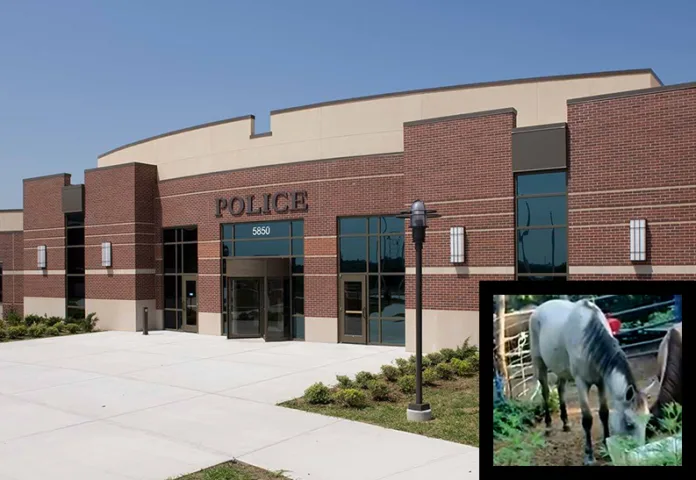
After the Shawnee Police Department shot and killed a horse earlier this month, an animal activist is hoping it can be a teaching moment for how they engage with loose animals.
On Oct. 7, Shawnee Police euthanized a wild mustang named Lacy in a field behind the police station on Johnson Drive. Described by police as “highly skittish around people,” Lacy had been on the loose for seven hours before police shot and killed it.
“Throughout the incident, the horse posed an ongoing risk to public safety due to its proximity to several major roadways, including Renner Road, Johnson Drive, I-435 and Maurer Road,” Emily Rittman, Shawnee Police spokesperson, said in an email to the Johnson County Post.
Weeks later, the incident stoked criticism on social media after Fox 4 ran a story about it, garnering reactions from horse and outdoor enthusiast fan pages with hundreds of thousands of followers, as well as horse activists like Scott Beckstead, a representative for American Wild Horse Conservation, a wild horse advocacy group, and law professor at Willamette University in Salem, Oregon.
“I think that it’s clear that the police agency had some options available that maybe it didn’t explore,” Beckstead said. “I think that’s what this shows is how important it is for agencies to train their officers on how to deal with animal encounters.”
To the contrary, Shawnee Police said it explored all of its options before euthanizing the horse, including getting assistance with people experienced with large animal captures and equine experts.
“The Shawnee Police Department made extensive efforts to safely capture the horse and is sympathetic to the difficult circumstances. The decision to euthanize the horse was made only after extensive discussion and consideration of available options in consultation with large-animal experts,” Rittman said.
Lacy got loose in the early morning hours
On Oct. 7, at approximately 5:15 a.m., Shawnee police officers responded to a report of two horses running loose near Johnson Drive and Maurer Road. While they were able to capture the smaller horse and return it to its owner, Jenny Haynes, the mustang named Lacy, who had reportedly not been halter trained or trained to respond to a strap or rope tied around them, remained on the loose, Rittman said.
During the pursuit, Shawnee Police received assistance from a ranch hand who specializes in large-animal captures in populated areas throughout Kansas, as well as others experienced in equine captures. Their attempts to capture Lacy were unsuccessful.
While Shawnee Police consulted with veterinary experts about tranquilizing it, it was deemed that it wasn’t a viable solution.
“After considering the expert opinions provided, along with the practical and safety concerns, this option was determined not to be feasible under the circumstances,” Rittman said.
While she was on the loose, Lacy crossed lanes of traffic multiple times, causing motorists to drive out of the way to avoid hitting her.
“Given the horse’s size and the speed and volume of traffic on these roadways, a collision could have resulted in serious injury or death,” Rittman said.
According to Shawnee Municipal Code 6.14.030, concerning dangerous animals, Shawnee Police were legally within their rights to euthanize the horse because it was putting people ” in immediate and reasonable danger.”
The incident was the first time Lacy got loose
Purchased by Haynes at an auction eight months ago, Lacy lived on their farm on Johnson Drive and Maurer Road. She was never a problem, Haynes said to Fox 4.
“The last three months she’s been out with Buck and Missy grazing, no problems; she never tried to get out. Somehow the gate got open,” Haynes said.
Easily spooked by strangers, Lacy was likely fearful of Shawnee officers with flashlights, Haynes said. While she was running into traffic, she was shot in a field where she wasn’t posing a threat, she added.
“She was in a big field; she wasn’t in the street; she wasn’t a threat,” Haynes said.
The incident can be a “teaching moment”
The news of Lacy’s death came a day after Beckstead discussed in his animal law class about the growing frequency of officers killing animals, including another incident, where officers shot and killed a donkey in August in Georgia.
“It just reveals that you know we still have a ways to go in making sure that law enforcement are prepared to handle situations like this,” he said.
Seeing both sides of the issue, Beckstead said both the owner of the animal and police need to do their part to try and avoid euthanizing a loose animal.
For the owner, that means making sure their animals are trained and not a threat to the public.
“Part of the responsibility here is with horse owner and the fact that this horse was so unapproachable that it wasn’t able to be safely haltered,” he said.
He added: “It really, you know, underscores why it’s important for every horse owner to make sure that they have worked with their animal enough that they, you know, that it can be safely approached, that it can be haltered.”
For police, he would like to see more expert resources available to try to calm and capture the animal, as well as more animal training being required for officers, so that euthanizing it is an absolute last resort.
“I have the utmost respect for law enforcement and first responders. Their first priority is to keep the public safe, and and they work in often very dangerous and stressful situations. That’s what they’re trained for,” he said.
He added: “What is important is that the Shawnee Police see this as a teaching moment and an opportunity to go back, build some training into their program, and then develop relationships with knowledgeable people, experts, veterinarians, trainers, and so forth, who can be the very first call in a situation like this, so that you’ve got good horse people on the scene right away to help resolve the situation safely.”
 Thanks for reading! If you value having an independent news outlet keeping tabs on local government, schools and taxes, we're asking you to contribute to our Education Reporting Fund.