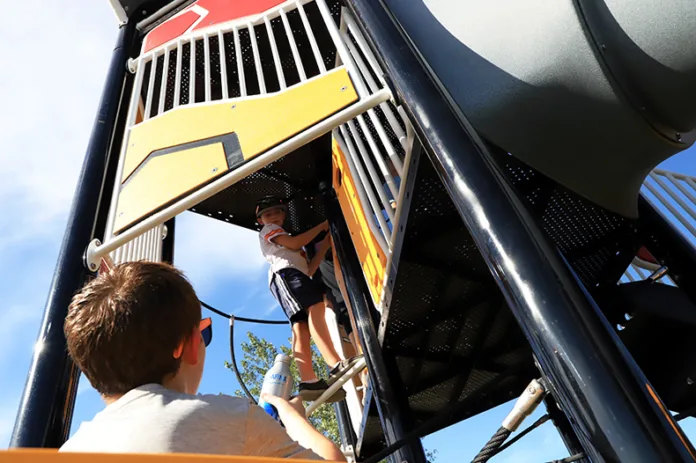
Overland Park could use revenue from a new sales tax to build new parks, refresh existing parks, expand the city’s trail network, upgrade regional pool facilities and more.
That is, if voters approve a new ¼-cent parks and recreation sales tax during a mail-in election early next year.
Earlier this week, the Overland Park City Council voted 9-3, officially authorizing the special election and approving ballot language that voters will see.
The ballot measure makes the special use sales tax possible and sets the terms for how the money could be used during its 10-year lifespan.
The sales tax question comes on the heels of a new parks and recreation plan called Playbook OP, which revealed a $250 million gap between anticipated funding levels and the full estimated cost of the plan over the next 10 years.
Councilmembers who have supported taking the sales tax question to the voters have called it a necessary step to more fully fund parks and recreation in Overland Park.
“Bills have been coming due, and they certainly will continue to come due,” Councilmember Logan Heley said, pointing to other Johnson County cities with existing parks sales taxes. “I think we’re doing the fiscally responsible thing here.”
Councilmembers Andrew Payne, Chris Newlin and Josh Beck opposed the tax for a number of reasons, including the idea of creating a new tax amid trying economic times for many families.
A 1/4-cent sales tax would apply roughly two cents to a $10 purchase, or twenty cents for $100.
How could a parks sales tax be used?
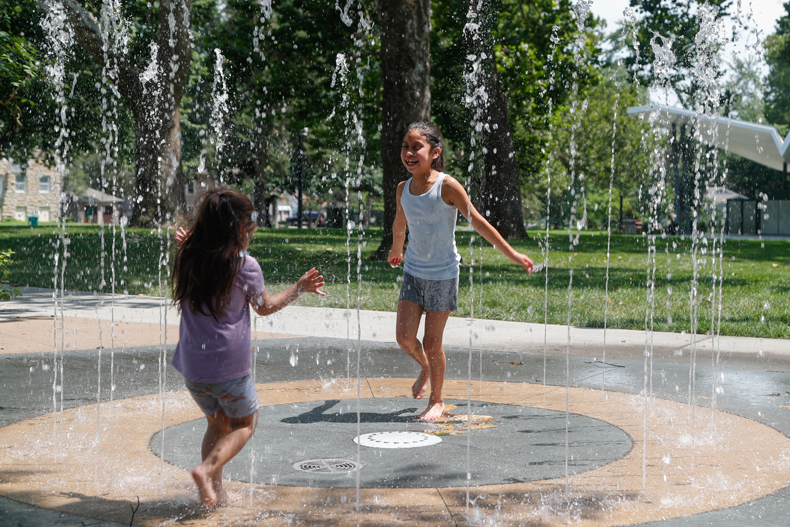
While nothing is set in stone, Overland Park officials have started planning for how funds from a new parks and recreation sales tax could be spent.
The tax, if approved, is expected to raise around $176 million over 10 years, which would be used exclusively for parks projects. (Read the language that will appear on Overland Park special election ballots here.)
On Monday, during a Committee of the Whole meeting, Bryan Toben, director of parks and recreation, gave a preview of potential projects that might be funded partially or fully by the sales tax.
On the list is a future park at 161st Street and Mission Road, where Overland Park has acquired some land. This site, adjacent to the old Kuhlman Diecasting Plant property, has been identified as a potential connection point to the Heartland Overlook Preserve north of Bannister Road on the Missouri side.
Another potential project includes an upgrade at Highland View Park in southern Overland Park.
Once envisioned as a home for a previously considered second city hall, the property was eventually divided to make space for a Johnson County Library branch and a Blue Valley elementary school. Today, the park has a small trail and some soccer fields.
“It is something that, after 30, 40 years of owning, it’s time to put an investment into the park,” Toben said.

The Indian Creek Recreation Center, an outdoor facility with tennis courts at 103rd Street and Marty, a large shelter, a playground and an Indian Creek Trail access point, could also be a beneficiary of the money.
The park floods frequently and is ready for updates, Toben said, but its location in the flood plain makes planning for its future challenging.
“We’re trying to figure out what that looks like, what its future looks like,” he said.
Overland Park could also use the sales tax to refresh some of its older parks, bringing new playgrounds, shelters or other amenities to places like Osage Park, Hickory Hills Park, Brookridge Park, Switzer Park and Linwood Park, among others.
Next steps for Overland Park’s sales tax:
Now that Overland Park has formally set the ballot language, the special election itself is officially scheduled.
Voters could begin receiving mail-in ballots by Feb. 10, 2027. Then, they’d have until March 2 to cast their vote, with the option of putting their ballot into a designated drop box or returning it by mail.
If voters approve the tax, the city would begin levying it on Oct. 1, 2027. The tax would last for 10 years. At that point, it would sunset, or the city would have to ask voters to renew it before it expires.
Keep reading: Overland Park won’t rebuild Bluejacket Pool, will someday close Stonegate Pool. What else pool plan says
 Thanks for reading! If you value having an independent news outlet keeping tabs on local government, schools and taxes, we're asking you to contribute to our Education Reporting Fund.