Incessant and often angry, harassing calls and emails from one Overland Park resident to Johnson County and Overland Park employees have so overwhelmed law enforcement that it has slowed their ability to answer 911 calls, interfered with their focus and eaten up untold staff time deciphering lengthy emails, county officials said.
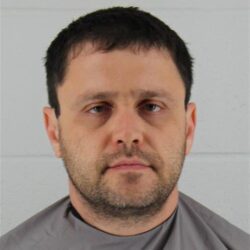
The alleged author of those emails and calls — Leonid Khayet, a man who last year gained some local recognition for raising $200,000 to help Ukrainians flee war — was booked into the county Central Booking Facility on Tuesday, Aug. 8, and released on bond, charged with violating a protection order in an unrelated battery case.
As that case pends, county commissioners grappled Thursday with the complexities of finding a way to protect staff members and block harassing calls and emails while still preserving residents’ rights to ask for help or speak their minds to county officials.
Overland Park, JoCo Sheriff have both sued
Peg Trent, the county’s chief legal counsel, said more than 28,000 emails were sent to officials on one topic between September 2022 and March 2023.
“That is overwhelming, but it is our job to read it,” she said.
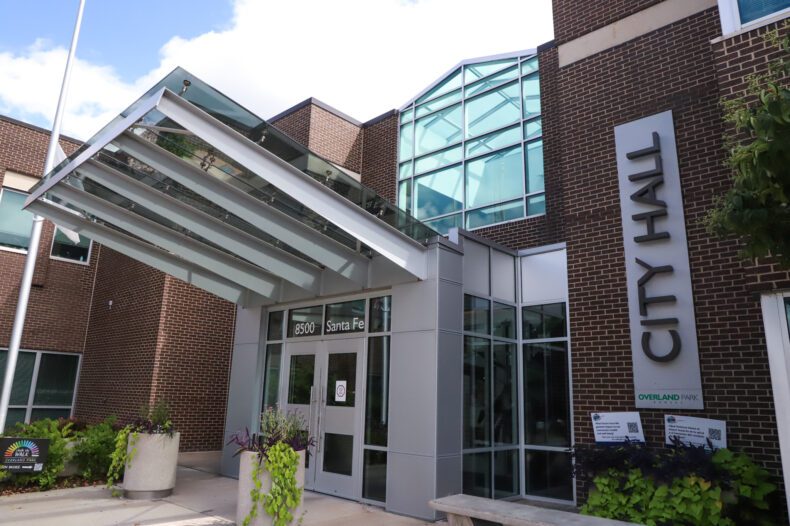
The city of Overland Park and, most recently, Johnson County Sheriff Calvin Hayden say they have taken numerous and varied steps to get Khayet, 40, to stop the excessive number of contacts on non-emergency matters.
They have sent written notices, which they say had no effect.
They each have now sued for court restraining orders in connection with the alleged harassment.
The sheriff’s office received hundreds of calls, emails
The sheriff’s suit, filed in January, is the most recent.
In it, sheriff’s officials allege Khayet made 503 calls and wrote 381 emails during a three-month period from September through December in 2022.
Many of the calls concerned a legal dispute Khayet had with Nebraska Data Centers over a business deal that was litigated in federal court, the lawsuit said.
Other calls referenced the Overland Park restraining order petition and a sheriff’s letter outlining limits on how Khayet could contact the office.
The magnitude of calls has had an oppressive effect on sheriff’s operations, the suit said.
The sheriff’s communications department was short-staffed by three officers when it was filed, and the often argumentative and confusing calls weighed down the department and caused call takers to worry about how they will handle the next one, according to the suit.
The emails are vague and confusing, and deciding whether a law enforcement response is necessary is time-consuming, the suit said.
Although the sheriff sent a letter telling Khayet to restrict his 911 calls to emergencies and to make other contacts with a specific officer by mail or by requesting a meeting, Khayet has not complied and continues with the emails and calls, the suit said.
Overland Park won a protective order against Khayet
Overland Park officials filed a similar lawsuit a year ago, also asking for a restraining order alleging hundreds of contacts to law enforcement.
In that case also, Khayet tried to convince the city police department to investigate Nebraska Data Centers, the suit said.
According to court records, the trial was held Jan. 5, 2023, and a permanent injunction limiting his non-emergency contact with city employees was issued Jan. 19.
The city later alleged Khayet violated that order by showing up at the W. Jack Sanders Justice Center in Overland Park with no apparent purpose.
His arrest on August 8 was on six counts of violating a protective order, but they were related to a previous battery charge, the details of which were not immediately available.
Khayet has represented himself in court.
U.S. District Court officials in Nebraska and the 8th Circuit also have prohibited contact from Khayet.
Khayet, a 2010 graduate of the Yale School of Management, was celebrated last year as an entrepreneur who used his networking skills to raise $200,000, helping 2,000 Ukrainians flee the war.
According to reports in the management school’s website and the Kansas City Star, Khayet, born in Belarus, was a child when his family left as refugees and settled in America.
New policy aims to protect employees
While county commissioners said they are used to getting numerous emails and calls, they also expressed concerns about protecting employees from racial or misogynistic calls and threats in the future.
Some noted the high volume of calls and emails received during the height of the pandemic.
Trent proposed, and the commission eventually accepted, a new policy that allows incessant phone calls and emails to be blocked on recommendation of the county legal team, if they are deemed harassing or redundant.
Blocking them would come with a written notice and information about other means of communication.
Hayden himself opposes a new policy
Some commissioners worried that the language was too vague and might result in people with legitimate concerns being blocked.
Commissioner Michael Ashcraft recounted the story of a constituent who persistently contacted county employees about a tax issue to no avail. He said that the constituent was later found to be correct.
Hayden spoke against the proposal, saying his office should handle harassment cases.
“There’s been a lot of time and money spent on one individual where it shouldn’t have had to happen. That individual is in custody today and guess what? He’s not calling anybody. That’s the way you fix this,” he told the commission in the county’s Thursday meeting (Khayet posted bond sometime that day.)
Dealing with a case like this can be “tricky,” Hayden said. But using criminal proceedings can eventually be helpful because after enough violations the courts can mandate some mental health treatment.
“It’s not just us on this individual. It’s the entire state, the Supreme Court of the State of Kansas, it’s the United States Marshall, it’s the FBI. He has harassed everyone,” Hayden said.
He added that a policy blocking contact makes for “bad optics” because the commission has quit videotaping public comments and sets time limits on them. “All of these things stack up to look like we’re limiting access to our citizens,” he said.
Commission eventually approved a policy resolution
Some observers who had signed up to speak also said the proposal was broad and wondered if it could be used against constituents who criticize the commission.
“This is a very broad resolution,” said Nancy Moneymaker of De Soto. “Is it uncomfortable or time-consuming speech by us as external actors that the county is worried about?”
Chairman Mike Kelly said the policy still allows contact with elected officials, and would only apply to the sheriff’s office if the sheriff opted in.
Commissioner Janeé Hanzlick said the county is obligated by law to protect employees from racial or sexual harassment.
She and other commissioners expressed concern about what happens if the calls and emails don’t rise to the level of criminal behavior the sheriff’s office could handle.
Commissioner Shirley Allenbrand said the harassment issue has been building since the COVID-19 pandemic.
“We’ve had people that have been in planning and zoning meetings and those people were followed to their cars. More than once. And that’s scary.”
The policy resolution was eventually passed 5-2, with commissioners Ashcraft and Charlotte O’Hara voting against.
Roxie Hammill is a freelance journalist who reports frequently for the Post and other Kansas City area publications. You can reach her at roxieham@gmail.com.