A two-room schoolhouse in Merriam changed the course of public education and desegregation efforts in Kansas and across the U.S. New research from a local university is exploring the depth of that impact.
Students at MidAmerica Nazarene University are researching the Madam CJ Walker School. Originally built in 1888 for both Black and white children, it eventually became a segregated and dilapidated school for Black children only in the early 1900s.
After School District 90, the district that covered that part of Johnson County at the time, built the new South Park Grade School in 1900 just for white students, the condition of the Walker School steadily deteriorated.
The growing inequality between the whites-only South Park school and the Walker School eventually led Walker School families to file the lawsuit that became Webb v. School District No. 90, which historians now say helped pave the way for the more well-known Brown v. Board of Education decision.
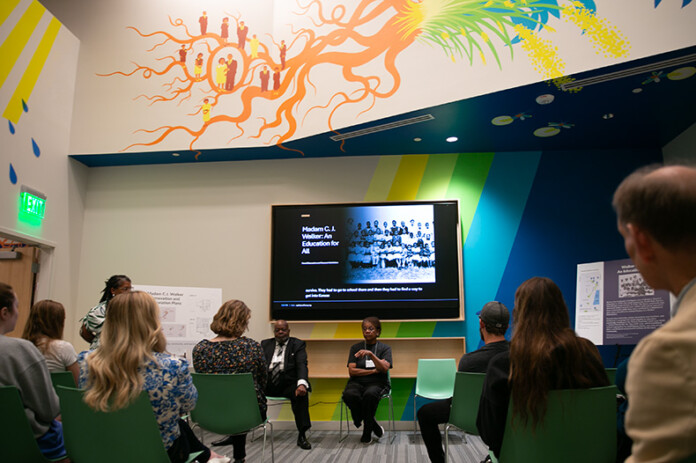
On Wednesday evening, about 40 people gathered at the Merriam Plaza Library — inside the Webb Family Meeting Room, dedicated to the Webb family — for an event hosted by MidAmerica Nazarene University students showcasing their research.
Mary Webb, whose father attended the Walker School, said she believes part of the reason the Walker School and the Webb v. School District 90 lawsuit is now largely forgotten is because families don’t always share their stories with younger generations.
She encouraged the crowd on Wednesday to talk to their children or younger generations about what life was like growing up in Johnson County.
But she said the fact that the Walker School is seen as part of Black history particularly, means it’s not always discussed or taught about.
“I’ll say this, it’s kind of a blanket statement, but Black history, [people] just don’t want to talk about it because it shows oppression,” Webb said.
A precursor to Brown v. Board of Education
After almost 50 years of Black students attending the deteriorating Walker School, School District 90 in 1947 used taxpayer dollars to build a new South Park Grade School only for white students, according to the city of Merriam.
The Walker School continued to deteriorate with no plans for upgrades.
Walker School families tried to appeal the segregation to the school board and Johnson County Court with no luck.
By 1948, Walker School families and local activist Esther Brown filed what became the Webb v. School District No. 90 lawsuit. The following year, the Kansas State Supreme Court upheld a state law prohibiting segregation in small towns like Merriam.
Webb v. School District No. 90 is considered a precursor to Brown v. Board of Education, the lawsuit that eventually made segregation in education illegal nationally.
Tony Adams, a panelist at Wednesday’s event who grew up in the South Park community and attended South Park about a decade after integration, said “this little school” changed history.
“The state of Kansas, and even before it became a state, was always on the right side of issues that pertained to this country,” Adams said.
“Fighting segregation was never a one-and-done effort”
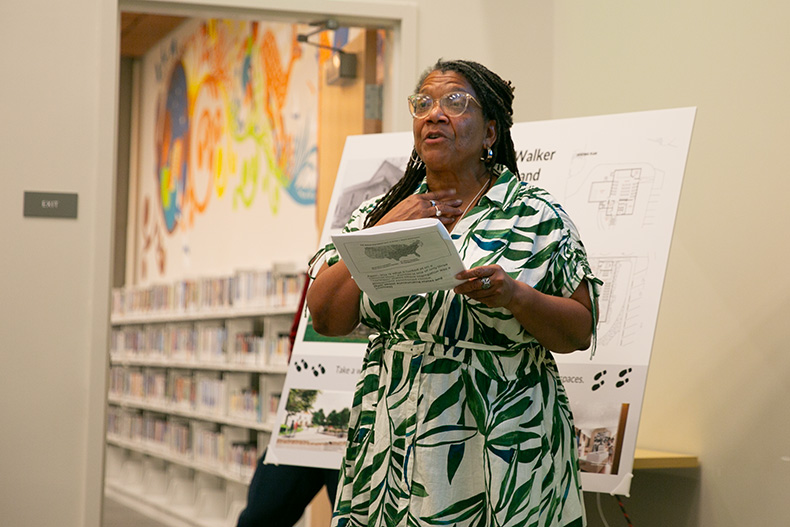
Donna Rae Pearson, the executive director of the Nicodemus Historical Society and Museum in Nicodemus, Kansas, said state laws in Kansas through the mid-1900s allowed school districts to segregate students by race, but there were limits.
When School District 90 built the whites-only school and left the Walker School to deteriorate, it ran afoul of the law because it was only intended for elementary schools in communities of 15,000 people or more.
But Black Kansans had been fighting unequal schooling for decades before that.
Between 1881 to 1951, Pearson said “Black Kansans filed at least 17 cases,” 11 that made their way to the Kansas Supreme Court and six others heard by lower courts, to get equal resources at Black schools — but not for integration.
Pearson said that Webb v. School District 90 “forced integration at South Park School in 1949 by highlighting unfair facilities,” which was proven to be a winning argument in earlier lawsuits.
“Fighting segregation was never a one-and-done effort,” Pearson said. “It was a process of spotting loopholes, shutting them down, and then pushing the conversation further until there was hardly any room left for segregation to happen.”
Federal funding cuts threaten future research
MidAmerica Nazarene University students are currently researching the Walker School and its impact on the civil rights movement.
The work the students are doing is intended for a historical exhibit at the site of the former Walker School, which is now home to the Philadelphia Missionary Baptist Church in Merriam at 9420 W. 50th Terr.
The research has been funded by Humanities Kansas, an independent nonprofit that offers grants, programming and partnerships to tell and document Kansas stories.
The Elon Musk-led Department of Government Efficiency, or DOGE, on April 2 cut the nonprofit’s federal funding through the National Endowment for the Humanities, according to a statement on the nonprofit’s website.
“If you’ve been paying attention to the news, many of those grants are no longer,” said Darin Tuck, an associate professor of history at Mid-America Nazarene whose students are conducting the research.
“So in many ways, this is the last of Humanities Kansas because of cuts to our governmental systems as of recently.”
Keep reading: New research spotlights Merriam school that helped pave way for Brown v. Board of Education