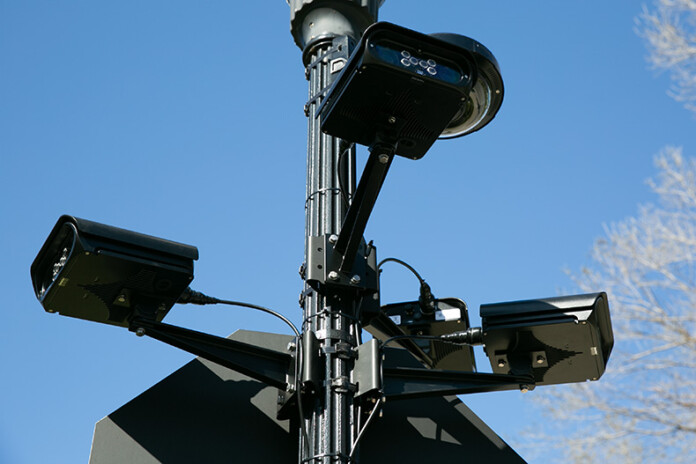
The Shawnee City Council approved a roughly seven-year, $4.9 million restructured contract with Arizona-based security technology company Axon that includes license plate readers, drones and cameras.
At the Shawnee City Council meeting on Nov. 9, the governing body voted 7-1 to approve a contract expansion with the Shawnee Police Department and Axon Enterprise Inc. for 95 months. Councilmember Laurel Burchfield was the lone dissenter.
The contract is an extension of an already-existing agreement with Axon, which currently includes body-worn cameras, in-car fleet video equipment and TASER 10 devices, and pays the company $423,000 per year through 2033. The funding comes from the police’s Public Safety Equipment Fund.
The new contract adds a bevy of new equipment that would, as city documents stated, transform the police department’s communications network from “a reactive response model into a proactive, unified Real-Time Operations network.” It would add about $198,000 per year to the existing contract and extend it to 2034.
The new equipment includes adding seven new portable license plate reader cameras for use in high-crime areas, streamlining emergency calls with AI technology, expanding the police’s ability to access cameras and combining police resources into one program.
The contract extension will run from Feb. 1, 2027, to Dec. 31, 2034.
The contract streamlines police communication and access
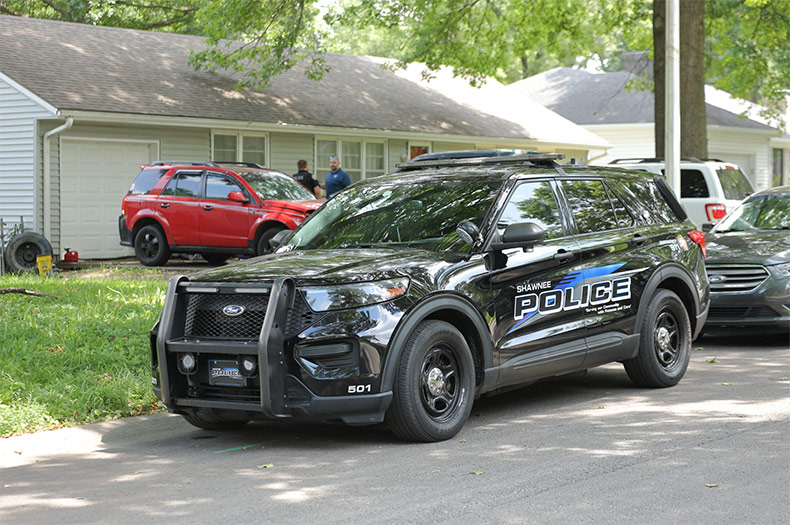
The deal would be similar to one Overland Park entered into with Axon in 2025, where the department received a technology overhaul that included body cameras, drones and AI technology.
One of the biggest pieces of equipment in the new contract is a Fusus Real-Time Operations Center. It is a digital interface that combines several different police communications, including computer-aided dispatch, police vehicle GPS and live camera feeds from in-car video, bodycams, traffic cams, drones and license plate readers, all on one screen.
“We don’t have to go to six different screens to see all those different products. Our officers … can see all those things on one screen,” Chief of Police Sam Larson said. “It’s highly customizable. We can pick and choose what we want our officers or our staff to see.”
In addition, the Shawnee Police Department is looking to establish Community Link, where local businesses, residences and schools would voluntarily allow police access to their cameras during an emergency.
“A bank could share their feed with us. If there’s this type of (emergency) call in the bank, like, say, a robbery or suspicious subject, then we would have access to their cameras,” Larson said
The police would not have access to their cameras during any other time, Larson said.
“We don’t have unfettered access to their system. If there’s a type of (emergency) call there, then we can see it, and that’s up to them. It’s not up to us,” he said.
Businesses or organizations that agree to it can also opt out at any time.
“If they agree today and next week, they decide they don’t want to do it, they can pull out of it with no problem, and we would stop that,” Larson said.
In addition, Fuses also contains a retail theft hub, which stores information about recent retail thefts, like known suspects and what kind of vehicle they drive in order to identify them more easily.
“(It) provides us more information to help go after those career criminals that continue to do these thefts all over the metro,” Larson said.
The contract adds more license plate readers
While it became a hot topic both nationally and locally in Johnson County, more license plate readers are included in Shawnee’s expanded Axon contract.
The Shawnee Police Department will also receive 10 total portable license plate reader cameras, including three that would replace existing cameras from a different vendor and seven additional units for use in “[hotspot] crime areas.”
The report did not state what constitutes a hotspot area. The Post inquired with the city to clarify what a hotspot would be, but Shawnee Police had not responded at the time of publication.
“If we have … a problem area, a problem street, a problem business, a problem whatever, and it met our criteria … We can set them up in what we call ‘High crime areas’ or ‘Hot spot areas’ and determine problem people that are coming and going and address those (problems),” Larson said at the Nov. 9 council meeting.
This past year in Johnson County, license plate readers have come under attack for alleged abuse and overreach.
Earlier this year, KCUR reported that the Lenexa Police Department had used its license plate reader cameras made by Leonardo, Axon and Genetec to keep tabs on a resident named Canyen Ashworth who had written a critical column about the Lenexa Police Department in the Kansas City Star.
Also in August, the Gardner City Council voted to deactivate four Flock cameras and cancel the city’s roughly $13,000 contract with Flock, a prominent maker of license plate readers.
The Shawnee Police Department has been using license plate reader cameras since 2009.
According to Shawnee Police Department policy, data from license plate readers is only to be used for “official business,” which will be dictated by a commander who sets protocols for access and data retention. Other agencies can access the data by request only. Data from license plate readers is stored for 180 days.
Contract also adds drones, AI assistance
Other parts of the contract involve getting new technology, including:
- Drone as First Responder (DFR) and Patrol Drones: Similar to other Johnson County cities like Olathe and Lenexa, the Shawnee Police Department will utilize six drones total as part of its law enforcement options. This will include three autonomous Skydio X10 drone systems launching from fixed docks to provide immediate aerial overwatch and allow for low-priority or unfounded calls to be cleared without dispatching ground patrol officers. It also includes three patrol-deployable drones for immediate on-scene use by officers.
The drones will help the police department cover emergencies as it continues its search to hire more police officers, Larson said.
“I personally see these as digital officers in the sky. We continue to have recruiting issues, trying to get good people to apply and go through the complete process. So we’re still short officers … We have an officer in the sky that can get to these scenes much quicker and have an officer in that area,” he said.
- Prepared 911 & Automated Non-Emergency Triage (ANET): An AI-driven system that utilizes live translation, location tracking, and assistive call-taking software directly in Shawnee’s dispatch center to process and divert non-emergency inquiries before they tie up critical dispatch resources. It would help lighten the load for human dispatch when they receive a heavy volume of calls.
“If you were to call a non-emergency number and dispatch is too busy to pick up the call, this AI-generated thing could talk to the caller,” Larson said. “The AI would ask the caller questions and figure out if it’s a medical call or if it’s a something else, and get additional data from them so it can help have the officer or have the dispatcher pick it up and get that information ahead of time.”
- Axon AI Assistant (Translation): Equips frontline body-worn cameras with two-way voice translation across more than 50 languages to quickly overcome language barriers in the field. The technology was tested for two months during the World Cup and was promising enough that Axon extended its free trial to the police department.
“An officer clicks a button on here.. It can auto detect the language of the person speaking … then the body cam translates to that language. And I push a button when they speak, and it translates it back to me in English. And it’s all recorded, and it is works very well, and our people love it,” Larson said.
- Virtual Reality (VR) Training Simulators: Police will get four VR kits for de-escalation, judgment and high-liability training. It will reduce shooting range fees, travel costs, and overtime required by traditional live scenarios, according to city documents.
- More cameras: The Shawnee Fire Department will receive 11 Axon Fleet 3 in-car video systems and nine Axon Body 4 cameras equipped with the live translation feature to assist personnel on calls when needed.
“If they were on a medical call or something (and) they need a translator for that, they could use that, should they need it … This would be a good thing and an immediate need,” Larson said.
City council’s mix of support, skepticism

While no one from the public spoke during the public comment section at the Nov. 9 meeting, three city councilmembers raised questions about the technology.
When Councilmember Eric Persson first read the Shawnee Police Department’s pitch, he was skeptical. After asking Larson a number of questions about the new equipment, he said he was convinced it was needed.
“I sent an email asking … some very detailed questions about transparency, privacy, oversight and long-term governance. And I do appreciate the response that I got based on those answers,” he said.
Worrying about data storage and rights, Burchfield asked Larson about who owns what the variety of law enforcement cameras capture. The police own the data collected by their drones and what’s captured on Fuses.
“If it’s our internal stuff, meaning the GPS of the cars, the live body cam, and the in-car video and traffic cameras, that kind of stuff, that’s ours, and who can view that is who we decide to do that,” Larson said. “If it’s another agency, it’s got to be through an MOU (Memorandum of Understanding). Both of us have to sign the MOU to allow (access).”
Talking about the 10 license plate reader cameras, Councilmember Erin Aldridge drilled down on Larson, noting that they tried to negotiate with Axon on fewer than 10 cameras, only to find the cost would be more expensive if they tried to reduce the order.
“If we took one thing out of this, the price is going to go up. It makes no sense to me, but they want to bundle everything together. If you get more stuff, you’re going to get a lower price. So we worked on that, and they wouldn’t take it out,” Larson said.
Joining Aldridge, Burchfield also asked if there was any way to de-bundle the deal.
“I think elements of this are very cool. The translator for me is such an interesting and valuable tool for you all to have. There are other things that I’m less excited about, and I heard you say that if we try to de-bundle or take something out, the price goes up. Can we look at de-bundling this in a way that makes sense to the city?” she said.
Closing out the discussion, Larson reiterated that de-bundling the deal is likely not an option if they want to save money.
“Captain (Nick) Pike has been working for two years on this program, and he’s been working very diligently on that. And I don’t think they’re willing to change,” Larson said. “They’re already giving us a really good deal on this. So, if we take anything out, its price is going to go up, which, again, makes no sense to me. But they want to get us on this.”
 Thanks for reading! If you value having an independent news outlet keeping tabs on local government, schools and taxes, we're asking you to contribute to our Education Reporting Fund.