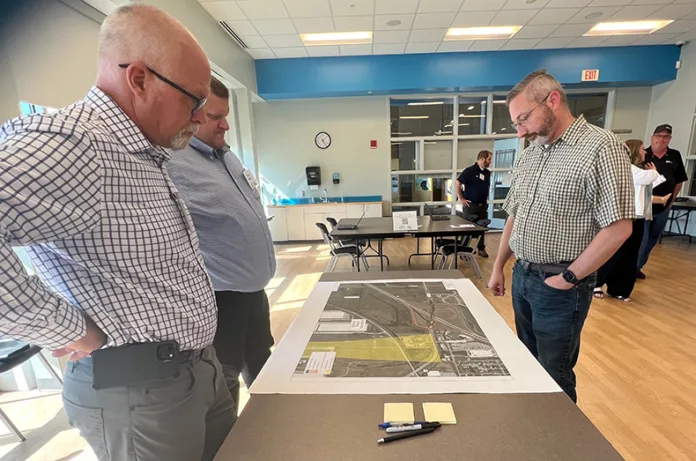
The Kansas Department of Transportation has begun the discovery phase of a proposed $25 million road interchange improvements project for the 175th St./U.S. Highway 56/I-35 overpass in Gardner.
KDOT predicts the key interchange in Gardner will be over capacity by 2060 due to continued major growth for the city on the east side of I-35.
The KDOT project design and engineering teams held an open house at New Century Field House on Tuesday, July 1, to gather public input on four designs before moving to the next preliminary design phase.
Here’s a link to the presentation materials from the open house last week.
Officials said the top project goals were safety, alleviating congestion issues, supporting local growth and development, identifying a cost-effective solution and improving multi-modal connectivity.
KDOT first looked at safety and traffic analysis of the interchange at the beginning of the year, then a public survey was sent out and an advisory group met twice. The advisory group consists of area stakeholders from Johnson County, the City of Gardner, New Century AirCenter, and fire and emergency services.
Survey results from 368 participants in April flagged top concerns by commuters, including:
- General traffic safety
- Difficulties turning left onto 175th Street/U.S. Highway 56 from southbound I-35
- Merging on and off ramps
- Truck traffic
- Traffic backups at Cedar Niles Road
- Concerns during inclement weather
Safety concerns the number one priority
Traffic safety for the interchange was repeatedly iterated from KDOT, the City of Gardner and Fire District #1 as the primary focus for improving the roadways that merge in the interchange, along with nearby Clare Road and U.S. Highway 56/175th Street at Cedar Niles Road.
“As rapid growth continues around the interchange, it’s important to facilitate the increased traffic in a safe and efficient manner,” said Jim Pruetting, Gardner city administrator. “With additional truck traffic coming from the east, safety is the highest priority.”
A total of 523 crashes occurred in the area around the busy interchange over a five-year period, according to a KDOT report. Of those crashes, four caused fatalities, and 140 caused injuries.
In that study of the crash data, KDOT reported that the stretch of I-35 around the interchange had 487 crashes, the stretch of U.S. Highway 56/175th street had 24 crashes, and the highway ramps had 12 crashes.
Officials said the U.S. Highway 56/175th and I-35 ramp locations were high-density crash locations, and U.S. 56/175th at Cedar Niles Road experienced the heaviest traffic during peak morning and evening rush hours with backups a quarter mile long.
Fire District #1 said the traffic loop from eastbound 175th merging onto northbound I-35 always had the most crashes their department received because of its tight turn radius. The turn radius was also difficult for the growing number of semi-trucks in the area as well as their own fire trucks and emergency vehicles.
“It is a challenging intersection,” said Chief Trig Morley.
All three design plans propose removing the traffic circle merge and changing it into a longer road merge.
Steven Cross, principal engineer and project manager for the Kansas Department of Transportation, said most of the feedback for safety concerns KDOT had received centered around the circular ramp merging northbound onto I-35.
“Everyone has agreed getting rid of this on-ramp is needed,” Cross said.
Increased development on the east side
Connected to traffic safety concerns with an outdated road infrastructure model, KDOT engineers and the City of Gardner, said the increased development opportunities and future growth on the east side of I-35 was the main driving force to improve the interchange.
Some of that new development includes a 262-acre $200 million mixed-use project known as Prairie Trace. When completed, it will have 424 apartments, 200 standard single-family and 168 compact single-family homes, along with retail, including a 50,000-square-foot anchor retailer, offices and service space, and three limited-service hotels.
Pruetting said additional commercial opportunities will also open up around the interchange thanks in part to “more efficient movement of traffic” from a new road design.
The city has also been looking at proposed development north of 175th Street and west of I-35, directly north of the interchange.
“The farm at Clare Road and 167th Street selling was a huge driver for the city’s development and need for the interchange improvements,” said Ben Ware, George Butler and Associates lead engineer.
Pruetting said the current process of developing a redesign of the interchange was a KDOT required step for “break-in” access to the northwest side for city development.
“Gardner has been pressing KDOT for a ‘break-in access’ along the southbound off-ramp for over five years now to facilitate proposed development on the northwest corner of the interchange,” Pruetting said.
When it comes to the increased development in the area and Gardner’s continued growth to the east of I-35, Cross said progress was inevitable, and it was his job to engineer infrastructure that upholds the growth of a small, growing municipality.
“My heart goes out to the people,” Cross said.
Four interchange design proposals
Kellen Headlee, public works director for Gardner, said the various design proposals presented “a lot” of ideas to consider.
“I can see using various elements from these (proposals) combined,” Headlee said.
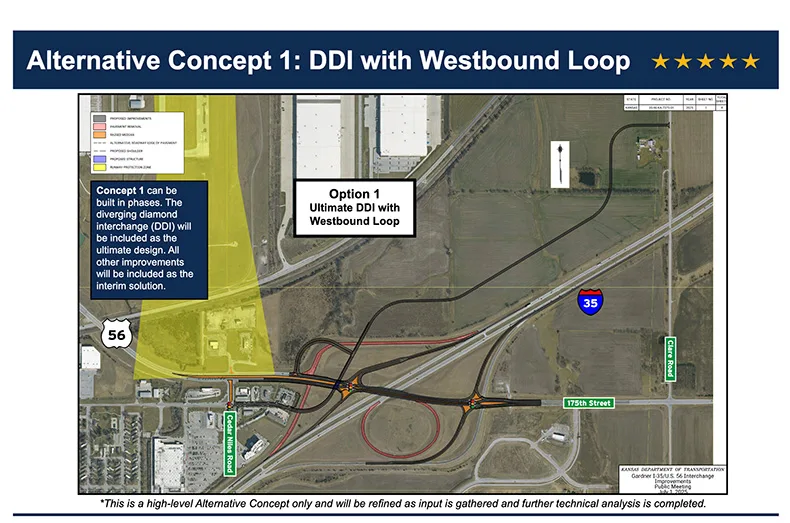
Design 1 is the simplest design with two diverging diamonds at each location on 175th Street to enter and exit I-35 north and southbound and a proposed underpass running under U.S. Highway 56. (As an example, 119th Street over I-35 has a similar diverging diamond interchange.)
Below is a map of the proposed Design 1.
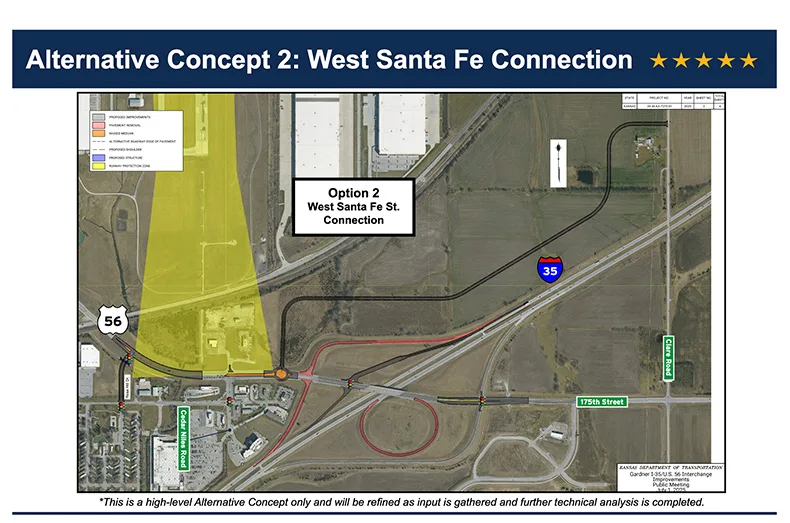
Design 2 provides an option for a West Santa Fe Street connection with a proposed roundabout on the west side of 175th Street.
Below is a map of the proposed Design 2.
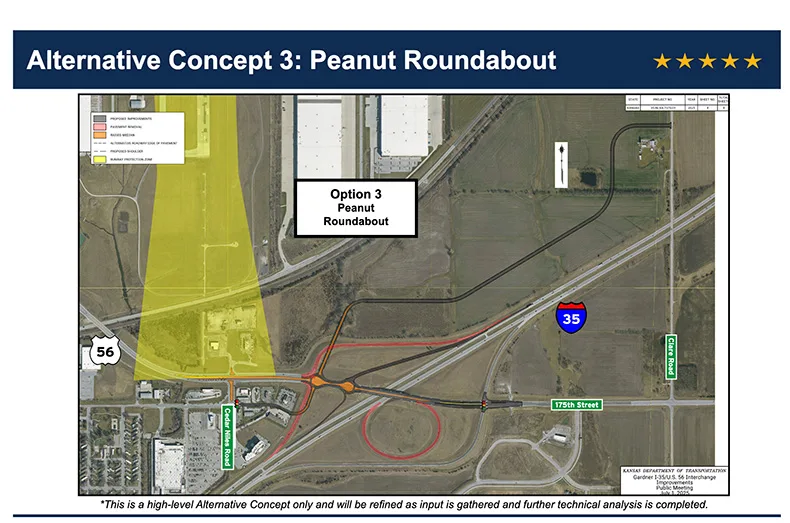
Design 3 is the most unique road design with a double roundabout that looks like a peanut on the west end of 175th St. that merges into U.S. 56 Highway. Officials said drivers flow through the two roundabouts in one continuous move.
Below is a map of the proposed Design 3.
The fourth proposal from KDOT is a “no-build” design maintaining the current infrastructure with no changes to number of lanes, shoulder widths or ramp layouts outside what is already scheduled.
What are next steps?
KDOT will determine the preferred alternative concept by August.
An advisory group is also set to meet this fall. A second public open house presenting the preferred alternative design is scheduled to take place in September.
KDOT expects to submit a report by the end of this year.
Ware, the lead engineer on the project, said he expects construction on the interchange project to begin within the next three to four years.
Want to stay informed, updated and engaged on this project? KDOT has a sign-up form available at this link.