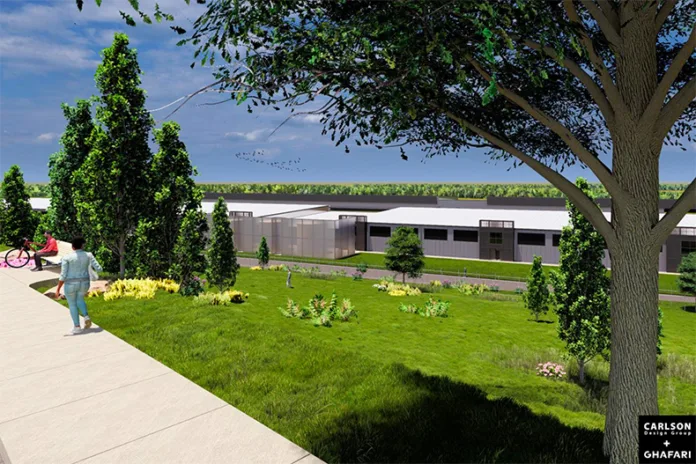
Just weeks after De Soto’s incoming 300-acre data center site broke ground, a separate data center developer is looking to build a campus nearly quadruple that size just down the road at Astra Enterprise Park.
This marks the fourth data center proposal to come up since March in western and southern Johnson County. Spring Hill and Gardner received applications earlier this spring, though both were withdrawn, and another application in Edgerton was denied earlier this month.
Following the applications in Gardner and Edgerton, residents pushed for moratoriums, which would’ve temporarily blocked data center applications. Earlier this month, both the Gardner City Council and the Edgerton City Council denied imposing six-month pauses.
Most recently, representatives from Texas-based company Digital Realty introduced initial plans earlier this month in De Soto to develop more than 1,400 acres on two parcels of land into a data center campus at Astra Enterprise Park — one parcel sits just northeast of Panasonic and the other just west. Multiple news outlets have reported that the first phase is anticipated to cost $4 billion.
In a presentation during the De Soto City Council meeting on June 4, Digital Realty representatives cited the company’s more than 20 years of experience building and operating data center facilities, which house rows of computers that store, process and transmit data. Here’s an explainer from the Associated Press about what data centers are.
 Loading...

 Reload document
  Open in new tab
 However, the company’s history does little to reassure residents who broadly oppose data centers. People have been coming out in droves to city council meetings across the county to speak against these developments.
Key concerns include water usage, noise levels, pollution, drain on the power grid, cost to residents, lack of trust with the developers and city councils, and the lack of research on long-term effects to the health of a community.
About Digital Realty
Rafal Rak, senior vice president of leasing and development for Digital Realty, said at the De Soto City Council meeting that the company’s goal was to introduce themselves and their initial plans for the site just northeast of Panasonic’s EV battery plant “with the goal of being transparent.”
“[And] making sure we’re designing and building a project that meets, or exceeds, the standards of the city and is something the community will be proud of,” Rak said. “We do believe the site we acquired, which is the former Sunflower Army Ammunitions Plant, is a good fit for a data center use — not all locations are.”
The company acquired two parcels of land at Astra Enterprise Park in May and, as of Thursday, has yet to start the formal process by submitting a site plan for planning commission consideration.
The company’s tenants come from a range of industries, including telecommunications, financial institutions, government agencies, healthcare providers and companies that provide cloud infrastructure.
“For the site at Astra, we’re in discussions with a major cloud infrastructure operator that’s a global company with an investment-grade balance sheet — a name-brand company that manages all the data that we create, use on a daily basis,” Rak said.
Residents said they want better for the community
Ahead of Digital Realty’s presentation, several people spoke against data centers during public comment — both Digital Realty’s proposed facility and the already approved $3.1 billion Beale Infrastructure facility, which is about two miles west of Digital Realty’s site.
Those opposed included De Soto resident Jennifer Sharp.
“With Digital Realty and Beale Infrastructure, we face 1,700 acres of data centers,” Sharp said. “A temporary pause is not enough. We want them out.”
Her key doubts, which other speakers also shared, included water usage affecting local water tables and wells, closed-loop cooling systems, like Beale’s, and how the water goes back into the public water system, and negative effects of a low-frequency hum on the health of the community.
Sharp asked the city to do three things:
- pass a hard, townwide limit on combined data center power and water use,
- ban all property tax incentives for Digital Realty, making them pay 100% of their taxes to the local schools,
- and adopt emergency updates that address low-frequency noises, enforcing limits at property lines.
“De Soto does not need [even] one data center,” Sharp said. “They need to pack up and leave. And you guys need to exercise your authority that you have to make them do so.”
De Soto resident Toni Caldwell, who also spoke during public comment, said she loves her city. She sees De Soto’s potential, but the future does not lie in data centers.
“We have the potential to become something truly different from the rest of Johnson County — we don’t need to be another Lenexa — but we are not moving in that direction,” Caldwell said. “We are not acting with intention. We are not listening to the people that live here.”
The proposal
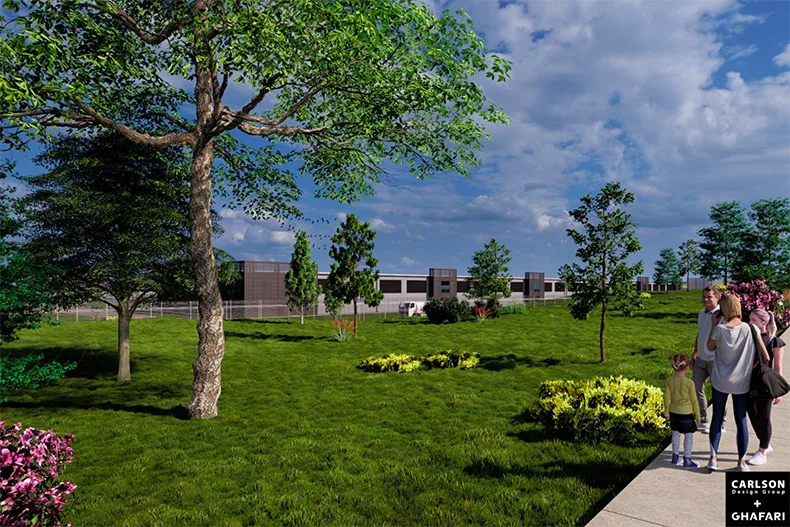
While Digital Realty hasn’t submitted the formal application yet, here’s what the company has stated so far:
- The first phase of the development would include about nine buildings off of West 103rd Street and Lexington Avenue, just south of the new Sunflower Fire Station.
- All necessary improvements to transmission lines and power substations, operated by Evergy, would be funded entirely by Digital Realty. The upgrades are estimated to cost more than $300 million.
- The buildings would use outside air cooling for 85-90% of the year, only using water during the hottest periods. According to the company’s website, water usage estimates are still being finalized. However, the city of De Soto would allocate one million gallons of water per day to the site.
- Digital Realty would fund a new industrial wastewater treatment plant.
- Sound studies would be conducted before and after construction. The company plans to design the site with the idea of keeping noise levels down, and visual impacts to a minimum, making considerations for where equipment would be placed, adding barriers, screening and landscaping.
- The company estimates more than 1,000 jobs would be created during the construction period. Once operational, the campus would employ roughly 250 people.
- The campus would have backup generators meant for emergencies. Regular testing would be required, though it would be limited to daytime business hours.
- To compare costs for Digital Realty’s first phase, Beale’s 300-acre site is expected to cost $3.1 billion, and the denied DAMAC-Digital site in Edgerton, which would’ve converted a 400,000-square-foot warehouse into a data center, would’ve cost $860 million.
Additionally, Enrique Bellido, head of due diligence and entitlements for Digital Realty, highlighted the company’s sustainability efforts, including its use of renewable energy at 185 of its data center facilities worldwide.
“As a global company, sustainability is important to us, not only in terms of greenhouse gas reductions,” Bellido said. “We have joined the Science-Based Targets Initiative. We work to have our projects be LEED certified.”
Next steps
Digital Realty still needs to submit the site plan to the De Soto Planning Commission, which will then consider the technical aspects of the plan and if it meets city development standards.
A public hearing won’t be a part of the process, as the land is already zoned for this kind of development.
Site plans don’t typically go before the city council, according to city Communications Director Whitney Lange.
If the company later requests economic incentives, that would be a separate process requiring a public hearing and city council consideration.
For the already approved Beale Infrastructure project, the De Soto City Council approved the following incentives in the development agreement:
- a 25% franchise fee reduction rate for power use,
- $1.5 million franchise fee collected for Phase 1/Building 1, based on power usage,
- $5.5 million franchise fees cap with 1.5% annual increases to the city of De Soto annually after complete construction,
- sales tax exemption on construction materials,
- developer pays sales tax on energy usage,
- and each building is eligible for a 10-year property tax abatement.