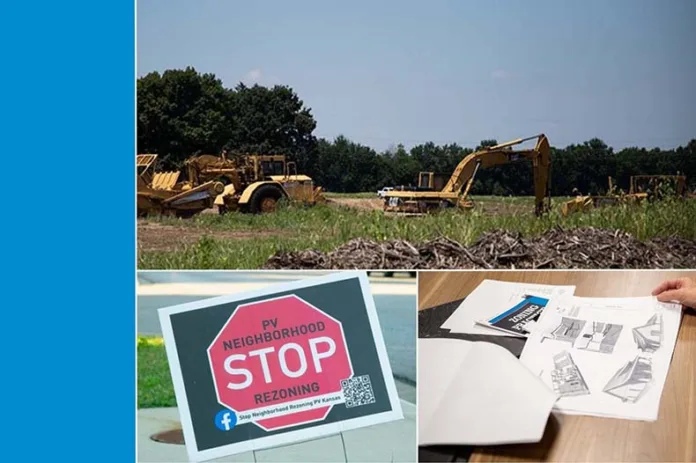
Overland Park continues to work on its new zoning framework, which could fundamentally change how Johnson County’s largest city approaches housing, echoing past efforts in other cities to tackle the widening housing shortage.
Overland Park’s new approach could, among other things, eliminate traditional single-family-only districts and smooth the path for denser housing products to be built, including townhomes, cluster neighborhoods and row houses.
While there’s been little conflict so far as Overland Park has worked on its new zoning and development codes with an eye toward housing, similar conversations in Johnson County over proposals less ambitious than what Overland Park is contemplating have turned contentious.
Shawnee saw it for several years as debates about where multifamily housing projects belong stalled development. More recently in Lenexa, a Habitat for Humanity project inflamed tensions between the city and neighbors.
That said, the Johnson County city that most starkly shows how smoldering conflict can emerge from discussions of housing is Prairie Village.
Residents formed a grassroot group in opposition to any changes to the city’s development codes. And though the city never proposed widespread rezoning or allowing large-scale multifamily housing options in historically single-family areas, accusations that it was and misinformation ran rampant.
The debate in Prairie Village devolved into fiery and at times personal conflict between a resident group and City Hall. In the end, efforts to formulate modest housing solutions in that city came to a halt, and little change was made to residential zoning.
At the same time, a recent change in state law designed to make it easier to build lower-cost housing options may soon force all Johnson County cities to grapple with the issue themselves.
What was Prairie Village actually talking about?

Prairie Village was one of the first Johnson County cities to start talking about solutions following a 2021 United Community Services study that showed a growing countywide shortage of housing.
It also coincided with the city’s efforts to enact some of the priorities laid out in Village Vision 2.0, the updated long-range development plan adopted in 2021, which emphasized a need for more housing options.
Prairie Village has long pondered how to stem the teardown-rebuild trend through which dozens of the original small post-World War II homes are getting replaced with larger, more expensive single-family homes.
At the same time, housing costs in Prairie Village and across Johnson County have exploded as property values rise. A decade ago, the average appraised value of a home in Prairie Village was $245,000. In 2026, the average appraised value exceeded $600,000.
Mayor Eric Mikkelson told the Post in a recent interview that these escalating housing costs have been pricing people out of Prairie Village. The city — one of the Kansas City metro’s most desirable zip codes — used to be an affordable place to live for essential service professionals, like teachers, nurses and firefighters.
“Every year, you lose a band of professions that can afford to live in Prairie Village,” he said.
He worries that it is turning Prairie Village into a southern extension of Mission Hills, the affluent suburb to the north.
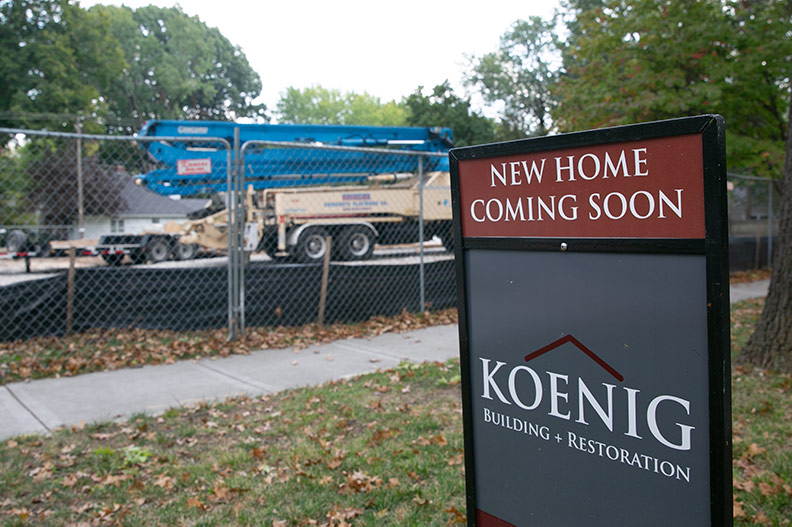
Ultimately, the city activated a public committee in 2021 and 2022 to study what kind of prospects there were to address housing attainability in Prairie Village and to look at the city’s zoning codes. The idea was that the committee — made of community members, land use attorneys, building professionals and city officials — would craft recommendations for the Prairie Village City Council to look into further.
That committee, the Ad Hoc Housing Committee, is now derided openly by some community groups. Councilmember Ian Graves, who chaired that committee, says it’s “become a bit of a weird slur in Prairie Village,” and it is frequently blamed for the years of drama that followed.
The original recommendations that came from the committee had a few strategies, though the one most often referenced is the recommendation to change zoning codes.
Under that strategy, the committee suggested the city should increase opportunities for attainable housing options to be developed in more zoning districts within the city. That included potentially allowing accessory dwelling units, sometimes called granny flats, in single-family neighborhoods.
The city council, in 2022, unanimously advanced the housing committee’s recommendations, giving the green light to dive deeper into the issue.
It wasn’t long before that whole effort was derailed. Within weeks, flyers started popping up alleging the city was looking at allowing multifamily housing in single-family zoning districts.
“What people said we were doing was all manner of nonsense,” Graves said. “Like, just absolute bullshit.”

Some examples of what he heard at the time were that the city wanted to specifically allow apartments or even gas stations in single-family home districts, which he felt was unfair and untrue.
Mayor Mikkelson offers a similar assessment, calling some of it “flat-out lies” and “political noise.”
“It prevented us from having a calm sort of rational conversation about all of the possible things we might consider in Prairie Village to address this very real need,” he said.
Still, the flyers urged residents to oppose those conversations, and several showed up to do so. From there, it snowballed.
“It just went insane; it went off the rails almost immediately,” Graves said.
It ultimately led to years of drama that devolved into personal attacks, multiple attempts to recall city leaders and a failed effort to overhaul the city government. The tension spilled into other unrelated issues as well, including plans to build a new Prairie Village City Hall.
Graves thinks it scared some communities in Johnson County from really addressing the issue for themselves.
“It definitely sort of cast a pall over housing discussions,” he said.
Overland Park is looking at a much bigger zoning code overhaul

What Overland Park is pondering with its Unified Development Ordinance overhaul is much more expansive than anything Prairie Village ever actually discussed.
In fact, it mirrors some of what angry Prairie Village residents accused that city of doing, even when that city wasn’t.
To be clear, Overland Park is not proposing to change zoning codes in such a way that would allow high-rise apartment complexes in traditional single-family neighborhoods.
However, the changes could allow things like row houses, smaller cluster-style neighborhoods, townhomes or even duplexes in some districts that are currently zoned for single-family homes. The idea is to move away from more restrictive zoning standards and ease the way for more attainable housing.
For example, the proposed Neighborhood 1 zoning district would have a preferred use of detached single-family homes. That said, it could also support uses like cottage-style homes, duplexes and townhomes, as well as parks and civic spaces.
The American Planning Association, a professional organization of planners, offers resources like the Housing Supply Accelerator Playbook. That document, created with the National League of Cities, suggests a range of solutions to speed up the development of housing, including things like streamlining the planning review process.
It also suggests that revisiting the zoning codes that guide the development of a community because traditional zoning rules and associated standards have created barriers to building more housing at a wider variety of price points.

Other literature from the APA suggests getting rid of single-family-only zoning districts could also make it easier to build housing. That’s something Overland Park has pondered with its proposed character-based zoning codes, which would allow for more housing density mixing.
A little closer to home, housing experts in the Kansas City area offer a similar assessment.
The way Katie Killen, director of advocacy and community collaboration for Habitat for Humanity of Kansas City, sees it, changes that pave the way for smaller, less costly housing types, such as starter homes, row houses and duplexes would help.
Killen said Overland Park is looking at it in a way she hasn’t seen other communities tackle in the metro area.
“I think Overland Park has been pretty thorough in this,” said Killen, who sat on a committee that contributed to the city’s new comprehensive plan.
What Overland Park is doing differently
Like in Prairie Village, Overland Park’s conversation about housing and zoning follows the adoption of a new, updated comprehensive plan (Village Vision 2.0 in Prairie Village and Framework OP for Overland Park).
However, Leslie Karr, director of planning and development for Overland Park, said her city was extra intentional about engaging with the public during that process and has continued to do so as it has approached its development codes.
That’s something Graves thinks has helped Overland Park avoid some of the pitfalls Prairie Village faced.
Graves has also observed that city officials have done a better job of coming up with specifics than the Prairie Village housing committee did. Without specifics, he said, there was “a vacuum” full of uncertainty, which left space for things that weren’t true to run rampant.
“Where Overland Park is doing it differently is,” Graves continued, “they’re coming in with specifics, like this is what we’re considering, this is what it would look like.”
Mikkelson agreed.
“If you put some concepts out there without a lot of specificity, just for discussion, like we did,” he said, “it can capture people’s attention, and embed in people’s minds, and mislead a lot of really good people who are legitimately concerned when they hear things like that in the absence of the truth.”
What’s next for Overland Park’s zoning overhaul?

Right now, the city is still developing its new Unified Development Ordinance. For the foreseeable future, the Overland Park City Council will continue its policy-oriented conversations about what kind of development belongs where and what these projects should look like.
Karr said that part of the process is likely to continue throughout the rest of 2026, with a draft version potentially available by the end of the year.
After that, the city would again hold some public engagement opportunities and open houses to gather input from the community and other stakeholders. From there, Karr said there would be some “fine-tuning” to the draft.
If that timeline holds, it would likely set the city council up to adopt the full final draft, potentially as soon as early 2027.
Looking toward the future, Graves thinks Overland Park stands to gain a lot from this process and that it’s likely setting itself up to lead the pack where zoning reform and housing attainability are concerned.
“I think the first city that really does this aggressively and proactively is going to be the one that reaps the most benefits in terms of new housing units, better tax base, more solid tax base, better commercial spots,” Graves said. “Really, 5, 10, 15 years down the road, they’re going to be way ahead of everyone else.”
“I’m really curious to see where Overland Park gets with this. They’re on a pretty forceful trajectory right now,” he added. “I suspect they’re going to have an easier time than Prairie Village.”
Mikkelson, even now, feels like “these are conversations that communities need to be having,” though he knows “it can be painful.”
“You’ve got to have some courage. Whenever you do anything big or different in local government, especially these days, you’re going to get pushback, and that pushback can be forceful,” he said. “You need committed elected officials in it for the right reasons, with the courage to listen and move forward, then with the right policy decision.”
Juliana Garcia contributed reporting to this story.
Keep reading: NIMBY opposition remains major hurdle to housing developments in JoCo, officials say
 Thanks for reading! If you value having an independent news outlet keeping tabs on local government, schools and taxes, we're asking you to contribute to our Education Reporting Fund.