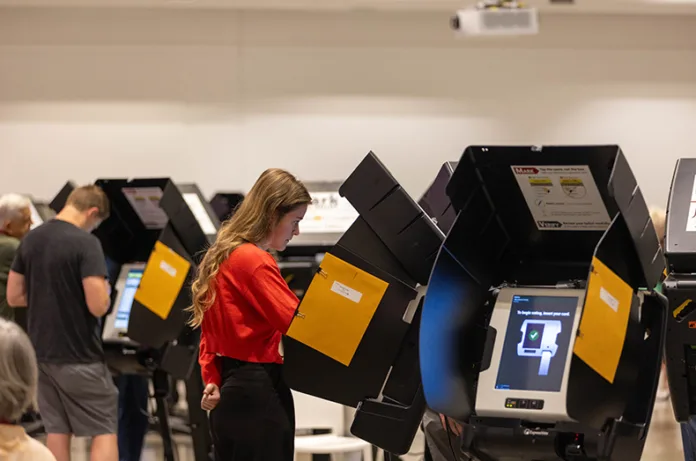
County Election Commissioner Connie Schmidt said she is happy with the 37.4% turnout in the Aug. 4 primary and would be unlikely to add eight former advance voting sites that were not open this month back into the lineup for November’s general election.
Total turnout lagged behind the most recent partisan primary election in a non-presidential year of 2022, when it was 56.3%. That year saw a historic primary increase in voting due in large part to a ballot question about abortion. Advance in-person voting that year was also higher than this year.
This year’s primary turnout also came in lower than Schmidt’s own pre-election projection. She said she’d estimated a 52% turnout for the Aug. 4 election.
“We didn’t quite make that, but I’m a believer in the voters, and so I’m shooting for that next primary election,” Schmidt told county commissioners during the vote canvass on Friday.
However, total turnout and advance turnout in this year’s primary election were higher than in the presidential year of 2024.
“I was very pleased with the voter turnout,” Schmidt said.
An uproar over closed early voting sites
Schmidt’s changes to early voting in Johnson County were called out last week by the American Civil Liberties Union and faced criticism and a protest in early June, when it became known that the number of in-person voting sites overall would drop from 18 to 12.
Schmidt did not open eight former sites, many in the central part of the county, but added two in the De Soto and Spring Hill area that she said would better serve the rural part of the county.
Among those concerned about the changes was Commission Chair Mike Kelly, who wrote a letter to Schmidt noting many of the sites that would not be opened were in densely populated areas where voters may lack transportation, have a disability or child care needs and work requirements that prevent them from voting.
Below is a copy of Chairman Kelly’s May letter to Commissioner Schmidt urging the election office to reinstate the eight early voting sites.
 Loading...

 Reload document
  Open in new tab
 On Friday, the ACLU posted a blog titled, “The Fight for Accessibility in Johnson County Elections.” It noted the total turnout this year was about 20 percentage points lower than in the 2022 election.
The post, by Zoe Ziesmer, voting rights policy strategist for the ACLU, also pointed out the sag in advance in-person turnout, with 68,294 early in-person votes this year compared to 98,751 in 2022. (Official numbers from Monday’s final canvass review confirm early in-person votes totaled 68,299.)
“The contrast between the early voting numbers in these elections paints a clear picture about what it means to actually accommodate the needs of voters. Johnson County voters rely on early voting, and when faced with fewer options and increased travel times, turnout will reflect these inconveniences,” she wrote.
Ziesmer also noted the original 18 sites are included in the current county budget. She ended by calling on the election office to restore the original sites and continue improvements on language accessibility.
“Trying to make them uniform and standardized”
In response to a request for comment on the ACLU post from the Post, Schmidt said, “Each election has different turnout based on voter interest and the contests and questions on the ballot. No single election is the same.”
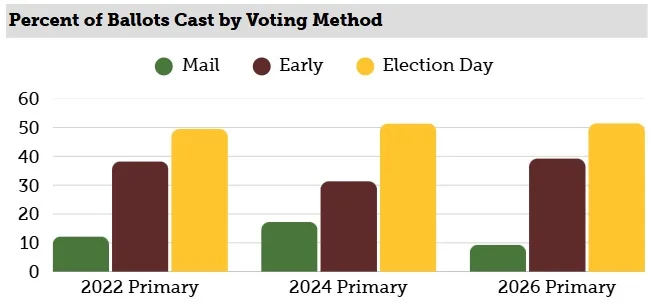
For example, she said, a slightly higher proportion of voters cast their ballots early in-person this year compared to both 2022 and 2024.
Schmidt said after the vote canvass on Friday that her advance voting setup — with the new sites, standard hours for all locations and more drop boxes — does a good job of providing voting opportunities more evenly throughout the county.
Changing back now and reinstating the 8 closed early voting sites for the November general election would cause confusion.
“Change is not good. We’re trying to make them uniform and standardized,” she said.
Schmidt used the county election office in Olathe as an example of that. Although the office has not been a voting location on Election Day for years, Schmidt said people still show up there every year looking to vote.
“If we move a voting place, oh my goodness. We try not to ever do that,” she said.
She acknowledged the concerns but countered that this is the first year all early voting locations were open for the same hours, “serving all voters in the county.” In previous elections, some early sites were not open for all of the hours possible during the advance voting period.
Schmidt said the new arrangement had locations consistently available for the largest number of people in all areas of the county. There were no long lines, she said. When the changes were made, she also said the locations of dropboxes for advance paper ballots are easier to remember because they are mostly at libraries.
The number of dropboxes was doubled, from eight to 16 for this election, and Schmidt told commissioners she hopes to add two more at Olathe libraries for the general election.
Below is a graphic depicting a comparison of voting methods over the past even-year primary elections.
Final election statistics
- Registration — There were 151,116 voters registered as Democrats, 185,600 as Republicans and 135,434 as unaffiliated with a party. Although Republicans led in total number of registered voters, more Democrats cast ballots than Republicans this year, 83,161 to 75,383. That translated into a 55% turnout for the Democratic Party and 40.6% for Republicans. In 2022, Democratic turnout was 71% and Republican turnout was 63%. The election office did not yet have a breakdown on how many unaffiliated voters registered with a party in order to vote in the partisan races. Kansas law allows unaffiliated voters to register under a party at the polls in order to vote in partisan races, but those who were registered with a party could not change at the polls. Voters who insisted would have been given a provisional ballot, but their partisan choices would not have been counted.
- The grace period — The courts allowed Kansans to keep the three-day grace period for late-arriving ballots at least for this election. In recent elections, mailed ballots that come in during the three days after the election have been counted as long as they were postmarked by the time polls closed on Election Day. The state legislature repealed the grace period for elections this year, but that repeal was temporarily blocked, so it was still in existence for the primaries. Its eventual end has had some people concerned because of complaints of slow postal delivery. In March, 1,008 ballots in special mail-in municipal elections were too late to be counted. Those elections were under different rules and had no grace period. Schmidt said election workers received 252 ballots during the grace period after the August 4 election. Those votes were included in her summary of provisional ballots.
- What to count or not to count — During the canvass, the county commission, acting as the election board, reviews the election commissioner’s recommendations on which provisional votes should be counted, not counted or partially counted. Those recommendations are based on several factors. For instance, a voter who didn’t have ID at the polling place can have votes counted by presenting the ID soon to the election office. But if that doesn’t happen, the vote isn’t counted. Schmidt recommended 1,676 ballots that were cast provisionally be counted, 559 not be counted and 861 be partially counted. Partial counts can happen if, for example, the voter shows up at the wrong polling place and casts votes in out-of-district elections. Commissioners voted unanimously to follow Schmidt’s recommendations in every case. They were Chair Mike Kelly and Commissioners Janeé Hanzlick, Becky Fast, Julie Brewer, Jeff Meyers and Shirley Allenbrand. Commissioner Michael Ashcraft designated Becky Jones, deputy director of financial management and administration for the county, as his proxy vote. The same members also voted unanimously to certify the overall results.
- Pick a card — Sometimes ties during the vote canvass are decided by a flip of a coin. During the final part of the canvass Monday, it took a slip of paper drawn from a bowl to decide a three-way tie of write-in votes for Aubry Township Clerk. Republicans David Webb, Dawn Christy and Jay Cook each received three write-in votes for the job. Kelly drew Cook’s name as the electee. The clerk position will appear on the general election ballot for a final vote in November. In the race for Spring Hill township clerk, Tara Combs was the only person to receive write-in votes. But she received them from both Democratic and Republican ballots. Combs received seven votes from Republicans and three from Democrats. Schmidt said Combs will select which party she wants her name to appear under on the general election ballot.