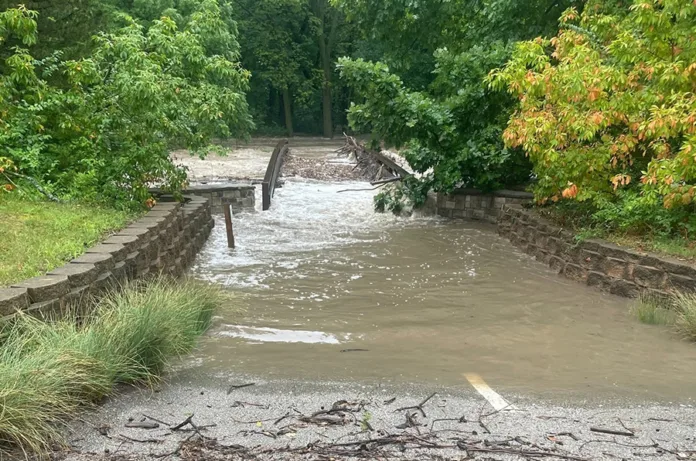
Correction: This story was updated at 2:37 p.m. Sept. 8 to correct the location of one of the flood-prone areas in Leawood. The area near B.J. Collins’ home on Wenonga Lane that also experiences flooding is between Cherokee and Pawnee streets from about the 12700 block to the 13000 block, not from 199th to 133rd streets.
B. J. Collins points out the ring of white tape on a utility pole across from her home on Wenonga Lane in Leawood. The tape, more than waist-high, is the high water mark from a particularly bad year of heavy rain a few years back.
“Lake Wenonga,” her neighborhood is sometimes called — a reference to the muddy runoff that has at times pooled up in the basin created by her street’s topography.
“It’s scary when it starts to flood,” she said on a May afternoon reprieve from a rainy spate of weather. A video she shared of a 2024 storm showed rapids rushing down her driveway, surging downhill into a valley of the Leawood Country Club golf course, directly behind her house.
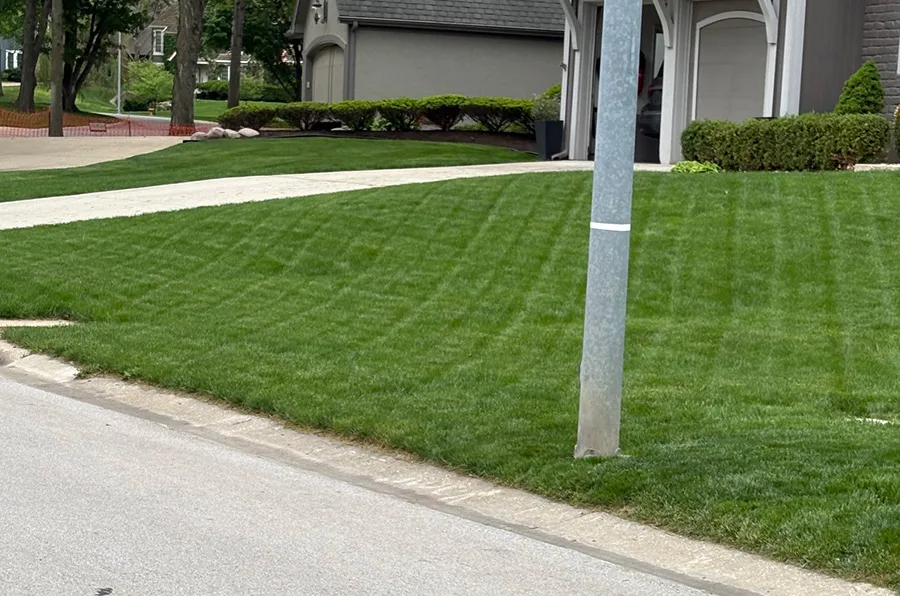
On the same day, in another flood-prone area, Jane and Bill Leverich were bracing for a different kind of water problem. Their house in Leawood Estates, just north of Interstate 435, gets water, too, when the rain hits hard enough.
The Leveriches and neighbors say their street can look like a fast-flowing river during the big storms. One particularly hard storm six or seven years ago sent water flooding into the cul-de-sac, turning their backyard into a swamp, Jane Leverich said.
Below is video footage from a 2024 flood event near Wenonga Lane, courtesy B.J. Collins.
When storms are predicted, Jane Leverich said, she sometimes gets a call from her daughter in Dallas, asking, “How high is the river?”
Spring rains this year went easy on the Wenonga and Leawood Estates, but as changeable fall weather and a strong El Niño approach, residents in Leawood’s flood-prone zones may once again be casting a nervous eye toward the weather radar and checking on their standing supply of sandbags.
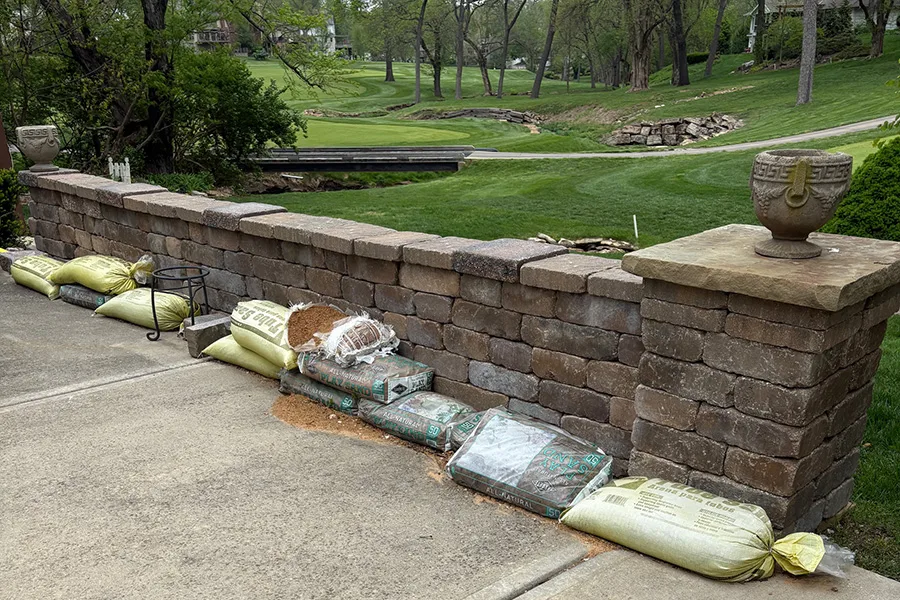
City staff and councilmembers have fixed their sights on neighborhood flooding, crumbling corrugated metal pipes and creek flooding.
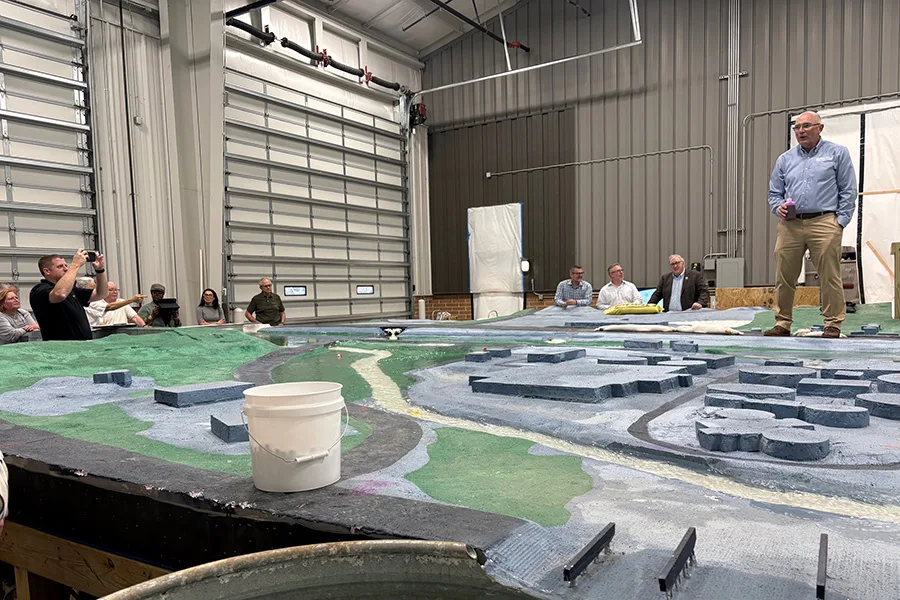
But the solutions won’t be easy or quick. So far their efforts have involved raising the roadbed of Tomahawk Creek Parkway and a 3-D flood model big enough to fill a maintenance shed room and float toy boats.
In the coming weeks, city leaders may also consider asking voters for a special tax to raise money to replace the failing corrugated pipes.
The privilege of the streams
Just about every community in Johnson County deals with stormwater issues, but in Leawood the topography makes the runoff a particular challenge.
Two major waterways — Tomahawk Creek and Indian Creek — run through Leawood, and city leaders have been careful to maintain their streamways while also looking for ways to minimize flooding, said Mayor Marc Elkins.
“Stormwater management is probably a bigger issue for Leawood than it is for at least some of the other cities because so much of that watershed drains through Leawood,” Elkins said. “(The creeks) drain 64 square miles of watershed above us, and we get the privilege of dealing with the water that is shared with us by surrounding communities.”
That water ends up near Interstate 435, where Tomahawk and Indian creeks merge. The result is beautiful streamways and walking trails, but also, sometimes, inundated streets and backyards.
Super El Niño

The runoff issues are nothing new. City officials have dealt with the flooded streets and complaints for decades, but progress has been slow going. The Leawood Estates neighborhood north of I-435 near Lee Boulevard documented children floating in rubber rafts on Pawnee Lane after a 1980s storm, and heavy storms still trouble that area. Corrugated metal pipe replacement has been an ongoing project since 2016.
There are several reasons for the lengthy timelines. Finding solutions usually involves detailed analysis of how the water’s moving, along with cooperation from residents on easements and from other funding sources like the county and federal government.
“In stormwater, one of the challenges for every community is finding a funding path, a funding strategy,” said Tom Kimes, senior project engineer for Leawood. “Stormwater projects are often quite expensive.”
Visibility also makes a difference. High water issues can also drop off the public’s radar when the weather is dry, Elkins said.
“Most stormwater issues are underground, so they’re not obvious like potholes in the street,” he said. “When you have a series of these significant storm events, they get to the top of everybody’s mind.”
They reached the top of mind in 2024. That year’s heavy rain events caused widespread flooding throughout Johnson County’s streamways and low spots.
This year, news of an impending ocean anomaly called Super El Niño has sparked concern. Although Johnson County underwent a hot and dry period in late August, the warming ocean of an El Niño has caused concern among forecasters because of the chaotic and hard-to-predict patterns and the fear that it might cause more intense storms in coming months.
Elkins hopes the city can pick up the pace. To that end, city officials have been studying the causes and possible solutions to its flooding woes.
A race against sinkholes
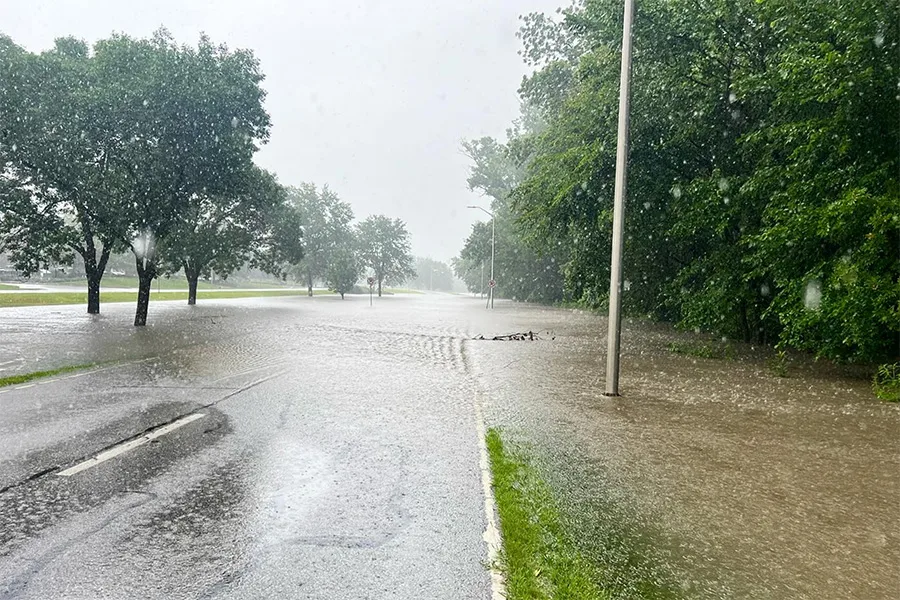
Top of the list this month will be the aging network of corrugated metal pipes that threaten to undermine city streets, causing sinkholes. City staff and councilmembers have been considering whether to ask for a sales tax that would speed up their replacement.
Corrugated metal pipes were buried under Leawood streets from the late 1960s through the mid-1980s.
Since the lifespan of the pipes is about 50 years, the city is now reckoning with pipes that have rusted through or caved in. The staff handles about 10 reports a year related to sinkholes caused by the deteriorating pipes, according to a staff report this spring.
The metal pipe is being replaced with concrete, but very gradually. There were 105,000 linear feet of corrugated pipe in 2015. Using a combination of bonds and proceeds from the local 1/8-cent sales tax over the years, Leawood has managed to bring that down to 90,000 linear feet.
But it will take another 55 years at the current $1.5 million annual spending rate to replace the rest of the pipe. Councilmembers are now considering a new sales tax to replace the one-eighth cent with a higher rate, possibly 5/8ths of a cent for 10 years.
Nothing has been decided yet, but during a recent work session, councilmembers exhibited a willingness to consider the higher rate and extend the scope of the tax to include upgrades in some police equipment.
The discussion is set to continue at Tuesday’s Leawood City Council meeting, where an estimate on how many years of replacement work a 5/8-cent tax would buy may be presented. The agenda also shows the council is prepared to vote to set a date for a sales tax election next year.
“Lake Wenonga”
It’s easy to see why a big storm could cause a pond to form in the middle of Wenonga Lane between Pawnee Lane and Cherokee Lane.
The road dips down from both the northwest and southeast, creating a low spot in the middle. The Leawood Country Club golf course sits in an even lower valley to the east, with Collin’s driveway being one point where water can drain to the golf course from the street.
During the heaviest rain events, water also forms big puddles over golf course greens. The rush of water from repeated heavy storms has moved a masonry wall separating the patio from the course by an inch and a half, Collins said.
Two summers ago, water in the neighborhood got high enough to float a work van.
Below is another video submitted by B.J. Collins of flooding in her backyard.
But it’s not just Wenonga Lane that is afflicted. The whole area is between Cherokee and Pawnee streets from about 12700 block to the 13000 block. Response to a city questionnaire showed residents mentioned 19 street locations that flood. The same questionnaire said Wenonga Lane flooded several times per year.
The city has been hearing about issues in the neighborhood since at least 2013, but a fix has been held up since then partly because of the COVID-19 pandemic and partly because of difficulties getting easements, said Leawood Public Works Director David Ley.
Prior to 2017 or 2018, city officials had assumed easements for stormwater projects would be donated, as a consideration for the work the city would be doing to improve water issues, Ley said. Residents apparently felt differently, with many negotiating for compensation or modified plans.
The city decided to start paying for easements but still had trouble getting all the necessary permissions. Ley said the project was delayed in 2021 when public and private economic activities ground to a halt during the pandemic.
The city has made some progress since then. Officials hired a civil engineering firm to come up with a watershed-driven plan that didn’t rely solely on increasing the size of the pipes.
Now they plan a $5.5 million bypass on Pawnee Lane to reduce the flow of stormwater that now heads to the golf course and Wenonga. There’s already metal pipe under Pawnee Lane that will need to be replaced anyway, Ley said.
The design approval and easements still need to be gotten, and the county stormwater management needs to weigh in, but barring major snags, the work could begin as early as next spring.
Long-standing water problems in Leawood Estates
The neighborhood just north of I-435, between Mohawk Lane and Lee Boulevard, presents what may be the most complexity when it comes to finding a solution for chronic flooding. There, a series of north-south running streets just below 105th Street have had flooding issues since the 1980s.
The city’s background documents include pictures of children rowing inflatable rafts on Pawnee Lane in the mid-1980s.
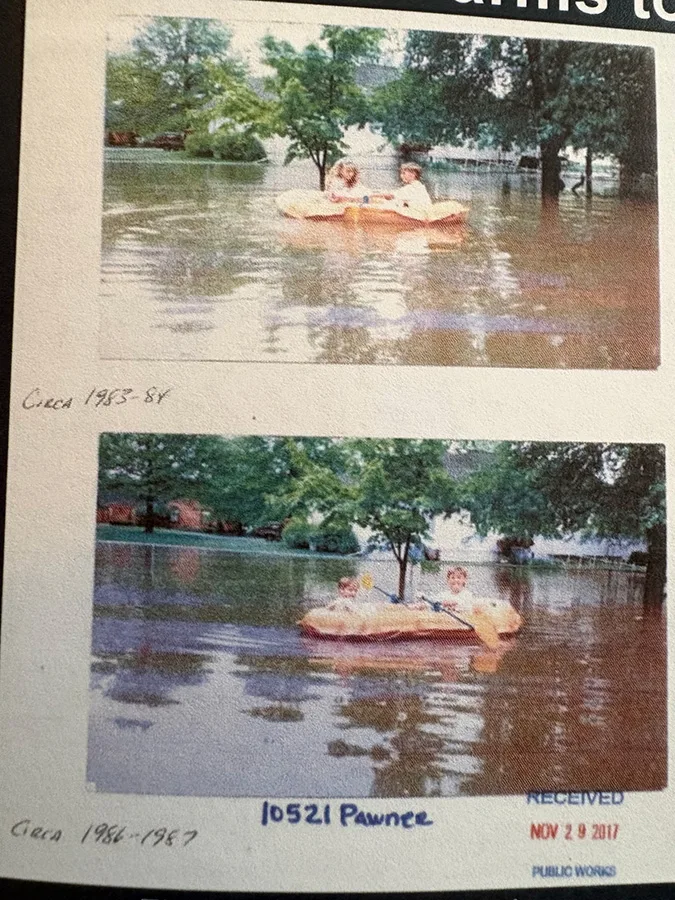
One street over, on Cherokee Lane, the Leverichs recall flooding seven or eight years ago, when the whole cul-de-sac at the end of their street flooded. After 31 years in the house, Jane Leverich said the couple has learned to keep sandbags handy.
“We all have sump pumps,” she said of residents along the street.
The problem is, again, topography. Water runs downhill from the north, past the cul-de-sacs at the ends of the streets until it gets to the highway sound barrier.
The barrier has drainage culverts taking water further south, but there’s a timing issue. Public works officials say that if Indian Creek, south of the barrier, rises fast enough, water that would have gone through the culverts backs up instead, eventually pooling up in yards.
Things are further complicated by the Federal Emergency Management Agency floodplain maps. Some houses in the neighborhood had been identified as being in the FEMA floodplain in 1977 but were removed in 2010 for unknown reasons, according to county background documents (See below).
 Loading...

 Reload document
  Open in new tab
 Since then, construction at the Tomahawk Wastewater Treatment Plant has triggered an update of the maps, and 12 homes north of the interstate are expected to be added back into the floodplain, according to city background documents.
Being included on a FEMA flood map can trigger a requirement for mandatory flood insurance in some circumstances and can affect resale value.
The 1970s FEMA maps were based on 1950s data, but in the last few years, the federal agency has been revising them for better accuracy, Elkins said.
“As a result, areas that were not viewed to be in the floodplain 20 years ago are now squarely in the floodplain,” Elkins continued. With today’s FEMA maps, “I think some of those homes would not be permitted to be built today, or if they were permitted to be built, would require extremely high flood insurance.”
Just before the pandemic, the city presented some alternatives to the county that included a buyout of the homes or a new sewer line down the south side of I-435 that would connect to the drainage culverts and take water away from the neighborhood. But the county funding would not pay for the more expensive sewer line, he said.
Solutions are pending, but home buyouts are still an alternative, Elkins said.
Progress slow but ongoing
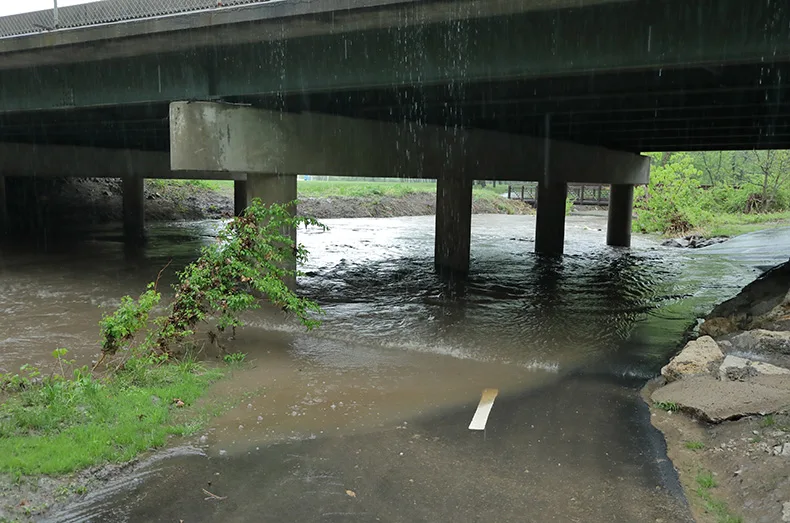
Elkins points to the area south of I-435, running down Tomahawk Creek Parkway as an example of the city’s progress in addressing flooding problems.
The area, dotted by ponds, is near where Indian Creek and Tomahawk Creek converge, and it’s also seen its share of flooding.
Heavy rains in July 2025 brought widespread floods that prompted Leawood to temporarily close all trails and the main entrance to Leawood City Park at 106th and Lee Boulevard, as well as the Leawoof Dog Park and multiple trailheads to Tomahawk Creek Park.
But major work on Tomahawk Creek Parkway that included raising sections of the road above the 100-year floodplain and creek channel enhancements have kept the road open during this year’s rains, Elkins said.
The city has also been working on a master plan on the Indian Creek streamway from Mission Road to State Line Road. As part of that, the city partnered with the U.S. Army Corps of Engineers to create a large 3-D model of the area and ran water through it to better understand how the streams were moving and affecting nearby buildings.
Also, the city has set regulations that would prohibit construction that raises the level of water in a floodplain by a foot, Elkins said. This is particularly important in north Leawood because of the number of teardowns and rebuilds, he added.
“That’s faint solace to those folks that have really wet yards for extended periods of time,” Elkins said. “But we are making progress and we do have standards in place that, as we go forward, will help.”
In the meantime, flood-weary residents may, like Leawood Estates resident Tom Carpenter, consider future options.
“I’m going to think about being on top of a hill next time,” he said.
Keep reading: Rusting pipes, outdated police tech drive Leawood to consider higher sales tax