Leawood voters will decide this spring whether to allow the city to charge a five-eighths cent special sales tax dedicated to replacing corrugated metal stormwater pipes and updating equipment in the police and fire departments.
With one councilmember absent, the Leawood City Council unanimously approved the measure, which calls for a March 2, 2027 vote. If approved, the tax would go into effect Oct. 1, 2027 and expire in 10 years.
How they voted:
Below is a breakdown of how councilmembers voted for the special election.
• Mary Larson: Yes
• Sherrie Gayed: Yes
• Rachel Rubin: Yes
• Matt Peppes: Yes
• Lisa Harrison: Yes
• Julie Cain: Yes
• Alan Sunkel: Yes
• Steve Kaster: absent
The tax would replace the existing one-eighth cent sales tax for stormwater and street mill overlay, which was originally approved by voters in 2000 and has been renewed four times since.
That tax has been split between the pipes and street resurfacing and would expire in June of 2028. But flooding and sinkholes from collapsing steel pipes and the expiration of another source of sales tax revenue have added a sense of urgency to replacing it.
Why is the city looking to raise taxes?
The city had been receiving a share of the county-wide sales tax that paid to build the courthouse and medical examiners building. That tax is due to expire at the end of March 2027. The amount of money it brought in for Leawood amounts to about $1.5 million, about the same as the current city tax for pipes and streets generates.
Pipe replacement was already going slowly, even with the courthouse tax money in the mix to pay for other things. Since 2015, city crews have steadily replaced 15,000 linear feet of steel pipes with concrete.
There are now about 90,000 remaining linear feet left. But at the current pace, it would take 60 years before all could be replaced, according to staff studies of the issue.
By swapping out the one-eighth cent sales tax for five-eighths, councilmembers saw a chance to take care of 60,000 linear feet of the remaining pipe in 10 years.
The higher tax would bring in about $8 million a year in revenue, which would be divided between the stormwater pipes, street resurfacing, and technology and facility upgrades in the police and fire departments.
The breakdown for the first full year of the tax allocates $4.9 million for stormwater, $1 million for streets, and $2.37 million for public safety.
Repeated flooding is top of mind
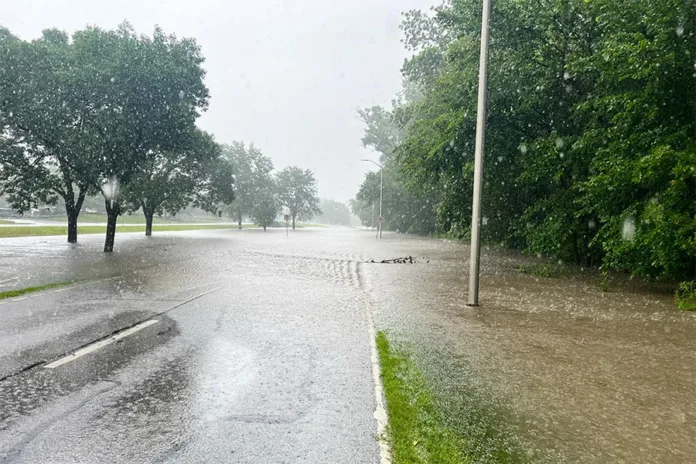
Councilmembers expressed concern about repeated flooding during the relatively brief discussion of the measure. Several said they’d like to see the city move faster than it has in the past.
“I do not think we can wait that long to replace all the corrugated metal pipe,” said Councilmember Sherrie Gayed. “Any way we can speed that replacement up, I think, is well worth it.”
Added Councilmember Mary Larson, “I’ve seen firsthand what failure of corrugated metal pipe looks like in someone’s back yard and I can’t in good conscience allow that to happen to some other resident.”
The city council opted for mail-in ballots rather than in-person voting, partly because they’d been told two school districts in Leawood — Blue Valley and Shawnee Mission — expressed interest in mail ballot elections on the same day. Having both types of elections going on at the same time in the same place would be confusing to voters and not acceptable to the county election officials, according to a staff presentation on the ballot question.
Sending out ballots with both the sales tax and school questions could potentially save money because the districts and the city would share the $70,000 cost of the election, they were told.
Keep reading: Leawood residents have dealt with flooding for decades. Will a higher sales tax help solve their problem?