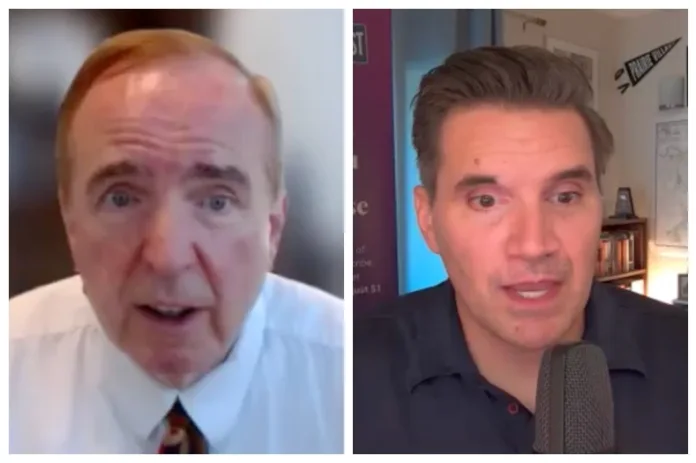
This campaign season, Post editor Kyle Palmer has extended one-on-one Q&A offers to all candidates running for statewide offices, including U.S. Senate, Governor, Attorney General, Secretary of State, and Kansas State Board of Education.
We will publish videos of Kyle’s full interviews and an edited transcript of his conversations as each candidate responds.
Look back at Kyle’s past interviews with U.S. Senate candidate Adam Hamilton, gubernatorial candidate Cindy Holscher, Secretary of State candidates Jennifer Day and Scott Morgan and Kansas State Board of Education candidates Amy Diediker and Jim McMullen.
If you value election coverage like this, consider signing up for a trial offer to get the Post for $1/week for six months.
Most of the attention in this year’s U.S. Senate race in Kansas has gone to Republican incumbent Roger Marshall and Democratic Leawood pastor Adam Hamilton.
But there’s a third name on your ballot: Libertarian David Graham, an Overland Park attorney and Shawnee Mission North grad.
With polls showing an increasingly close contest between Marshall and Hamilton, whatever votes Graham garners could matter significantly, but he says he’s not running to be a spoiler.
David Graham joined Post editor Kyle Palmer to talk about why he’s running and what his campaign message is.
Watch the full interview
Read the highlights
The transcript below has been edited for clarity, length and grammar.
Post: Most of our readers may not have heard your name, but you are a Johnson County guy, a Shawnee Mission North grad. Give us the short version. Who are you, and why are you running?
Graham: I did graduate from Shawnee Mission North High School, and then I went to Washburn University in Topeka, where I got a BA in political science and philosophy. I then went to KU for law school and got my JD there. I have been practicing law since then. So that’s my education. My dad was a truck driver, and my mom worked retail. I have a blue-collar background, even though I work in a white-collar type job now. I’m running because I want to give the voters a choice. In this case, it’s a very stark choice between two candidates who agree — although to different degrees — to have bigger government and higher taxes versus me. I want less government and lower taxes.
Post: We’ll get into some of those policy prescriptions and your policy priorities, but I’ll ask what might be the prototypical question for a third-party candidate when there’s a close race between the two major parties. These polls between Marshall and Hamilton show an increasingly close race, within the margin of error in some cases. So if you garner 3% or 4% of the vote, it could be very consequential. Do you see yourself as a spoiler?
Graham: I’m not running to spoil. I’m running to win. Make no mistake about that. I am running to win this election. I will tell you that I have been contacted by a lot of people who say, “Thank you for running because now I have someone I can vote for in this race.” The people who are going to vote for me have already come to the conclusion that they cannot vote for Roger Marshall, and they cannot vote for TV preacher Adam Hamilton. They tell me that. A lot of times people say, “Well, if you weren’t in the race, who would these people vote for?” They probably skip that race or not vote at all. To the extent that I quote-unquote “take votes away” from someone, I really believe that I’m taking them evenly from the other two candidates. Now, would those people vote for one of the other candidates or not? Some of them probably would, but to that degree, I think it’s an equal split. As a Libertarian, I do stand for certain things that appeal to the right. I’m strong on the Second Amendment. I want less government, lower taxes. But I also have certain positions which the left likes. For example, I favor legalization of marijuana. So I’m not a spoiler. I’m not trying to be a spoiler.
Post: You were not invited to this now-viral State Fair debate in Hutchinson [between Hamilton and Marshall]. I believe you were in the crowd. If you had been on stage that day, what would you have said to your two opponents? What would have been your message to voters?
Graham: If I had been on stage, I would have hoped they would have put me right in the middle of those two guys, and it would have changed the entire tone of that debate. Here’s why: I’m running a positive campaign. I’m telling people what I stand for and asking them to vote for me. I’m not staring the other guy down, pointing my finger and making accusations about their lifestyle or their background, the personal issues that have nothing to do with the campaign. At the state fair, I heard a lot of talking points. I didn’t hear any proposed solutions. I’m offering solutions. So if I’d been on that stage, I would have repeated that we need to reduce government and lower taxes. Let’s abolish the Department of Education. Let’s abolish the Department of Energy, and that’s just for starters. Let’s go through and demolish the so-called administrative state with all these regulations and so-called independent agencies. Congress creates them, but they’re executive branch agencies, and they pump out regulations and regulations on top of regulations. If we abolish certain laws and abolish the regulations that go with them, that lowers the regulatory burden on industry that delivers our goods and services. You do that, the price of goods and services in terms of production and distribution go down, and that’s how I deliver affordability for people.
Post: This dates back to your 2022 campaign for [U.S.] Senate, but you have said for years that you think taxpayer-funded health care should be abolished in all forms, or at least greatly reduced, if not completely eliminated. That includes defunding Medicare and Medicaid. I think there’s probably a lot of readers who have said they prioritize health care and have called for expanding Medicaid in Kansas for years. Explain your position.
Graham: Government has created a health care crisis in this country, so I am not going to look to government to solve the health care crisis in this country. We have a free enterprise system. As long as I’ve been alive, we’ve never tried pure capitalism, a free market economy in health care. I think we should try it. I mean, what’s wrong with it? Freedom’s good for everybody. So if I’m elected, I’m going to be one of 100 [in the Senate]. I’m a pragmatist, and I realize we’re not going to abolish Medicare tomorrow, and we shouldn’t. We need to provide something for the people who’ve relied on it, but as quickly as possible, we need to move away from this.
Post: What would that look like?
Graham: Well, doctors could operate however they want. They could charge money however they want. You could work out a contract with your health care provider, and we’d have a lot less regulation. Just from my own personal experience as a person who’s been in relatively good health all their life, I have, on occasion, run into a doctor who says, “What we should do is this, but I can’t because of regulation. So I’m going to give you this drug instead of this other drug. But if this drug fails, come back and then I’ll give you the drug you ought to have in the first place.” That’s craziness. But the doctors have to do it if they want the compensation. I really believe that a free market economy where you can go to the doctor when you want, you pay him a fee that he agrees to take, that’s going to work better than all these regulations that are confusing and complex.
Post: You’ve called yourself previously very conservative. You’re endorsed by the Pro-Life Libertarian caucus. There is an emerging branch of libertarianism that is more conservative when it comes to the issue of abortion and reproductive rights. Historically, I gather that Libertarians have said that abortion is a personal decision that is up to a woman and a doctor. But you have said that you are a pro-life Libertarian. Can you explain that position?
Graham: It’s a great question. Libertarians, to put it very simply, believe you have the right to swing your arm until you get to the tip of my nose. So the question in the abortion debate is: Is the unborn child a separate human being? If it isn’t, or if it isn’t yet, then some Libertarians would believe that abortion’s OK. I happen to take the view, which I believe is the most scientifically correct, that is that at the point of fertilization you have a separate human being. Consequently, no one has a right to kill that separate human being, so that’s the debate. And I will say this: the Libertarian Party nationally, as well as our state Libertarian Party, is divided on this issue. We have the extremists on both ends, and then most people are in between. It’s just the same as in our country. We have strong pro-life people, we have strong pro-abortion people, and then we have the people in the middle. I happen to be pro-life based on scientific principles, and that’s where I stand.
Post: The economy is the top issue for a lot of Kansas voters. You’ve said inflation comes from overregulation. We’ve also seen the impacts of the up-and-down roller coaster of tariff policy over the last year or so. What do you make of the Trump administration’s tariff policy right now?
Graham: A tariff is a tax. I’m not opposed to all tariffs everywhere at all times, but there are two problems with the current tariff policy. One is, we’re putting tariffs on things we shouldn’t be, and secondly, the current administration puts the tariff on, then they take it off, then they put it back on, then they pause it for 30 days, then they lower it. It’s all over the place, and there’s no predictability in the market. I don’t think there should be any tariffs on food. I really am more opposed to tariffs than the occasional limited use of tariffs. Now, Ronald Reagan used tariffs to save the American auto industry in the late ’80s. That, I think, arguably was a valid use of tariffs, but today most tariffs are ill-advised.
Post: Is there a specific regulation that you have thought about that is potentially harmful to economic growth, either for small businesses or for families? Is there something that you would be really willing to eliminate almost immediately, or at least vote to eliminate if you are elected?
Graham: I know that there are a lot of regulations in the health care industry and the grocery store industry. But I can give you one because a friend of mine, this happened to her. I have a friend who’s a barber, and she bought a barber shop, and it’s carpeted. They are constantly haranguing her because there’s a regulation that says you have to sweep the floor at the end of every day in a barber shop. You’ve got to keep it clean, which makes sense. Well, she uses a vacuum cleaner, and it’s a very clean shop, but she doesn’t sweep it with a broom. So that would be a regulation that needs to be changed from broom-swept to kept clean, or just abolish it. She mostly takes care of elderly ladies, and who’s going to go to a shop to get their hair done if it’s filthy? Nobody. So the free market can take care of this problem.
Post: You’ve said in the past that nation-building and proxy wars have left the U.S. worse off. Should the U.S. be at war in Iran, and would you vote to cut off funding for that, or vote to limit the president’s war powers if elected to the Senate?
Graham: I favor a strong national defense, but it should be a smart national defense. The United States should only be involved in military excursions that pose a threat to the United States. So, as to the Iran War, just a couple of things. Yes, I would vote to get out of that war, but let’s have a resolution to declare war. Let’s see if that passes. The Constitution says it’s Congress that declares war, so let’s vote on this war. And if most Congress people vote for it, then our nation arguably is for it. Otherwise, we vote no. I vote “no,” and I vote no on the war in Ukraine too. We have no interest in that war, no direct, immediate interest in that war, and so I would end our involvement in that, as well.
 Thanks for reading! If you value having an independent news outlet keeping tabs on local government, schools and taxes, we're asking you to contribute to our Education Reporting Fund.