This campaign season, Post editor Kyle Palmer has extended offers for one-on-one Q-&-As to all candidates running for statewide offices, including U.S. Senate, Governor, Attorney General, Secretary of State and Kansas State Board of Education.
We will publish videos of Kyle’s full interviews and an edited transcript of his conversations as each candidate responds.
Look back at Kyle’s past interviews with U.S. Senate candidate Adam Hamilton, gubernatorial candidate Cindy Holscher and third-party Secretary of State candidate Scott Morgan.
If you value election coverage like this, consider signing up for a trial offer to get the Post for $1/week for six months.
On Nov. 3, voters in southern Johnson County and northern Miami County will choose who represents them on the Kansas State Board of Education. That’s the 10-member board that sets academic standards for every public school in the state.
The District 3 seat covers portions of all six Johnson County public school districts but primarily represents Blue Valley, Olathe, Gardner Edgerton and Spring Hill.
Republican Jim McMullen of Overland Park is vying for that seat. He’s an attorney and business owner who readers may remember for his one term on the Blue Valley school board. He won his party’s primary in August and now faces Democrat Amy Diediker of Olathe for this board seat.
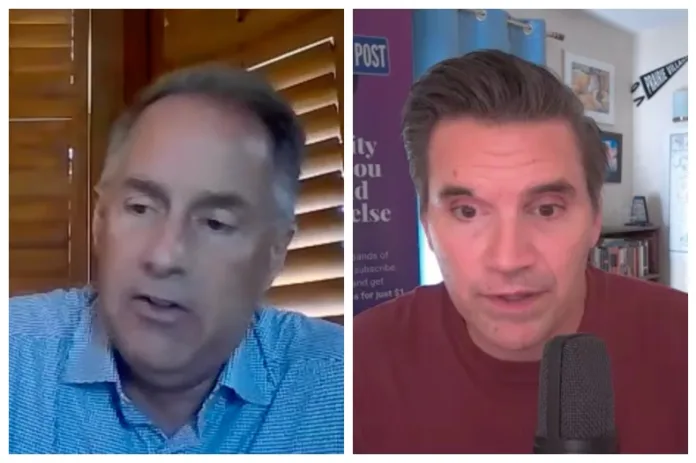
Watch the full interview
Read the highlights
The transcript below has been edited for clarity, length and grammar.
Post: Last November, you had served one term on the Blue Valley board, but Blue Valley voters did not reelect you to the school board, and now here we are a year later. You’re competing for this seat on the state board. Why should Johnson County voters send you to Topeka?
McMullen: Well, Kyle, I’ve got a pretty consistent message that I’ve taken to the public. In my 2021 campaign, my 2025 campaign and in this campaign, it’s a very similar message that I think is an important message, and that is to reorient our schools towards a knowledge-first, academic-rich environment that celebrates rigor and challenges students to be their best. The reality is our schools have not, by and large, been committed solely to that vision over the course of the last three or four decades, and so my entire purpose for doing this is: It’s an important part of the public discourse to orient our schools towards their core and fundamental mission.
Post: That phrase — “Knowledge first” — figures prominently on your campaign website. I was also struck by what you said after your primary victory, something to the effect of “schools have mistaken activity for results.” What do you mean by that?
McMullen: The reason that I say that sometimes the schools can mistake activity for results is that there is a natural tendency, because schools have children in their buildings seven hours a day, five days a week, nine months out of the year, to view the mission of the school as broader than what I argue is the fundamental objective of the schools. That effectively becomes something like mission creep. You hear phrases like, “We want to educate the whole child.” Well, that’s a loaded statement. What does that mean? There are efforts to expand beyond that fundamental objective. What I would argue is that they are fundamentally a distraction from achieving the things that we should be first and foremost committed to our children to do.
Post: You mentioned rigorous academic standards. You seem to suggest that some of these other things might be distracting from that core educational mission. What can the state board do to focus on that?
McMullen: I do think that the state board has done some very good things over the course of the last several years, but I still think it’s got a broad and a bit amorphous mission. Just as an example, in the last decade, there was the “Kansas Can” campaign that the state board championed. That particular approach to education is what I might call a therapeutic approach to education, as opposed to an academic approach to education. It leads to things like extensive grade inflation, which is not a Johnson County problem. It’s really a kind of a feature of education in the United States, public and private, where it’s just a little bit of the mentality of everybody gets a trophy, and we’re going to reward everybody’s work, so that if you’re showing up every day, you deserve accolades. That, I think, is a demotivating factor to all students. So these are the core principles in which I think we must emphasize as a state board of education leadership.
Post: More pointedly, you’ve said you’re tired of what you’ve called “stupid educational fads.” Things like whole language, DEI, inquiry mathematics, trauma-informed discipline practices. It’s a wide-ranging list of things. Seems to suggest that, again, you think that schools are too often focused on the wrong things. If local districts are choosing to implement these types of “fads,” as you call them, is it the state board’s job to intervene if you think they’re wrong?
McMullen: No, I don’t. I am in favor of our local school boards having as much emphasis, as much control and direction, because they do represent the parents most directly in their communities. But setting a particular focus and example at the state level that schools or school districts are expected to adhere to does allow for leading by example. So at the end of the day, you diffuse the ability to execute well if you cut off the local school board at the knees. Some level of freedom is absolutely warranted, but the state school board does exist for a reason. It is constitutionally established under the Kansas Constitution, and the members of the board should embrace that mission.
Post: What do you attribute to this well-documented decline in student performance? Not just in Kansas, not just in Johnson County, but writ large over the United States over the past several decades. Test scores have gone down, ACT scores, whatever metric you want to use. Is it these “fads” distracting from educational performance? Is it other things? What do you attribute to that?
McMullen: I think one must recognize that the culture has changed. We are so much more technologically connected. You can almost track the rise of the smartphone and social media to declining reading scores. I’m in my 50s. If you ask an average 50-year-old if they read as much now as they did 20 years ago, almost all of them would say “no,” because they spend more time engaged on their phone, maybe reading 180 characters at a time but not full-length pieces of writing. There’s a definite impact on that in terms of student performance, but you can only control what you can control. And so we can’t control the culture, but we can respond to what’s occurring and try to put objectives in place that we think will work. I’ll use a brief example. If you went back 25 years to the national reading scores for students in Kansas in elementary, middle and high school, Kansas placed in those scores around the top 10 in the United States. These days, Kansas is somewhere in the middle of the rankings. You know, around 25 to 30. Mississippi, which is where I first taught, was 49th or 50th in the country 25 years ago. They implemented a fair number of changes at the state level regarding curriculum 10 years ago, and Mississippi has gone from the 49th or 50th place in reading scores to the top 10 in the United States, and they’ve done that spending about $3,000 less per pupil per year than Kansas does.
Post: Next year, in June 2027, the current state funding formula expires. This board will help shape what replaces it. You just mentioned, or at least suggested, that it’s not always funding directly correlated to performance or better outcomes. What should the new funding formula do and emphasize?
McMullen: I do have a basic principle that I think everyone should keep in mind over the course of, let’s say, 40 years. Kansas, out of its general budget, has allocated somewhere in the neighborhood of 50% to 57-58% of its general budget to K-12 education. So it’s a little bit fanciful to think that the percentage of the general budget is going to increase beyond what’s called that high end of 57-58%. It could occur. It’s unlikely to occur. So I like to deal with reality. We have two areas of funding, generally speaking, in the state of Kansas that have to be addressed. One is, let’s call it your general funding for operational needs — salaries for your teaching staff and your support staff. Then, there is also funding for your special education requirements, and those special education requirements have grown in every Johnson County district. The percentage of students that are identified as having special education needs has grown from about 15% of the student body to 20% of the student body.
Post: You agree with those fairly frequent calls we hear to fully fund education, to fully fund the state’s obligation for special education funding, which four Johnson County districts have moved to potentially sue the state over the shortfalls in that funding. Where do you land on that?
McMullen: I think the deficits in special education funding are real to the local districts: Blue Valley, Olathe, Spring Hill, Gardner, Edgerton, Louisburg. All these school districts are impacted, and that impact is driven by increased costs associated with delivering those special education services. I’m just trying to be a realist that the belief that you can quote “fully fund special education” and not basically move the chairs that are on the deck in terms of education funding. That’s not really realistic. It’s a good political talking point, but it’s not based in reality. If we do fully fund special education in the way that is talked about in the public sphere, then what will probably result is a flattening out, or even a decline in the general funding that’s allocated to schools. So that’s a real challenge.
Post: Many of our readers will still remember your time from the Blue Valley School Board, the bit of controversy that came up in 2022 when you called then-President Biden’s message about transgender visibility, in your terms, as “embracing child abuse.” After that, thousands of Blue Valley constituents signed a petition seeking your removal from the board. It didn’t come to that, but the board did eventually vote to take away your role as vice president. I want to give you a chance to maybe talk to some of those readers who associate your name with that instance. How should, let’s say, a transgender student in Olathe or Blue Valley, or their family feel if you’re representing them on the state board of education?
McMullen: My opinion on these issues is the same as it has been for the last 20 years. So what I said then is what I say now, and I was correct. The reality is, we don’t need to focus on identity or identity politics. We need to embrace every child as they are and where they are. That doesn’t mean that we advocate for false teachings. It simply means that we try to address every kid who might be shy, might be might be hyperactive, might detest school, might love school, might have conflict with their peers, might be silent and doesn’t really want to get engaged in any aspect of school life. Every one of those children is important in the school setting, so you know no child’s identity is a detriment to them. Every child is the way God made them, and we’re there in a school system to help them elevate and become a better person.
 Thanks for reading! If you value having an independent news outlet keeping tabs on local government, schools and taxes, we're asking you to contribute to our Education Reporting Fund.