While there were plenty of unexpected local results from the Nov. 3 midterm, none may have been more surprising than Democrat Kristen Schultz’s victory in Kansas House District 43.
The district, which Schultz calls a “historically red dot of Johnson County,” covers much of the southwestern corner of the county, including parts of Edgerton, Gardner and Olathe, before extending into rural Douglas County.
President Donald Trump won House District 43 by 23% in 2024, meaning Schultz’s 51%-49% victory over incumbent Republican Rep. Bill Sutton marked a 25-point swing from red to blue in two years.
Sutton has represented the district since 2012 and had never been seriously challenged, winning his previous elections by an average margin of 24%. (He ran unopposed twice, including in 2024.)
This year’s midterms were marked by a blue wave nationally that saw Democrats take control of both chambers of Congress, pick up six governorships and extend their gains down to statehouses across the country.
While Democrats in Johnson County were bullish about flipping some Republican seats and breaking the GOP’s supermajority in the Kansas House, District 43 was not one targeted by the Democratic Legislative Campaign Committee as one likely to change hands.
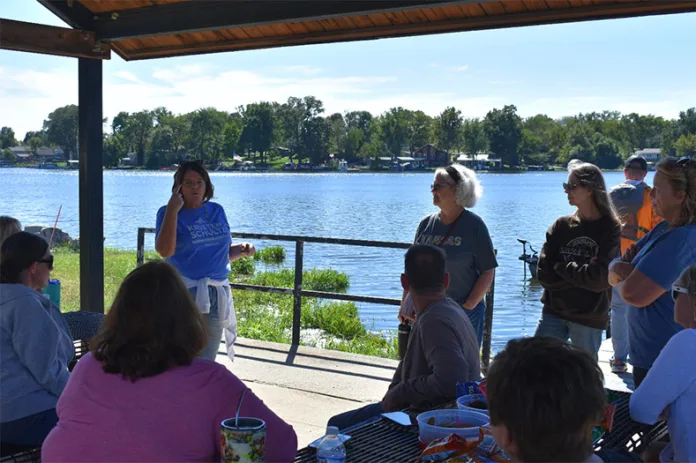
Schultz, a former Gardner Edgerton school board member, attributes her victory to what she calls a grassroots campaign — going door to door in local neighborhoods, attending city council and planning commission meetings and raising money from individual donors.
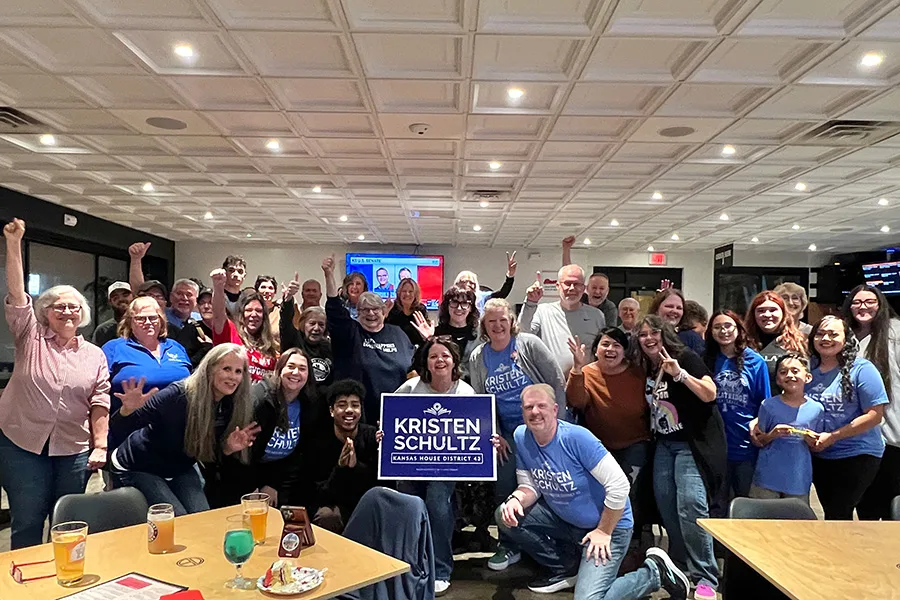
“That is a testament to people wanting change, wanting to see real results from their legislators,” Schultz said in an interview with the Post in mid-November. “They’re done with the culture wars. We want to talk about things that impact us every day, like the price for gas or the price for food.”
Schultz’s surprise victory also hinged on some key issues, most notably growing opposition to data centers and concerns about school funding from the state, that helped her build a winning bipartisan coalition.
“This district has moved to the center”
Schultz’s win is part of a greater shift toward blue in southwestern Johnson County, which former Gardner mayor Dave Drovetta said could be attributed to changes in attitude and demographics.
“I think there truly has been a shift from what I would say has traditionally been deep red to more purple,” Drovetta said. “I think this district has moved to the center.”
From Drovetta’s perspective, Schultz’s active efforts to give her district a voice were noticeable in contrast with the incumbent Sutton, who Drovetta said was largely absent from campaigning.

“I think her focus on fully funding schools was key, and her position on listening to the constituents from the standpoint of data center opposition in this area,” Drovetta said.
While knocking on doors, Schultz said affordability and cost of living seemed to be voters’ main concern, but she also had many people bring up their concerns with data centers. She said that when she also brought up school funding, people were concerned that they, as taxpayers, would be responsible for what the state wasn’t providing for the district’s schools.
Overall, she said her win was a community effort, not one driven by one party or partisan group.
“I think it goes beyond data centers,” Schultz said. “We had a 14-year incumbent, and most people didn’t even know his name. He didn’t feel moved enough by this position to make himself present in the community.”
In a phone call with the Post, Sutton said he wouldn’t speculate on what Schultz’s win means for the district.
“As to my future plans, I’ve been asked this before, and I just say that when you visit the maternity ward and a woman’s just given birth, that is not the time to ask her how many more children she wants,” Sutton said. “Too soon.”
An unlikely ally over data centers
Still, Schultz had to win over some conservatives in order to flip District 43. Conservatives like Carrie Schmidt.
Schmidt, a frequent and loud critic of local school board and city council decisions in southwestern Johnson County, has taken up data centers as a cause in recent months.
She is heavily involved in the anti-data center movement around Gardner and Edgerton. She says Sutton did not reach out to her after the city of Edgerton sued her and another resident for petitioning for an ordinance that would classify data centers as “industrial nuisances” that could cause “substantial risks to the public health, welfare, and peace.”
“I know many Republicans who voted for Democrats because they do not want these data centers,” Schmidt said. “Trump has been pushing these, and he’s Republican, so everybody else that’s Republican gets lumped into that. People just go, ‘Fine, I’m going the opposite direction because that is going to protect our land, our water, our health, the environment.’”
As a legislator, Sutton voted in 2025 for a bill that Gov. Laura Kelly eventually signed into law granting a 20-year sales tax exemption to some data center developments.
At a candidate forum hosted by the Post on Oct. 7, Sutton said it was the state’s job to put “guardrails” on data center agreements and suggested it was mostly an issue about local control.
“The city council knows much better, the county knows much better their area than I,” Sutton said at the forum. “I can’t speak to Hays [Kansas] for crying out loud.”
In her response to a Post candidate questionnaire, Schultz criticized Sutton’s vote for the data center sales tax exemption, saying the state shouldn’t offer such breaks until data center developers can show a meaningful public benefit.
But at the Oct. 7 forum, she made a similar point about local control as Sutton, saying she would defer to communities.
“There is sometimes a big discrepancy between what a representative might like and what their community wants, and our community overwhelmingly opposed data centers,” Schultz said in early October.
For her part, Schmidt, the data center opponent, said Schultz was more attentive to residents’ data center concerns during the campaign.
Schmidt admitted she has disagreed with Schultz on issues in the past — including when Schultz was on the school board — but expressed appreciation for how Schultz is visibly present in her community.
“She’s determined, and I think that she’s going to listen to the people and make herself more accessible to the people than Bill Sutton did,” Schmidt said.
School funding fired up some voters
School funding, and particularly fully funding special education in K-12 schools, was also a key campaign issue for Schultz.
Schultz called for the state to fully fund special education at the statutorily required level of 92% of districts’ excess costs. She said districts like Gardner Edgerton feel the pinch when they have to transfer genderal funds to help cover the gap created by the state funding shortfall.
“Fully funding special education is about keeping that commitment, not writing a blank check,” Schultz said in response to a Post candidate questionnaire in October.
Schultz said the state could help pay for increased education funding by reviewing corporate tax breaks and taking a closer look at state spending. She also said she’s open to exploring tax revenue from legalizing cannabis sales.
Sutton said at the October candidate forum that the state’s special education funding gap would go away if the federal government paid its full share of the costs. He also noted that education and social services already make up more than 80% of the state budget, so increasing spending would require more economic growth or cuts in other places.
“Sure, we can fund, we can throw more money at anything under the sun, but let’s take a little bit of a step back,” Sutton said at the forum.
The issue over school funding crystallized even more for some residents after the Gardner Edgerton school board in September failed to approve exceeding the revenue neutral rate for next year, scuttling the district’s recommended budget and prompting some $3 million in cuts.
Normally a routine vote, the board fell one vote shy of exceeding the revenue neutral rate, meaning the district will have to keep its property tax revenue flat next year and cannot pencil in expected increases from rising home values.

Lana Sutton, Bill Sutton’s wife, was one of two votes on the board against exceeding the revenue neutral rate, casting her vote as one that protected taxpayers’ pocketbooks.
Sam Dominguez, a Gardner parent who challenged Lana Sutton unsuccessfully during last year’s school board elections, said the board’s revenue-neutral vote was the last straw for her and other voters.
“Aside from the no data centers thing that we saw this year, this has been one of the few unifying topics I’ve seen in recent years here in Gardner,” Dominguez said. “Regardless of where we stand politically, we come together for our kids.”
Dominguez said there’s comfort in having Schultz, who used to be on the school board, as a representative in Topeka because she understands legislation’s impact on schools.
“A lot of people who would typically vote towards the right were a lot more inclined to vote for a candidate like Kristen because of what’s happening in our school districts,” Dominguez said.
A promise to keep communication open
Among all her campaign points, Schultz said her top priority is to keep her community in the know about what decisions are being made in Topeka, as well as the why and how behind those decisions.
“I’m not going to Topeka to fight with people,” Schultz said. “I want to work on the issues that matter to my community, and I think now that the most exciting part about that is we have a chance to do that.”
After a long campaign, she said she’s relieved now that the real work could begin.
“I think this is definitely signifying a turning point,” Schultz said. “But we have to come through now, right? We have to really work to fulfill some of the promises we’ve made.”
 Thanks for reading! If you value having an independent news outlet keeping tabs on local government, schools and taxes, we're asking you to contribute to our Education Reporting Fund.