A Prairie Village tree panel addressed how residents can best help the city’s aging canopy, including tips for planting and caring for trees.
Why it matters: Prairie Village’s tree canopy is a key feature of the city, according to city officials, providing shade and aesthetic appeal for decades.
- But that tree canopy is aging, and residents are wondering what can be done to preserve this well-known asset.
Background: A tree ordinance to protect Prairie Village’s aging trees went into effect in June 2021, but tree removals remain a hot-button issue for some residents.
- Residents near 75th Street and Roe Avenue were upset by tree removals in a church’s parking lot in June 2021.
- The city at that time said the ordinance did not apply to the church’s tree removals because the ordinance only applies to certain activities like new commercial or residential construction.
- Earlier this year, other residents were upset by a 75-year-old oak tree’s removal on a residential lot that was part of a tear-down rebuild project.
- For that removal, the city said at that time that the developer requested a waiver due to the site’s drainage and that the request was granted.
Tree seminar panel recommendations
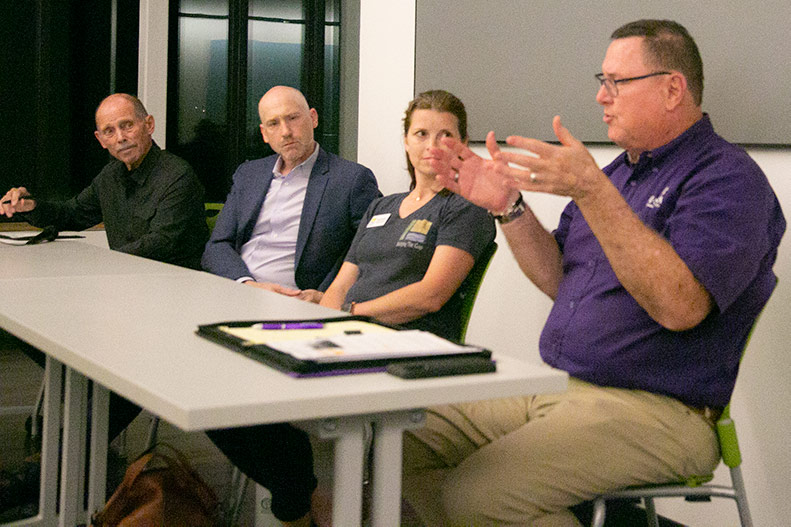
On Wednesday night, a panel of experts spoke at a tree seminar sponsored by the city aimed at offering ways Prairie Village residents could help preserve the city’s trees.
Here are some frequently asked questions the panelists addressed to help residents understand how to best plant and care for trees.
What can I do to give trees on my property the best chance at growth and longevity?
Sarah Crowder, program manager of the Heartland Tree Alliance, said proper planting can go a long way.
- Heartland Tree Alliance has planted around 35,000 trees in the metro area since the early 2000s, Crowder said.
- After two years in the ground, in most cases, Heartland Tree Alliance has less than 10% death in their trees.
- Picking a good tree for your budget and space, as well as a good spot, also impacts the growth and longevity of a tree, panelists said.
- Maintenance is a big part of ensuring a tree thrives, as well.
What types of trees should I plant?
That’s a tricky question, said Matt Stueck, vice president of Suburban Lawn & Garden, because some trees that should theoretically thrive in our climate might not, and the only way to know is to plant the tree.
- Stueck suggests researching types of trees beforehand to better understand what you’re looking for — and know that if you’re going to buy a tree during planting season in fall, it might not look full and appealing at the nursery.
- Still, Stueck and the other panelists offered their favorite underutilized trees, which for Stueck includes elms, which he called “the quintessential un-messy tree.”
- Ivan Katzer, a board certified arborist, said some of his favorites include chinkapin oak, swamp white oak and dawn redwoods.
How do I properly plant a tree?
First, Stueck said to hire a consultant to help determine the best spots on your property to plant your tree, which could help its longevity.
- Katzer also said to prepare an area 10 feet in diameter to allow for unrestricted growth.
- The bottom of the hole needs to be compact to act as a pedestal while the tree grows, Katzer added.
- Try hosing off any dirt around the root ball and plant it bare root, Katzer said, to ensure you’re planting the tree where the roots begin.
- You need no more than three inches of mulch to cover the roots, Katzer said. Anymore than that will make it difficult for water to get to the roots, he said.
What does tree maintenance look like?
A big part of maintenance is pruning, Katzer said.
- Pruning needs to be done on the ends, and is all about leveraging weight, Katzer said.
- Katzer said not to wait until the tree is towering over your house to begin to prune it, but to begin once the tree is established — at about two or three-years-old.
- Over pruning is just as harmful to a tree, though, he said, and pruning foliage interferes with photosynthesis and therefore the tree’s growth.
- Katzer and Dennis Patton, Johnson County K-State Research and Extension horticulture agent, say not to let grass grow within four to five feet of the trunk of your tree.
- This is because it causes competition for the tree, Patton said, and research shows twice the growth rate in trees without competition.
- “You don’t need grass in your front yard, you need trees,” Katzer said.
Prairie Village’s aging tree canopy is something I’m worried about. How can I help?
Crowder says the easiest think you can do is plant a tree.
- Prairie Village’s large pin oak population, specifically, is as old as the city — about 70 years.
- Crowder said there is a lot of discussion about species diversity to deter diseases, but age diversity is just as important.
- She compared an aging tree population to an aging human population, and said younger trees can help address the issue.
What if I have more questions?
One resource to begin with is the Johnson County K-State Research and Extension hotline at (913) 715-7050.
- The Heartland Tree Alliance also hosts different training sessions for orchard keeping, tree keeping and pruning.
- More about those training programs can be found online here.