The constitutional work isn’t done yet for Kansas voters.
Now that the excitement has died down from the August primary question on abortion, voters are being asked to again consider changes to Kansas’ core document.
Two more questions appear on the ballot in the November 8 general election proposing modifications to the state constitution.
Although they won’t be as high-profile as the proposal to remove the constitutional protection of abortion rights (which ultimately failed), they will be important in subtler ways to the way state and local governments operate.
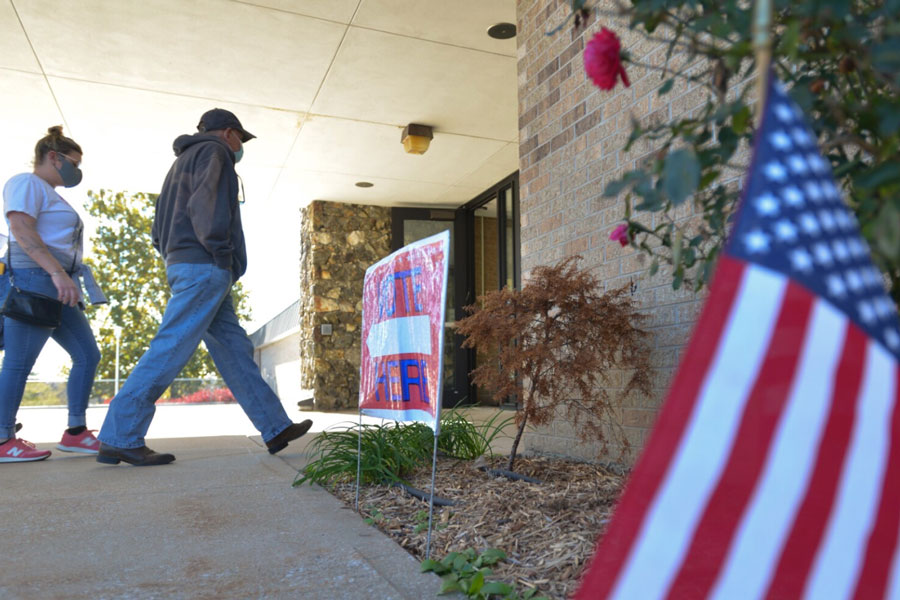
Early voting has already started, so check out this primer on the two constitutional amendment questions you’ll see on your ballot before you head out to an early voting site or mail in your ballot.
Question 1: The administrative veto amendment
Read the ballot language here.
What’s it about: This proposal digs down into the nuts and bolts of the rules on who gets to decide the minutiae of state regulations that can have a big effect on everyday life.
- Approval of it would change the balance of power between the governor, who is currently a Democrat, Laura Kelly, and the state legislature, which currently has a Republican supermajority.
- It would essentially give lawmakers a legislative veto over rules and regulations put in place by the governor.
Background: At the most basic level, the legislature writes laws and the executive branch, headed by the governor, then determines how those laws are implemented.
- The practical application of those laws covers the finer points of such things as public health, food safety and environmental rules, to name a few.
- The governor currently has veto power over new state legislation, and if lawmakers disagree, they need a two-thirds vote to override a veto.

The stakes: The state legislature does not have similar veto power over the executive branch’s administrative rules.
- Lawmakers unhappy with the rules have the option of passing new laws addressing rules, which would again be subject to veto.
- The amendment proposed by lawmakers as House Concurrent Resolution 5014 would give state legislators power to directly veto the executive rules with a simple majority.
What your vote means: A “yes” vote for this resolution would grant the state legislature more power to revoke or suspend rules adopted by the executive branch agencies.
- A “no” vote would preserve the current process and allow executive branch agencies’ rules and regulations to remain in place, unless the legislature passes new laws.
Question 2: The elected sheriff amendment
Read the ballot language here.
What’ it’s about: This amendment specifies that all Kansas counties — with one exception — elect, rather than appoint, their sheriffs.
- Currently all counties but one are already electing sheriffs, including Johnson County.
- This amendment, if approved, would remove the option of making them appointed positions in the future.
Background: The idea of an appointed sheriff came up last year during the 10-year review of Johnson County’s Home Rule Charter.
- The idea to make the Johnson County Sheriff an appointed position was suggested by one county commissioner, but the idea never went anywhere with the charter commission.
- The charter commission did briefly discuss making the sheriff’s election nonpartisan, but that idea was withdrawn because of questions about its legality.
The stakes: Even so, the idea of an appointed sheriff caused a stir among local Republicans, and state lawmakers passed House Concurrent Resolution 5022 putting this amendment on the ballot.
- The proposal makes an exception for Riley County, which combined sheriff and police departments in 1974, abolishing the separate office of sheriff.
- The amendment excludes any county that abolished its sheriff’s office before Jan. 11, 2022.
What else: The amendment also would change which officials can initiate an ouster of a sheriff for misconduct.
- Currently a local district attorney or county attorney could begin the process, called a “writ of quo warranto.”
- The amendment would specify the state attorney general as the only authority who could initiate such a recall.
- However, voters can still recall sheriffs through a petition, which requires signatures equaling at least 40% of the number of voters for sheriff in the previous election.
What your vote means: A “yes” vote would be for permanently making sheriff’s offices across the state, including Johnson County’s, an elected position and also set in place the recall process with the attorney general’s writ or a popular petition.
- A “no” vote would be for keeping open the possibility of one day making the sheriff’s office appointed, rather than elected, and also keep in place the current process for removing a sheriff from office, which can be initiated by a local district attorney.
Roxie Hammill is a freelance journalist who reports frequently for the Post and other Kansas City area publications. You can reach her at roxieham@gmail.com.