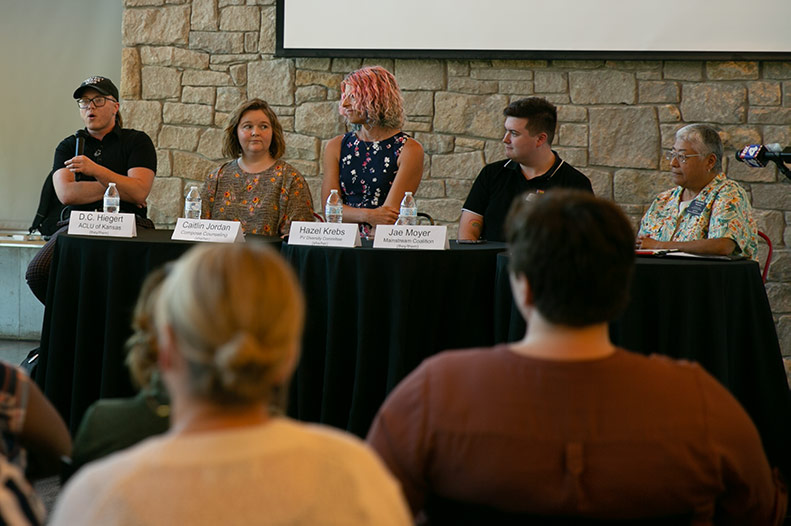
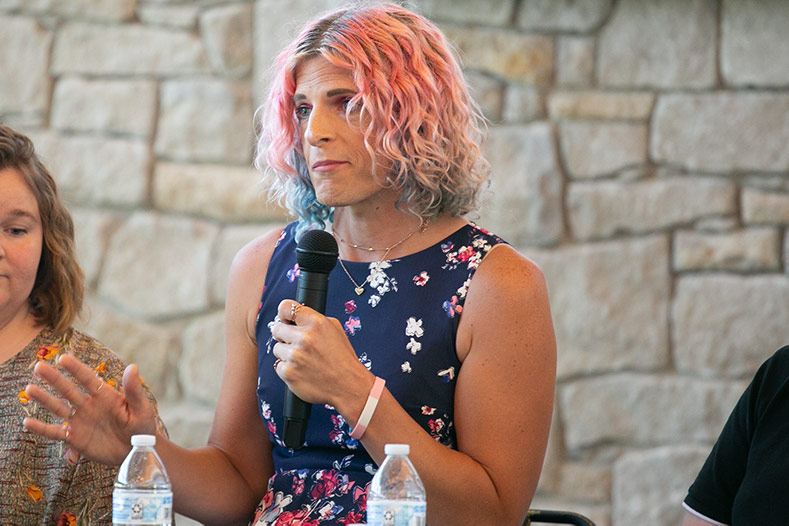
Hazel Krebs, a Prairie Village trans woman, has thought about leaving Kansas for Colorado.
Speaking at a town hall Monday night put on by the city’s diversity committee, Krebs said Colorado is making it safe for the LGBTQ community, while Kansas, her home for the past seven years, is becoming more dangerous.
Monday’s event’s at the Meadowbrook Park Clubhouse sought to raise awareness of anti-trans legislation in Kansas that is set to take effect Saturday.
Krebs told the crowd of about 50 that she had considered moving because of Senate Bill 180, dubbed the “women’s bill of rights” by supporters, which makes the state’s legal definition of male and female based on a person’s sex assigned at birth.
But Krebs said she ultimately decided to stay in Kansas and use her voice to speak out against the law.
“I have the privilege to leave, but I also have the privilege to fight,” Krebs said. “I have been activated since this SB 180. I am determined to protect the people who are not willing to be up here.”
The town hall comes days before the law takes effect
Under SB 180, women are defined as people whose reproductive system produces ova, and men are defined as people whose reproductive system fertilizes ova.
Its Republican backers say the measure is needed to protect cisgender women, but critics see it as one of the broadest restrictions on trans rights in the U.S.
SB 180 becomes effective July 1, after Republican lawmakers overrode Democratic Gov. Laura Kelly’s veto of it.
A separate law prohibiting trans women and girls from playing on women’s and girl’s sports teams is also going into effect next month over Kelly’s veto.
The same day as the diversity town hall on Monday, Kansas Attorney General Kris Kobach announced that trans Kansans’ driver’s licenses and birth certificates will revert back to their gender assigned at birth, in line with SB 180.
The law also requires people to use bathrooms that conform to their sex assigned at birth, though the law doesn’t say how such provisions would be enforced.
Panelists say SB 180 is dangerous
Democratic state Rep. Susan Ruiz of Shawnee, one of the four panelists Monday, said the narrow definitions of male and female included in SB 180 are “dangerous.”
Ruiz said the law could apply to a woman with a reproductive system that is unable to produce ova, for instance, if she had a hysterectomy.
Another panelist, D.C. Hiegert, a Skadden Fellow at the American Civil Liberties Union of Kansas, pointed out that SB 180 and similar bills lack teeth, without enforcement provisions or civil penalties.
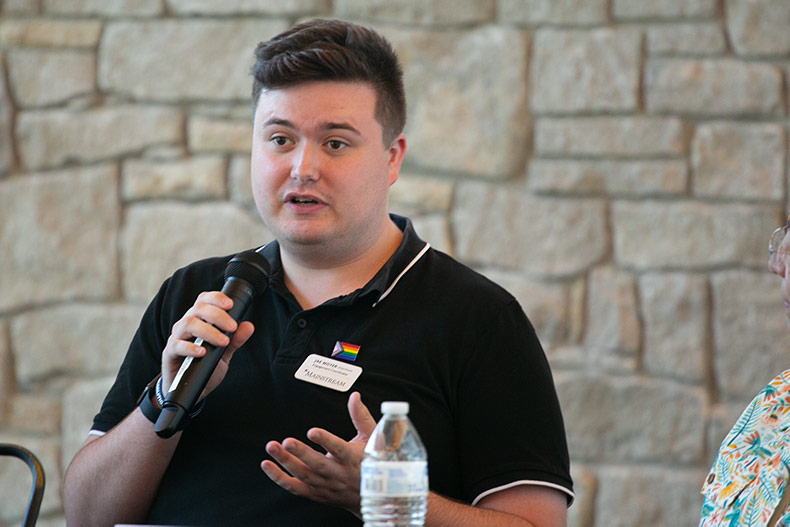
Jae Moyer, a local LGBTQ activist and the engagement coordinator at MainStream Coalition, said SB 180’s attempt to define gender identity “blatantly erases transgender Kansans.”
“It’s dismissive and it’s harmful, and it tells those members of our community that they do not belong here,” Moyer said. “So that’s the impact: They want to erase people like us from our state, and it’s harmful.”
Caitlin Jordan, a licensed professional counselor with Liberty-based Compose Counseling, said she mostly works with adolescents who are gender nonconforming, trans or nonbinary.
Jordan said there is already a disproportionate amount of anxiety, depression, suicidal ideation and suicide attempts in the queer community.
With her clients specifically, Jordan said, she has seen more prevalence of suicidal thoughts, a significant increase in self-harm behaviors and more hospitalizations.
There are ways the community can support trans Kansans
Moyer said small things such as flying a pride flag or putting your preferred pronouns in social media biographies are signals to the LGBTQ community that you are an ally.
A series of rallies statewide are set to take place at 11 a.m on July 1 to protest SB 180, Moyer said, which happens to come the day after the end of Pride Month in June, the annual recognition celebrating the LGTBQ community.
Krebs said fellow, cisgender Kansans can speak up.
“A bunch of cis people talking about trans people can get dangerous,” Krebs said. “Speak up, have the bravery to speak up and challenge people.”
Go deeper: Roeland Park adds gender transition policy to employee handbook