Each week during the 2024 Kansas legislative session, we will provide Johnson County lawmakers the opportunity to share their thoughts about what is happening in the state capitol.
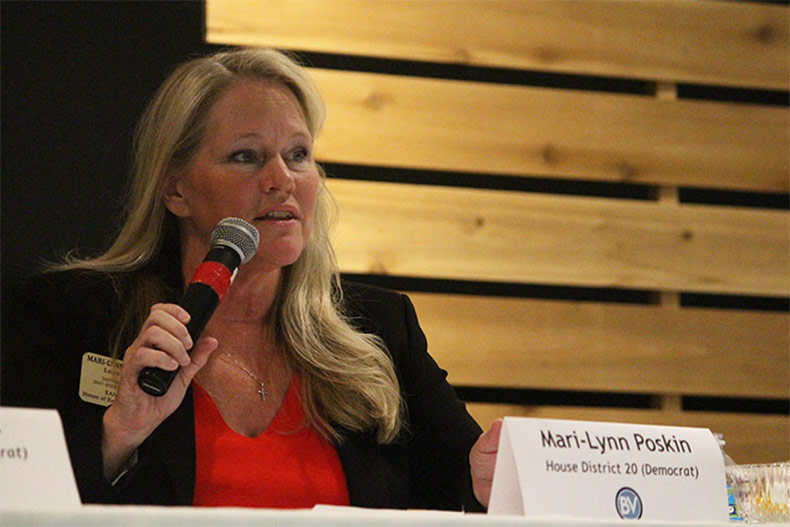
Below is a submission from Democratic Rep. Mari-Lynn Poskin, who represents House District 20 covering parts of Leawood and Overland Park.
Republican Sen. Molly Baumgardner of Louisburg and Democratic Rep. Rui Xu of Fairway have also both been asked to submit columns later this week.
The views expressed in each Capitol Update are solely those of the lawmaker.
The 2024 legislative session started with the hopeful rumor that school vouchers would be off the table, as they were so unpopular last session and it is an election year for every single legislator in the state.
I had hoped that the harmful policy plays against our schools would be minimized for the same reasons. Johnson Countians understand the critical role that our children’s outstanding schools play, not only for their future successes, but in the overall economic success of our region.
Well…I was wrong. Vouchers are back and arguably worse this time, in the form of a refundable “education opportunity” tax credits, proposed in SB 509.
Arizona is making the news for outrageous purchases and abuses using public tax dollars in its voucher program because it requires receipts. SB 509 doesn’t even offer Kansas that protective backstop. It would just hand out about $240 million (75% of State Base Aid, currently $5,088, for dependents enrolled in accredited private schools and 50% if unaccredited) for filling out an application with a dependent social security number.
It doesn’t even demand that an unaccredited option deliver instruction in “reading, grammar, mathematics, social studies and science,” as did last year’s voucher bill. Voters do not support voucher programs, as evidenced in every state that has put it on the ballot.
Voters actually want special education fully funded
What do voters support?
Well, here in Kansas, they support fully funding special education, which we heard loud and clear knocking on their doors in 2022. Surely, the Legislature is focusing on that this session, right? Wrong.
Instead, they are pushing to dismantle the SPED funding task force and to include local dollars toward the state’s statutorily required 92% of excess costs. In the 2023-24 school year, special education is expected to be funded at only 69.3%.
Because special education services must be provided under federal law, the shortfall is made up from a district’s general education funding, hurting ALL students in the districts. The last time special education was statutorily fully funded was the 2009-10 school year. The special education funding proposal this year is $80 million short of even keeping up with inflation from then.
There is a reason that the Kansas Supreme Court did not trust the state legislature to constitutionally fund general education and retained jurisdiction in the Gannon lawsuit. Unfortunately, that was recently relinquished last month.
Two other education bills are also problematic
On the policy side, Rep. Adam Thomas, Republican of Olathe, introduced two bills of significant concern.
HB 2700 would create a state level school library book review that districts would be required to implement. Parallel to Johnson County voters overwhelmingly rejecting 1776 PAC Project/Moms for Liberty school board candidates, the bill failed to garner a single piece of proponent testimony at its hearing.
At the same time, HB 2612 would allow anyone to challenge a schools district’s accreditation. During the hearing for that bill, I asked the revisor if this would allow Allie Sorenson, the Utah school voucher lobbyist caught on tape saying she wanted to “destroy public schools,” the answer was “yes.”
The embattled Oklahoma Superintendent of Schools has weaponized accreditation in Tulsa, Mustang and Edmond. We need to be incredibly wary of attempts to do the same in Kansas.
Again, the bill prompted nearly 100 opponents’ testimony and only one supporter. I urge voters to stay informed on school policy and funding as we head into the 2024 election cycle.