Each week during the 2024 Kansas legislative session, we will provide Johnson County lawmakers the opportunity to share their thoughts about what is happening in the state capitol.
Below is a submission from Republican Sen. Molly Baumgardner, who represents Senate District 37, covering parts of both Miami and Johnson counties, including Edgerton, Spring Hill and parts of Gardner, Olathe and Overland Park.
Democratic Rep. Mari-Lynn Poskin of Leawood submitted a column earlier this week. Democratic Rep. Rui Xu of Fairway has also been asked to submit a column later this week.
The views expressed in each Capitol Update are solely those of the lawmaker.
During my time as chair of the Senate Education committee, we have worked steadily to bring reforms for struggling readers with dyslexia and for school districts that have implemented new support opportunities for these students.
To recap some of those reforms:
- In 2018, the Kansas Legislature passed SUB HB 2602 which created the Dyslexia Task Force.
- In September 2020, the State Board of Education rejected the Kansas State Department of Education’s recommendation to delay implementing some of the task force’s recommendations.
- In 2021, SB 173 added students identified as having dyslexia to the list of those for which funding for at-risk programs and services was to be used.
- In 2023, House Bill 2322 added dyslexia to the list of disabilities covered by the state’s special education law.
Challenges remain, reading scores remain below 2018 levels
Unfortunately, the literacy work of parents, educators, volunteers, board members and legislators has had mixed results.
We continue to have inconsistent pockets of awareness and needed training in our universities and school districts. A result is that state reading assessment outcomes have lagged.
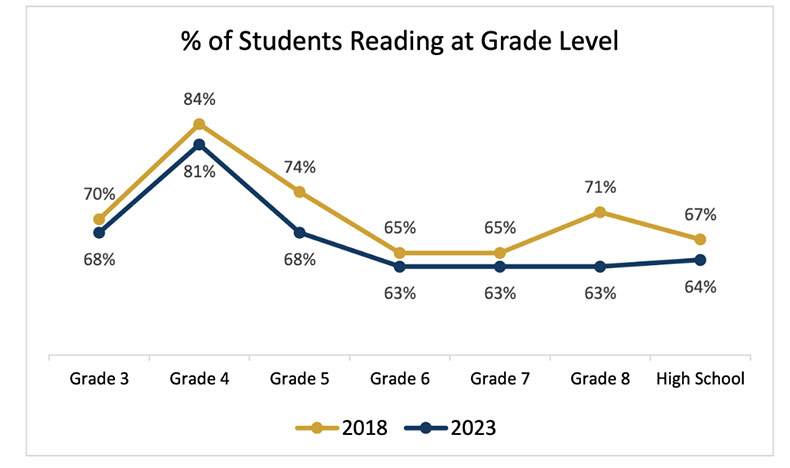
The line graph below shows a comparison of state assessment results, by grade, for 2018 and 2023.
While the reading achievement of 4th graders is consistently higher than that of other grade levels, Kansas students aren’t gaining the reading strength desired. (This graph was created by Kansas Board of Regents staff, using data from the Kansas Department of Education.)
New bill would provide “blueprint for literacy”
This session, Senate Bill 532, dubbed the “Kansas Blueprint for Literacy”, was introduced in a joint Senate and House Education Committee meeting on March 4.
It addresses the need for a comprehensive, organized approach to addressing the reading issues facing our Kansas students and educators.
SB 532 is referred to as landmark legislation because it’s pulling so many entities together to collaborate, including the Board of Regents, the education college deans at our six Regent universities, the State Board of Education, the Department of Education, the Kansas Association of School Boards, community college leaders, the teacher’s union (KNEA) and our private non-profit university deans.
Leading the charge for the Kansas Literacy Blueprint is former Kansas City, Kansas Public Schools Superintendent and current Regent, Dr. Cynthia Lane.
During the bill hearing, Lane provided this insight, “SB 532 will prove to be one of the most important bills this Legislature will consider in 2024. Our students’ ability to read is fundamental to their life’s success — in their academic career and in their life beyond school. As we now recognize, our teaching methods have not met every child’s needs, we must change course — not only in how we teach reading at the elementary level but in how our institutions prepare our teachers.”
JoCo superintendent speaks highly of effort
Olathe Superintendent Dr. Brent Yeager offered this supportive testimony, as well.
“As a district, we applaud the collaborative effort undertaken to acknowledge the foundational role of literacy for students and, equally important, recognizing that quality of instruction is critical to student achievement outcomes,” Yeager said.
He added, “In our experience, not all teachers entering the classroom have the pre-service training necessary to be effective in teaching literacy. As a result, our district has invested significant resources for in-service and professional development — and in securing substitute teachers — to help our teachers be more successful in their work with our students.”
You can learn more about SB 532 here.