The Johnson County Post will receive a $300,000 grant from the Google News Initiative to help the company expand and bring its trusted community coverage to all Johnson County residents.
The Post was among just 14 organizations selected to receive funding through GNI’s Growth Catalyst program, a partnership between GNI and the Blue Engine Collaborative focused on providing high-performing local news operations with financing and support to expand into new markets. The grantmakers received nearly 180 applications from organizations across the country for the program.
With the grant funding, the Post will be able to bring the same level of consistent, reliable, trustworthy coverage we’re known for in Shawnee Mission and Blue Valley to the Olathe, De Soto, Gardner Edgerton and Spring Hill areas.
“This transformative investment from GNI is a big step forward in our mission to build a sustainable news operation that can serve Johnson County for decades to come,” said Post publisher and founder Jay Senter. “Capital is difficult to come by in the online news space. We’re extremely grateful that GNI and Blue Engine have entrusted us with these resources and for the vote of confidence in our approach that they represent.”
The first installment of the grant funding will be delivered in the third quarter of 2025. Google’s global grantmaking policy prohibits the use of grant funds on newsgathering activities, so the money will be used on operational expenses like marketing, sales, hosting and development. However, revenue generated from the Post’s growing subscription base and its new legal notices business will allow the company to immediately open up a new reporting position fully dedicated to covering Olathe. The company expects to add a second new full-time reporter sometime in 2026.
“Getting more reporters out into the community is key,” said Post editor Kyle Palmer. “The way you find out what stories need covering is by having real live humans out in the field talking to other people who live here. We’re excited to be able to add more reporters to our staff.”
2024 saw the Post earn $1M in annual revenue for the first time

The Post’s early success with digital subscriptions attracted national attention back in 2018 and 2019, when it was the subject of coverage by Harvard’s Nieman Lab and NPR’s Morning Edition. But it’s been over the past five years that the company has seen its most explosive growth.
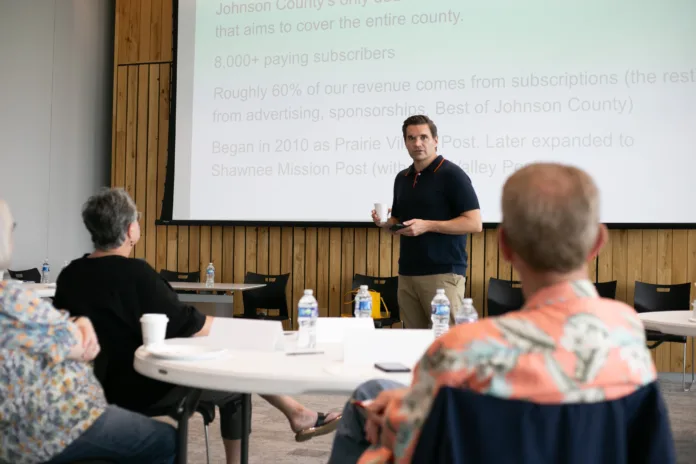
In 2020, the Post had approximately 2,500 paying subscribers and generated less than $400,000 in total annual revenue. At the end of 2024, the company had nearly 8,000 paying subscribers and had generated more than $1 million in annual revenue for the first time in its history.
The success of its subscriber-based business model has allowed the company to steadily grow its staff and provide trusted coverage of local government, business and schools to more and more Johnson County residents. The company had just four full-time employees at the start of 2020, only two of whom were focused full time on news production. Today, the Post has nine employees, with six full-time newsroom staffers.
“We’re proud to have the largest newsroom dedicated to Johnson County in nearly two decades,” Senter said. “But Johnson County is a big, dynamic place, and we need to keep growing if we’re going to fully cover everything it’s got going on. This grant is a major step forward in allowing us to do just that.”

“Readers first” approach focuses on community needs
Part of what’s made the Post a success in an increasingly difficult local media environment is its dedication to first understanding and then meeting the needs of its readers. This approach, which the Post calls “Readers First,” prioritizes the issues that matter most to the community — not to power brokers, political parties or journalists.
“Our thought is that if we’re going to base our business on subscriptions, we’d better be providing coverage that people value enough to pay for,” Senter said. “The fact is, what’s traditionally been of interest to newsrooms often isn’t of interest to the people they supposedly serve. If you’re going to provide community coverage that people really value and want in their lives, you’ve got to understand your audience, what their lives are like, and what kind of information they need.”
As part of the grant-funded efforts, the Post will organize a series of focus groups and other in-person events in the expansion markets to get a better sense of the issues that matter most to the people who live in these communities.
“Insights we’ve gotten from our community through surveys and focus groups have helped us craft and refine our coverage mix to center the biggest issues impacting Johnson Countians on a day-to-day basis — issues that often get overlooked by other media,” Palmer said.
The Post’s most recent subscriber satisfaction survey found that nine in 10 subscribers are mostly or very satisfied with their subscriptions, while 93% of subscribers say we’re trustworthy and 96% say they’re getting their money’s worth.