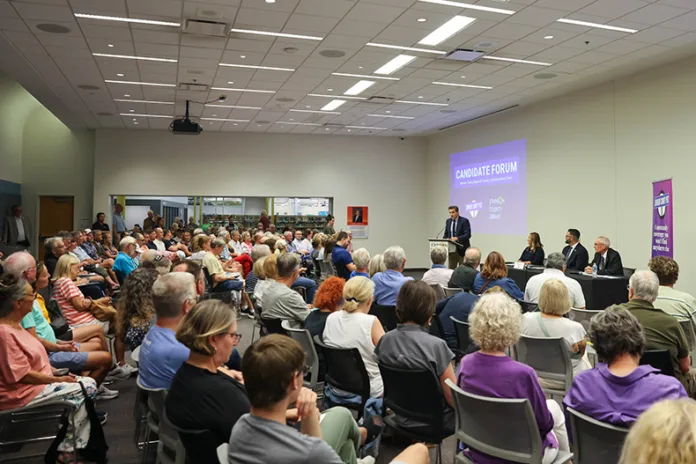
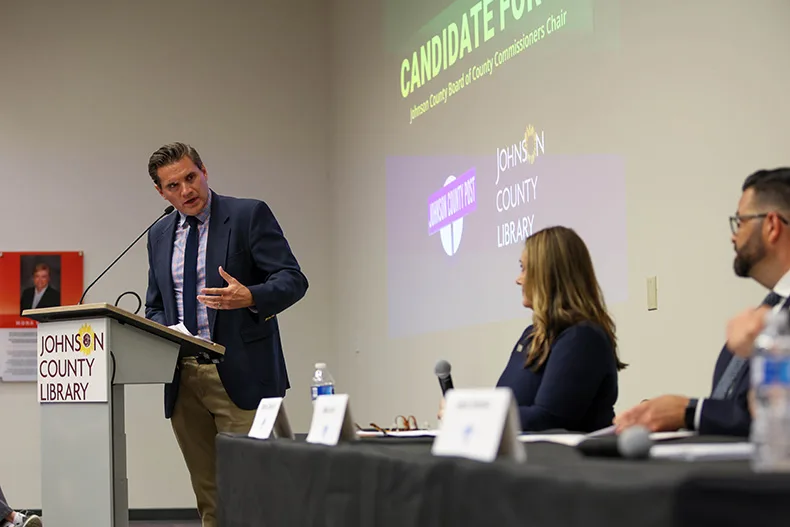
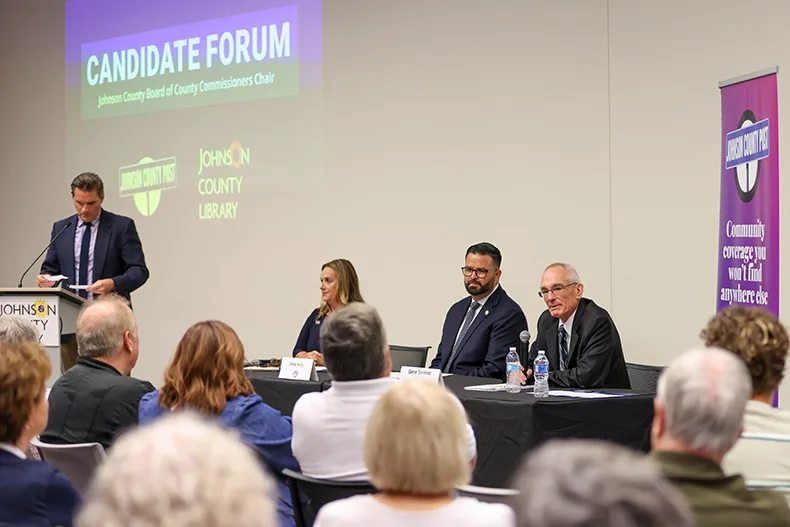
A pre-primary forum for Johnson County Commission Chair candidates drew an overflow crowd Tuesday for a lively discussion of affordable housing, election management, World Cup spending and property taxes.
The forum, hosted by the Johnson County Post and co-sponsored with the Johnson County Library, was over an hour of question and answers for Karen Crnkovich, incumbent Mike Kelly and Gene Senesac, who are running in the Aug. 4 primary. The top two vote getters will face each other in the November general election.
Questions were submitted by Post readers via email ahead of the forum, as well as submissions from the audience that evening. The full recording of the forum can be found here.
A vocally demonstrative crowd of about 180 people filled the Central Resource Library Carmack Community Room, sometimes breaking in with scoffing, loud applause or booing when the discussion wandered into topics like budget cutting or fair elections.
At one point a woman shouted “liar” at Kelly’s assertion that a recount of the Prairie Village vote to keep its form of city government was proof elections were conducted fairly.
Want to watch the entire forum? Here’s the video below:
Who are the candidates?
The county commission chair is a non-partisan race, meaning no party labels will appear on ballots next to the candidates’ names. The candidates are:
- Karen Crnkovich of Olathe, owner and operator of DMC Service Inc, a heating, cooling, ventilation and plumbing company. Crnkovich was also a candidate in the 2024 Republican primary for the nomination to oppose U.S. Rep. Sharice Davids, a Democrat.
- Mike Kelly of Prairie Village, the current county commission chair, was elected in 2022 and is serving his first term. He was mayor of Roeland Park from 2017 to 2022 and co-founded Climate Action KC, a conservation group. Kelly is a lawyer handling real estate construction and design cases at Husch Blackwell.
- Gene Senesac of Olathe, retired as director of transportation for agricultural food processor Archer Daniels Midland in 2019 and has been a consultant since that time, according to his LinkedIn. He has also served on the Olathe street maintenance sales tax finance oversight committee.
Early voting site closures
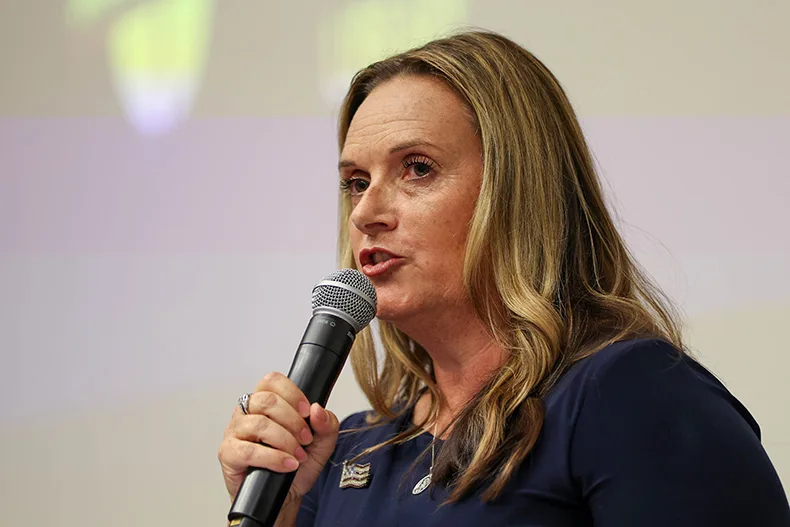
A decision by Election Commissioner Connie Schmidt to close eight early in-person voting sites in some more densely populated areas of the county while opening two on the rural fringe in De Soto and Spring Hill has sparked protest and pleas to reopen the sites for the general election.
The county commission doesn’t have authority to overrule that decision, but Kelly sent a letter to Schmidt expressing his concerns. Schmidt was appointed by Secretary of State Scott Schwab to serve in the interim after former commissioner Fred Sherman resigned in December.
Kelly — “Voting is fundamental, and we should be enfranchising as many voters as possible,” he said. “At a time when there’s national rhetoric about electioneering or rigging, we need to be doing everything we can to be transparent about the ways people can vote.”
Kelly said transparency on data supporting the change was lacking from Schmidt. “I think it’s great they’re adding locations in Spring Hill and De Soto, but it shouldn’t be at the expense of other locations in Olathe, in Overland Park or in Westwood.”
Crnkovich — “I do support the reduction in locations,” she said, adding that prior to the decision, the early voting sites had different schedules making it so confusing, voters needed a “secret decoder ring.”
“Guys, that is what disenfranchises voters,” she said. The decision makes sites open on the same days and adds substantially more available hours for voting than in the 2022 election, she said.
Senesac — said Schmidt’s decision was a hard judgment to make, then moved into election conspiracy territory.
“Just some of the things I hear on the periphery suggest that there’s some, I’ll use the word ‘nefarious’ things going on, and I think that needs to be investigated,” he said, to applause. He then suggested — without evidence — that there were irregularities in vote counting and that some numbers were “miraculously reduced or reversed and other numbers poured in.”
He was asked in a follow-up, for supporting evidence. “No, I don’t think it requires that. I’m telling you that I’ve heard that,” he replied. County election officials have maintained that election audits show the election process has been run fairly.
Kelly was given a chance to respond. “If you want to know how safe and accurate and secure the Johnson County elections are, let’s go back to just last year and talk about the recount in Prairie Village,” he said, followed by an outbreak of murmuring and one shout of “liar!”
He was referring to an election last year in which Prairie Village residents were asked whether to retain or “abandon” their form of city government. Voters rejected the abandon question by nearly 30 percentage points. On recount, the vote count was exactly the same.
World Cup spending
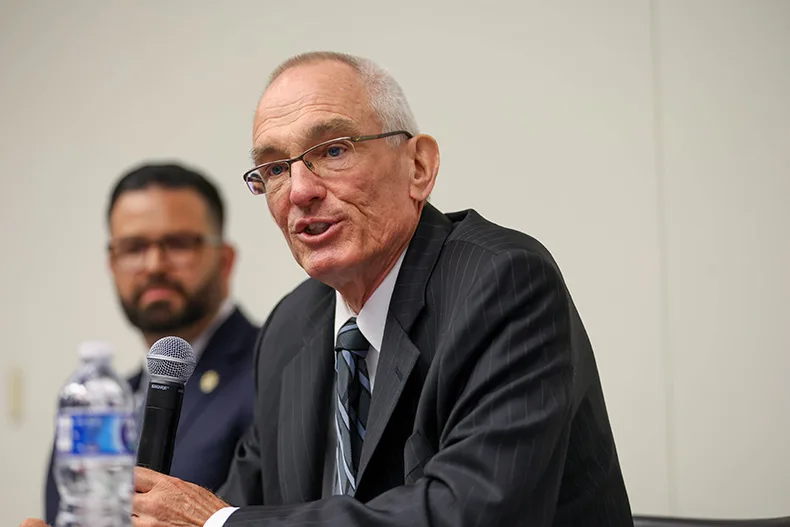
Senesac — made numerous Facebook posts this year critical of the use of taxpayer money to set up temporary bus routes to help visitors move around the county. The commission also approved a pilot airport shuttle project to measure interest in service to Kansas City International. Senesac maintained that grant money should have been used for “hard assets” rather than temporary service, and that not enough people used the bus to make it worth the cost.
Crnkovich — said big promises were made to businesses about World Cup visitors but she didn’t see evidence of it in her own company’s workflow to restaurants and other tourist-adjacent business. Decisions on spending should be made based on return on investment, she said.
Tourism can help, she said, but “let’s face it, Johnson County is a suburb of a much larger metro” that will never become a tourist destination for people from places like Florida. “I love Johnson County, but it’s not ever going to be the tourist destination that people have dreamed of. And that’s just straight talk, folks.”
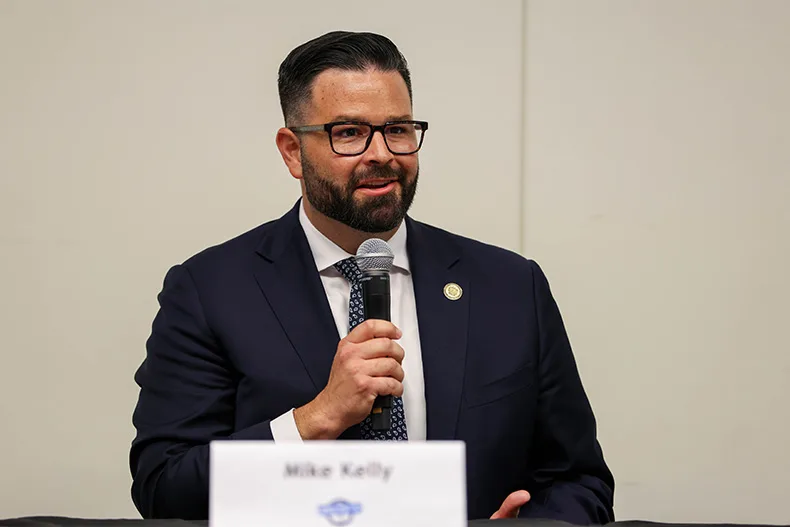
Kelly — said he is proud of the work the county did setting up transit for World Cup visitors, adding that the international tournament has been a rare opportunity to help Johnson County rise on the world stage.
Tourism is often overlooked as a way to reduce reliance on property taxes, he said, adding that the tourism industry in the county saves individual taxpayers about $800 a year.
Kelly said the county will make the analysis on return on investment once data is in on the $700,000 it spent on transit.
Property taxes
The candidates were asked whether they would move the taxing rate low enough to negate the effect of rising property values on the county’s portion of the property tax bill and what spending cuts they might make.
Crnkovich — “Absolutey, yes. That is the straightest answer that you’re going to get from anyone at this table.” Crnkovich said the problem is the county’s personnel spending and reserves. Full time equivalent positions have increased 18% over the past five years, she said. “They are building bureaucracy,” with salaries often going to mid-level employees.
She also said the county is holding too much in reserves, based on experts she has consulted and that reserves should be based on total expenses.
Later, she said, “If I don’t rein in spending and cut property taxes I won’t run again.”
Kelly — said the commission and staff have made $15 million in service modifications, but it’s been difficult because of inflation that has driven up the cost of ambulances, for example. He also said the commission will work more with state legislators, who have cut off some sources of revenue to counties in the past.
Later, Kelly drew equal parts applause and boos when he talked about the county in relationship to state and federal governments.
“I don’t know about you all but I thought DOGE (the Trump administration’s Department of Government Efficiency) was an absolute failure. It did not save very much money, if any money at all and the unintended consequences of those cuts are being felt by people today and will continue to be felt for years to come.”
Reserves are a form of insurance for infrastructure investments like wastewater plants, he said, and many reserves are tied to those departments. The bond rating agencies, that set the borrowing rates for governments, require unobligated reserves of 28% of spending, he said. “If we don’t have that triple-A rating we are going to spend tens of millions more on projects over the years, and that is going to be on the backs of the people of Johnson County.”
Senesac — said reserves need to be reviewed case-by-case and that county leaders should adapt to the changes made in revenues from the state. He said talking about ambulance inflation is “cherry picking” and that personnel is a big area that needs to be tackled.
But when asked for specifics on what he’d cut, he said, “Listen, we’ve got great services in the county and we don’t need to cut any of them. There’s plenty of excess in the budget elsewhere that we can work on.”
He later said the commission has been a “rubber stamp” on spending requests from department managers. “I haven’t seen one time that there wasn’t a rubber stamp on the cost that came forward from staff,” he said.
On the topic of personnel, candidates were asked about how they’d address high turnover among first responders.
Senesac — said finding the core problem would require talking to leadership, and that it’s important to make sure emergency services are staffed appropriately. “I feel like we do a good job today.”
Crnkovich — referenced her experience running her own business. Based on that, “I can tell you there is usually a culture problem when it comes to turnover,” she said. “It’s the culture that needs to be supported in a positive way.”
Kelly — said the county has co-located some ambulance services with Shawnee, Overland Park and Olathe and hired more roving paramedics as call volume has increased. “So why is there burnout in Med-Act? Because it’s a very difficult lifesaving job and we don’t have enough paramedics. It’s convenient to be able to talk about wanting to fully fund Med-Act but then also not wanting to pay your people.”
Housing
Kelly — said the county has responded to the national affordable housing crisis by meeting with developers and nonprofit groups with projects like Habitat for Humanities and Metro Lutheran Ministries and those partnerships are creating some affordable housing like Olathe Pathways at Heritage Park.
County commissioners also are looking at where excess county property might be employed as housing, he said.
Senesac — questioned projects like the Habitat project in the works for western Lenexa.
“You’re putting that right in the middle of an area where other people’s homes are affected. And I don’t want to say that it’s a NIMBY (not in my backyard) situation, but I think it needs to be a little more thought that goes into that.”
It’s not the county’s responsibility to fund “upstart housing,” he said.
Crnkovich — “Adding more apartments is not a solution. In fact that is a detriment,” she said. “All that does is trap people into rents,” where they can’t build equity and grow their own wealth.
The county should not become a landlord or interfere in what municipalities want on housing, she said.
Data centers
Large buildings proposed for computer servers and data storage have recently become an issue and have received pushback in some Johnson County cities, particularly in the western and southern areas of the county. Candidates were asked how they stand on a countywide moratorium on data centers.
Crnkovich — “I’ve gone on the record saying I do believe we should have a moratorium in Johnson County on the building of all new data centers because there are citizens that have valid concerns and questions that need to be addressed,” she said.
She said any tax incentives given to center developers should include clawbacks so counties can recoup if the companies don’t make good on their promises.
Kelly — said he doesn’t support a moratorium. “I believe in the idea of local control and every community should be able to decide what’s best for every community,” he said. “A moratorium without a plan isn’t a plan. It’s pandering.” Kelly said he’d support a community conversation, and possibly a policy-level understanding among communities.
Data center developers should create their own power, (“hopefully it’s renewable energy”) use water conserving methods such as closed-loop cooling systems, and pay full cost of their power and battery storage, as well as agreeing to benefit schools and libraries, he said.
Senesac — said he needs more information on the types of different systems data centers can use for water and power, and would need to hear from communities on their expectations for clean water and availability. Cities should negotiate harder on land use, he said.
 Thanks for reading! If you value having an independent news outlet keeping tabs on local government, schools and taxes, we're asking you to contribute to our Education Reporting Fund.