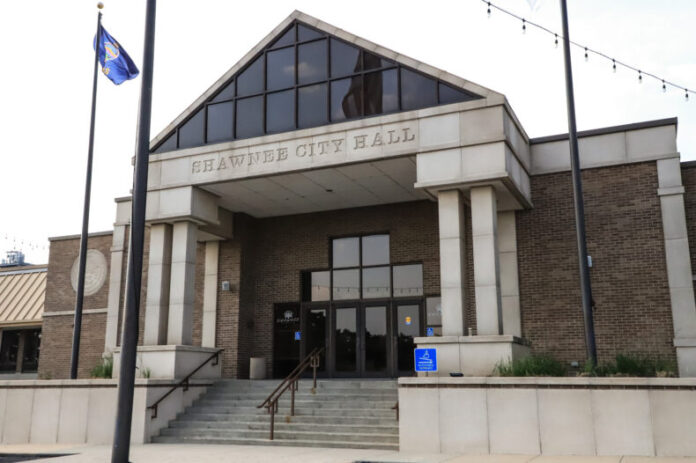
Despite some pushback from residents, the Shawnee City Council was unanimous in its approval of its annual budget and agreement to exceed the revenue neutral rate.
On Aug. 24, the Shawnee City Council voted 8-0 to adopt the city’s 2027 budget and exceed the revenue neutral rate.
The adopted budget includes a flat mill levy rate, with 23.267 mills that is expected to generate property taxes of about $36.21 million, according to city documents.
Home value appraisals ticking up means more property taxes
A city’s property tax rate, called the mill levy, decides how much a property owner owes in taxes to the city based on their property’s assessed value.
In Shawnee, the average home appraisal is $455,393, up about 8.2% from last year.
Shawnee homeowners can use the following formula to calculate how much they might pay to the city in property taxes if the proposed mill rate increase is approved:
- Multiply your home value by the residential assessment rate in Johnson County, which is 0.115.
- Take that number, divide it by 1,000 and multiply the outcome by the city’s property tax rate in mills. (In this case, you can use 23.267)
Based on the average appraised value of a home in Shawnee provided by the Johnson County Appraiser’s Office, the average homeowner can expect to pay $1,218.50, which makes an additional $70 or so for the year compared to 2026, or $5.83 per month.
Reminder: A homeowner’s property tax bill also includes rates set by other jurisdictions such as the county, school districts and fire departments.
What is the revenue neutral rate?
The revenue neutral rate is the tax rate that generates the same amount of revenue as the previous budget year using the current-year assessed valuation.
A Kansas law passed in 2021 requires taxing jurisdictions like Shawnee to host public hearings if they plan to exceed their revenue neutral rate by bringing in more in tax revenue than the previous year.
Exceeding the revenue neutral rate allows the city to take in more revenue than it did the previous year.
This is the third year in a row that the city council has passed a flat mill levy rate.
The general fund is running on a deficit
The 2026 budget projects about $78.927 million in general revenues and about $80.3 million in general fund expenditures.
The general fund budget will be operating with an estimated $2.548 million deficit. That includes a one-time $1.6 million spending from the General Fund Reserve Reduction Plan.
Part of the reserve reduction spending has gone to projects like pipe replacement projects around the city, including a sinkhole that occurred near Mill Valley High School in 2025.
“We are spending these dollars on stormwater projects. The City has … quite a backlog,” City Manager Paul Kramer said. “Every year, we have more projects than we can deal with.”
Residents pushed back against exceeding the revenue neutral rate
Several Shawnee residents pushed back against the city exceeding the revenue neutral rate, stating the city should help decrease money its residents should owe.
“Exceeding the RNR sends the wrong signal that rising property values are an automatic revenue windfall, rather than a signal to hold the line for taxpayers,” Joe Quinn said.
Other residents cited growth in new homes and businesses as a way to make up money, rather than have people pay more in property taxes.
“I know we have a lot of new growth and homes being built. We should be making up some there,” Christine Kohler said.
Councilmembers like Kurt Knappen defended the decision, citing inflation, the need to retain and hire city employees and the cost of insurance going up.
“We have more needs, Fire Department needs, Police Department needs. In addition to that, we do have a significant inflation,” Knappen said. “I’ve voted for two tax decreases. I’m all for reducing taxes. We’re going to keep the mill levy right where it’s at.”
Councilmember Erin Aldridge agreed.
“I understand that we’re talking about your hard-earned dollars, and we don’t take this responsibility lightly. As Kurt (Knappen) said, we are not increasing the mill levy. We’re maintaining that. It’s just the assessed valuation that’s going up. We want to make sure that we’re using your dollars responsibly and maintaining the services that you expect,” she said.
 Thanks for reading! If you value having an independent news outlet keeping tabs on local government, schools and taxes, we're asking you to contribute to our Education Reporting Fund.