This campaign season, Post editor Kyle Palmer has extended offers for one-on-one Q-&-As to all candidates running for statewide offices, including: U.S. Senate, Governor, Attorney General, Secretary of State and a Kansas State Board of Education seat covering Johnson County.
We will publish video of Kyle’s full interviews and an edited transcript of his conversations as each candidate responds.
Look back at Kyle’s past interviews with U.S. Senate candidate Adam Hamilton and third-party Secretary of State candidate Scott Morgan.
No Johnson Countian has been elected governor of Kansas since Prairie Village’s Bob Bennett in 1974, and you have to go back before World War I to find a Democrat from Johnson County who has sat in the governor’s chair.
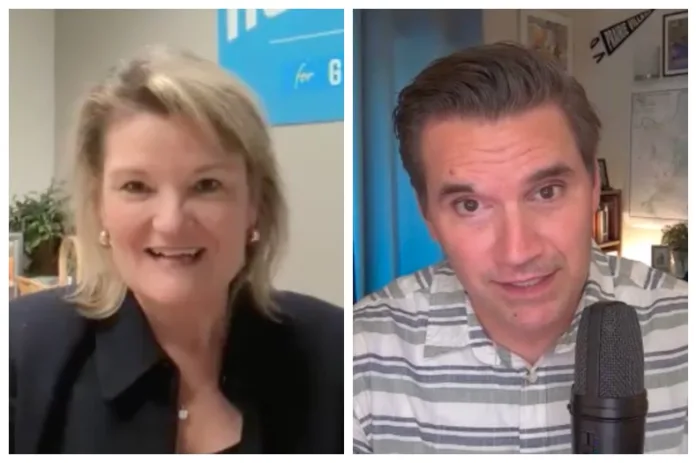
But Cindy Holshur wants to change that.
The state senator from Overland Park won an all-Johnson County gubernatorial primary in August, defeating fellow state senator Ethan Corson and Overland Park Mayor Curt Skoog, to carry the Democrats’ banner forward.
Now, she’s competing with Republican Ty Masterson to see who will succeed Democrat Laura Kelly, who has led Kansas the past eight years.
Recent polling has shown Masterson with a lead, but Holscher says this year’s election may provide a unique opportunity for a Johnson Countian to break through statewide.
*The Post has extended invitations for interviews to Masterson.
Watch the full interview
Read the highlights
The transcript below has been edited for clarity, length and grammar.
Post: So we know the history. I’m sure you’re well aware of it, but let me ask why you thik a suburban Democrat from Johnson County can sell this year in places like Garden City or Hays, other parts of western Kansas? What gives you the confidence that you’re the person to break through?
Holscher: There are a couple of different things. One, I look at the changing perception of Johnson County. You know, in the past we have heard hesitancy about electing someone from Johnson County to a role such as this. What I have seen, though, is that perception across the state has evolved primarily because almost everybody in some part of Kansas has a son or a daughter or a relative that now lives and works in Johnson County. Someone who had to potentially leave a rural area to come work here. So that means that folks have spent more time here in the area, going to places like Deanna Rose or other attractions with family members. Additionally, I’ve done over 80 town halls across Kansas. There really has been a shift in terms of where people are and viewing how things are going. We have seen so many policies come from the federal level that are hurting Kansans. We have an affordability crisis out there. People are struggling. That makes people, when they’re in that type of a crunch, view things differently. And the fact of the matter is, my opponent’s been in charge for six years of the Senate, has had a supermajority to work with, could have addressed these issues, but hasn’t. So that tells me he either doesn’t know how to address the issues of affordability or doesn’t want to because he’s controlled by corporate donors.
Post: Interestingly enough, you had an all-Johnson County primary, the Democratic primary in August. You came through, even though one of your opponents, Ethan Corson, a fellow state senator, was endorsed by Laura Kelly and outraised you [in fundraising]. What did Democratic primary voters see in you that maybe the party establishment missed?
Holscher: Being able to relate to folks across the state, and I think that comes from my background. I grew up on a farm. I’m the granddaughter of tenant farmers, the poorest of the poor. I come from a military family as well as a union family. That’s a lot of points of connection with folks all across the state. So you know that common background really does make a difference with voters.
Post: Any rifts that needed to be healed after the August primary? Any intraparty conversations that have been that have happened since then?
Holscher: We are all good. Governor Laura Kelly endorsed me the very next day [after the primary]. [Former governor] Kathleen Sebelius endorsed me. The party is coalescing. Things are going well.
Post: Last year, you voted for the Senate bill that included tax incentives for data center developers. Now you’re calling for a statewide moratorium on new ones. What’s changed your mind? Why should voters trust this new position more than the prior vote?
Holscher: What’s changed my position are the voters, the people across the state, as well as new information. When we voted on that bill over 15-16 months ago, the situation seemed very different than it does now. And I will tell you, what was talked about in terms of that bill was the jobs it would bring to the area and the economic benefit it would bring to our state. But what we have seen unfold since that time period has been something very different. We have seen these hyperscale data centers come into communities that suck up our water, that jack up utility rates and don’t bring the promised jobs. So, I issued the call for the moratorium — a pause — so that we can all get on the same page. Essentially, let’s take a deep breath and focus on how this really should look. There are some communities and folks out there that are saying absolutely no to data centers, but there are a number of people saying, ‘Hey, you know, okay. We can do this, but let’s do it the right way.’ So that’s what my call has been about: ensuring that we have guardrails in terms of efficient water usage, as well as efficient energy usage, and making sure that we get local jobs.
Post: Would you characterize that vote for Senate Bill 98 [for data center incentives] as a mistake at this point?
Holscher: If we had the information then that we have now, it wouldn’t just be me. There would be several others who would vote differently. I’m confident of that. But yeah, I certainly would vote differently based on the information we have now.
Post: Another issue that’s come up pretty frequently over the last year is the Chiefs Stadium deal. The Chiefs coming to Kansas, building their stadium in KCK, their headquarters and training facility in Olathe. In 2024, you did vote for that STAR bond law that eventually opened the door to the Chiefs moving to Kansas. But then, after the team announced its move in December of last year, you voted against actually creating the sports authority that will oversee that team’s project, and you’ve called it a “giveaway to billionaires.” Help voters square those two votes and what has changed for you.
Holscher: I’m always going to pursue economic potential for our state, and I think we should. We should explore those options. So that initial vote to explore the possibility of bringing the Chiefs or the Royals or both to Kansas — and, of course, we want to keep them in the area — so I wanted to explore that potential. But then, after seeing the bill that Ty Masterson put together in terms of what it contained, I think billionaires should pay for their own stadiums, so that’s a huge concern to me. Additionally, there are a couple of other things in there that are concerning. I want to make sure this is union labor used for the construction of the facility, and that it’s good wages. I also want to make sure that local businesses get the benefit of this deal. I want to make sure that local businesses are getting their share because we have to ensure there’s a good partnership. You know, the deal is done at this point. And yes, I had reservations about it, but as governor, what I’m going to do, like I said, I’m going to make sure that those promises are upheld in terms of good union jobs. I work to make sure again that local businesses are part of that investment.
Post: Some voters might see both in the the data center issue and the stadium issue as these votes being politically advantageous as opposed to principled. How would you respond to that criticism?
Holscher: I’m always going to be accepting of new information. I’m not going to dig in my heels on a vote that wasn’t good for the people. Like I said, if there’s new information that needs to be considered, I’m going to listen to the voters. Even the voters were in a different mind space in terms of where they were on those issues. You know, when the whole Chiefs deal was first talked about, there was a lot of support, and we’ve seen some of that change too, as people become more familiar with the parts of the bill. On data centers, I didn’t receive anything from voters saying that they had problems with it, so like I said, even their viewpoint has changed, too. So that’s why I’m standing with the people.
Post: What specific property tax relief policies would you advocate for? What what types of things do you think? What types of relief could the state potentially offer homeowners?
Holscher: When we talk about property taxes, what we have to do first is think about and ask why are property taxes so high? And it comes down to two things. It comes down to the fact that we are obligated in terms of the state level to fund general education per the [state] constitution and special education per federal mandate. Now, what’s happened over the past several years? The Legislature has adequately funded general education, but special education hasn’t been fully funded since 2011. Again, we’re federally mandated, so when that funding doesn’t happen on the state level, it gets pushed over to the local level. That makes property taxes go up. The second thing in terms of why property taxes so high is the fact of the matter that this legislature, session after session, has essentially been in this rut of giving exemptions to corporations and billionaires. There’s only so much revenue to work with, and if you’re giving it away to corporations and billionaires, then you’re not fulfilling those other areas of funding education. And again, that gets shuffled to the local level. If you look back at property taxes over time, close to two decades ago, property taxes, that pool of revenue, about 40% of it came from homeowners. My understanding is that now, that pool of revenue is closer to 70% coming from homeowners. So it’s been a huge shift. So that’s why our property taxes are so high. So what we have to do is we have to address the core of the issue here. Unfortunately, what we’ve been seeing are gimmicks that put caps and basically squeeze the balloon and shuffle the property tax burden somewhere else.
Post: The current school finance formula is set to expire next year. If you are governor, you will kind of oversee the process of writing a new one. What would be your non-negotiable for writing a new public school finance formula?
Holscher: My concern is that, with the makeup of the Legislature as it is, that they’re really going to try to sabotage school finance. Over the past several years, we have seen just attack after attack on our public schools in the form of voucher programs. And we know those voucher programs, while they’re marketed to help [poorer]children, that’s not what happens. Those voucher programs go to typically folks who are already sending their kids to private school that are making over six figures. It’s just a transfer in terms of defunding your public schools. There are certain provisions there that concern me based upon what I’ve seen this [legislative] body do. We have a school funding formula that’s working pretty well. What I’m looking for is a continued strong funding program with inflation adjustment, and then actually fulfilling thge obligation of funding our schools.
Post: At the State Fair debate that you all had a couple of weeks ago, Ty Masterson called you a “socialist,” the most radical candidate in Kansas history. In turn, you said he was too extreme for Kansas and also referred to him as “Brownback 2.0.” Make your case to that Johnson County moderate voter who might have been convinced to vote once or twice for Laura Kelly to keep their vote with you.
Holscher: Every race I have won — House races, Senate races — have all been from red districts. Every single one of them. I can’t be very extreme if Republicans keep electing me. It’s Republicans who have been helping elect me to office every single election cycle that I have run. The fact of the matter is, the things I support — Medicaid expansion, access to affordable housing, access to affordable childcare, lowering property taxes, legalization of cannabis and public school funding — those are all things supported by a large majority of Kansans. So my views and what I’m doing are absolutely mainstream. Unfortunately, my opponent is on the opposite side of all of those issues. That’s extreme. Not standing with the people of our state, opposing things like Medicaid expansion: that’s extreme. Opposing legalization of cannabis, which my opponent has opposed: that’s extreme. And trying to defund our schools, which Masterson has been trying to do: that’s extreme. I’m standing with the people and where they are, and that’s very mainstream.