Earlier this summer, the Post asked our readers what issues you wanted to hear candidates in federal, state and local races address leading up to the Nov. 3 election.
Based on that feedback, we developed a five-item questionnaire centering the issues most important to residents across Johnson County.
Each day this week, we’ll publish the candidates’ responses to one question.
Today, we’re publishing candidates’ responses to the following question:
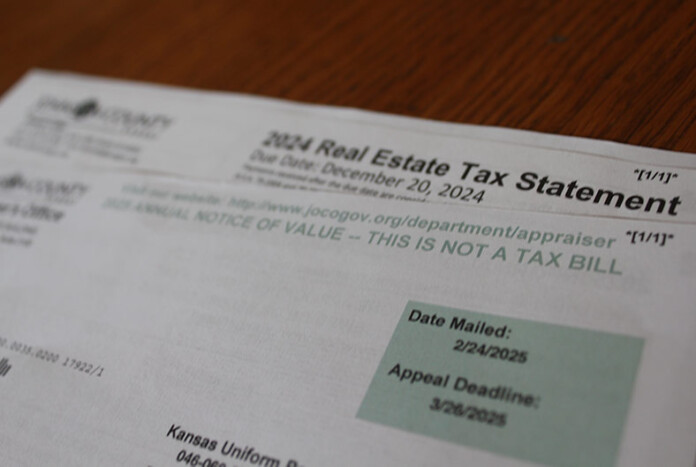
Property taxes remain readers’ top complaint, and much of their frustration lands on the county. The $1.9 billion county budget for next year that commissioners approved this month keeps the county’s tax rate essentially flat, but rising home values mean most homeowners will still pay more. In particular, older adults on fixed incomes say they can’t keep up. Should the county lower its rate enough to fully offset rising appraisals, even if that means cutting spending? If so, where would you cut first? If not, how do you justify bills that keep going up?
Below are the answers the Post received from candidates on the issue:
Chair
Karen Crnkovich
 Yes. When rising appraisals generate substantially more property-tax revenue, the county should lower the mill levy rather than simply allowing tax bills to rise.
The 2027 budget is $1.911 billion and includes approximately $530 million in reserves. I would start by right-sizing reserves while protecting the county’s AAA bond rating, but we cannot stop there.
Every category of spending should be evaluated, including staffing, administrative growth, outside consultants, construction costs, contracts, and whether services are more efficiently performed in-house or outsourced.
I do not believe meaningful property-tax relief requires sacrificing public safety or core county services. It requires prioritizing those services and demanding measurable value from everything else.
I have publicly committed that if I cannot deliver meaningful property-tax relief during my first term, I will not run for reelection in 2030.
Mike Kelly (incumbent)
 As a homeowner, I understand the concerns regarding property taxes. Johnson County retains about 20 cents of every property tax dollar collected, the rest going to schools, cities, our community college, and the State. Even as costs rise – construction costs are up 39% from 2019 to 2025 and ambulances are up 83% – all revenues are spent diligently and scrutinized within each department. This year, we implemented a countywide hiring pause, delayed non-critical expenses, and consolidated roles across the County. This work identified $31.4 million in cost savings, cost avoidance, and additional revenue to help offset the increasing costs of critical services.
Johnson County has reduced its tax rate by 9.3% since 2018. That’s $41 million a year the County chooses not to collect. Additionally, Johnson County created a property tax relief program to help its most vulnerable. Over 1,000 residents received direct relief.
The truth is, homeowners are paying more property taxes because of State action. The Legislature continues to exempt business properties – including commercial equipment – from property taxes, forcing homeowners to make up the lost revenue. The most impactful and sustainable property tax relief can be achieved by partnering with the Legislature to establish local control and diversifying revenue sources that lowers the tax burden on homeowners. Progress is happening. Last year, we helped change the rules on motor vehicle registration, giving local control back to counties and reducing millions in reliance on property taxes. We’ll continue to push for local control on other revenue streams, like tourism tax, sales tax, and franchise fees.
District 1
Becky Fast
 Kansas faces a fundamental equity issue within its property tax system. In 1988, homeowners contributed approximately 40% of property taxes; however, this share has since increased to nearly 70%. The shifting burden to homeowners has been attributed to state exemptions granted to commercial and other classes of property. Concurrently, Kansas does not fully reimburse counties for the complete cost of providing 18 state-mandated services, resulting in local property taxpayers bearing the additional financial responsibility.
Rising costs for roads, ambulances, and other essential services, combined with state and federal funding reductions, put increasing pressure on local budgets. Two years ago, I brought forward a proposal to engage a third-party firm to evaluate county services, identify opportunities for consolidation and greater efficiency, and find alternative funding sources beyond property taxes. That process identified $34 million in service modifications, including $15 million in spending cuts, helping limit budget growth to just 0.37% well below the 3.4% inflation rate at the time.
As your County Commissioner, I have voted to lower the County’s property tax mill levy in six of the past eight years. However, the County accounts for about 20% of a typical property tax bill. Meaningful tax relief requires collaboration among all taxing entities to address the rising financial burden on residents.
Long-term reform must also be implemented at the state level. Kansas must revise its property appraisal regulations, eliminate unjust tax exemptions, and redistribute the property tax burden to ensure that homeowners do not bear an excessive share. I will continue to strive to reduce costs, enhance efficiency, and identify potential savings. Homeowners deserve substantial property tax relief without compromising the essential services that our communities depend on for a high quality of life.
Ben Hobert
 The question is too narrowly framed. The following can reduce property taxes: (1) grants of tax abatements and approval of Tax Increment Financing (TIF) Districts should be critically evaluated not handed out like candy. Recently, the egregious Shawnee TIF District proposed TIFing a 77 home residential development increasing the tax burden on existing homeowners. The Shawnee Mission School District’s intervention with its veto right prevented this abuse. The Board had discussions but did not exercise their veto right. (2) Abuse and erroneous reserves analysis. (a) Why is there $7.8 million in a Register of Deeds Technology fund which, under state statute, should be applied to equipment when it exceeds $50,000? Or the restrictions relaxed by cooperation with the state legislature? (b) The Board’s analysis of reserves is erroneous. If a reserve is restricted to support functions constituting 30% of the budget, it does not evaporate. It can support shortfalls in that portion of the budget or tax collections can be shifted elsewhere. Therefore, the County carries excess reserves which are used as a slush fund. (3) Chairman Kelly offers invitations to identify cost reductions and, when presented, no discussion follows. Philip Bauer suggested not tearing down the Corinth Library at a cost of $33 million, instead renovate it at an estimated cost of $3 million. The savings could be applied to operations. Although budgeted, this money has not been spent. (4) Eliminate Chairman Kelly’s new Strategic Communications department with 11 employees. We don’t need more employees working on spin.
District 4
Teresa Erb
 On December 11, 2025, the Commission approved an expansion of property tax relief to benefit low income residents, including seniors. However, affordability is one of my priorities, and rising property taxes are a significant part of that challenge, particularly for older adults on fixed incomes. I understand the frustration of homeowners whose property values continue to rise even though their incomes have not. When property values increase significantly, I believe the Commission should consider reducing the mill levy to help offset the impact on taxpayers. However, I want to evaluate the effectiveness of the recent expansion of property tax relief first. I would not commit to keeping tax bills flat every year without considering the cost of essential services, the needs of our growing and aging population, and the county’s long-term obligations.
I believe the Commission has a responsibility to scrutinize spending and look for opportunities to operate more efficiently before asking residents to pay more. That means examining departmental budgets, evaluating programs for effectiveness, and identifying expenditures that can be reduced or deferred without compromising essential services. I would not identify specific programs for cuts without first understanding their costs and the consequences for residents. I am particularly concerned about older adults on fixed incomes who may struggle to remain in homes they have owned for decades. I support examining ways to provide targeted property tax relief to those residents who need it most.
My goal is to keep Johnson County affordable while maintaining the quality of services and infrastructure that residents depend on. That requires fiscal discipline, careful consideration of spending priorities, and recognition that rising property taxes have real consequences for families.
District 5
Michael Ashcraft
 As I said during the Post’s Forum, “You don’t have to be Euclid to know the cost of government is going up.” Those increases affect everyone. Here are just a couple of items that come to mind when we talk about governmental financial decision making:
- Recently, staff dutifully prepared a cost/benefit analysis that showed that a De Soto TIF request would cost JoCo taxpayers about $500,000 over the term of the agreement. By presenting a documented “adverse effect”, the proposed action came under the direct purview of the BoCC. In other words, the BoCC could veto (effectively voting to remand the TIF back to De Soto for reconsideration) the TIF. The motion to deny the TIF and remand it back to De Soto failed for lack of a second. TIF dollars are collected but rather than going to the general good, they are given back to the project developer to be used for specific improvements to the property such as landscaping and parking lots rather than general tax relief or direct service funding needed by the community.
- Last year, the BoCC approved adding a solar installation and a water reclamation system (i.e. capture rainwater to use when flushing toilets) to the new Health Services Building (HSB) at a projected cost of $3.1 Million and $1.6 Million respectively. Based on staff annual savings estimates, it will take 36 years for solar, and 44 years for reclaimed water projects to breakeven. Whether or not you support such projects, I doubt most homeowners would think that such a prolonged ROI is the best use of tax dollars.
These are just a couple of examples of how more prudent use of financial resources could have saved taxpayers real money. Similar opportunities exist everywhere. The key is to instill efficiency as a core value in the county’s leadership thinking. The organization’s current values are enshrined in what is referred to as our “Pillars of Performance.” This is a noble framework which is intended to guide leadership, vision, mission, behaviors, and operations. It is a 241-word treaty. Notably, “efficiency” is not mentioned once.
The key is to develop and maintain a corporate culture that rewards efficiency while promoting performance. The ability to find that sweet spot is the true hallmark of a high-performance organization. All governments should strive to be faster, better, cheaper.
JoCo is no different.
Greg Mitchell
 The county does need to lower the tax rate for homeowners. The share of county government funding from residential property taxes has increased significantly over the past several years for various reasons, including state-level decisions. I believe the best way to fix this is to use a variety of tactics to reduce costs and increase revenue from other sources.
On the cost side, I favor reviewing county programs to identify redundancies across departments where we can reduce costs through consolidated purchasing or personnel. Additionally, I suspect opportunities exist to consolidate programs and services with other governmental entities within Johnson County, as well as nearby counties, where a cost-sharing arrangement could be implemented.
It is also important to diversify revenue streams. This could include charging a fee for a greater number of services the county provides. At scale, nominal fees, especially for high-volume services, could significantly increase revenue. In addition, I suspect Johnson County has the scale and capacity to provide secrnrvices to smaller counties for a fee. I know of one example where this is already happening. The Johnson County Medical Examiner’s Office provides fee-for-service autopsies for some smaller Kansas counties that have limited capacity.
I believe addressing this problem from both a cost and revenue perspective can relieve Johnson County taxpayers while continuing to provide the high-quality services we have all come to expect.
Coming up:
Tomorrow, we will publish the candidates’ responses to the following question:
The county funds the election office, but the election commissioner is appointed by the secretary of state. After eight early voting sites were cut before the August primary, readers asked what county leaders can do. Do you agree with the decision to close these early voting sites? Why or why not? Is there anything the county commission can do to make future decision-making about elections more transparent?
 Thanks for reading! If you value having an independent news outlet keeping tabs on local government, schools and taxes, we're asking you to contribute to our Education Reporting Fund.