Overland Park wants to make it easier to use its “missing middle” pilot program on lots that may not have been developable before.
Several months after Overland Park launched its housing pilot program, the city is now considering whether to temporarily amend its development codes to encourage the use of the program, particularly on infill and atypical-shaped lots.
The idea is to allow homes with a pre-approved design in the Portfolio Homes pilot program to be built on properties that might not typically pass legal muster for residential development due to their shape, size, setbacks or their inability to have public street frontage.
It would also further streamline the process by reducing the number of steps required to get such a project approved, potentially lowering the price tag and moving developments ahead more quickly.
This special program would last for one year or until six projects were approved under the framework, said Leslie Karr, the city’s director of planning and development services, during a meeting earlier this month.
It’s part of an effort in the city of Overland Park to address escalating housing costs and a shortage of housing units — an issue facing several Johnson County communities. The focus of these pilots has primarily been on “missing middle” housing — that is, more mid-sized and moderately priced housing options that are largely absent despite demand for those types of housing options.
Last week, as part of the multistep process to approve a temporary amendment to the city’s Unified Development Ordinance, the Overland Park Planning Commission voted 8-0 in support of a special pilot to accompany the Portfolio Homes program.
Commissioner Ned Reitzes called it “a wonderful idea,” adding that he hopes it works as intended to encourage more housing development at the middle of the size and cost spectrum.
Commissioners Jenna Reyes, Jameia Haines and Matt Masilionis were absent from the meeting.
What is the Portfolio Homes program?
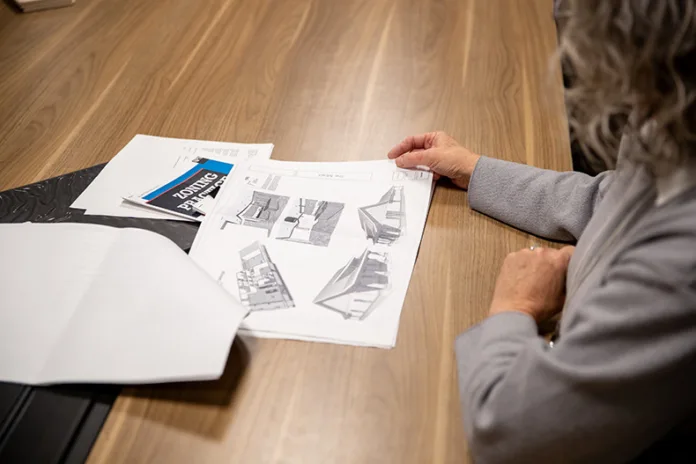
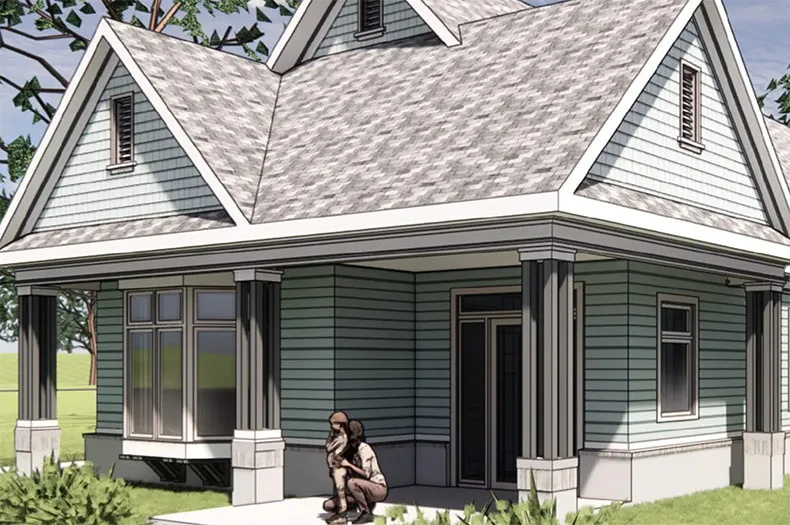
In the works for several years, this program was launched last year and offers a collection of pre-selected, nearly pre-approved home designs to encourage the development of a variety of housing choices and reduce costly pre-development costs.
In all, the Portfolio Homes pilot features 26 pre-reviewed plans for smaller single-family homes and duplexes designed to blend in with existing neighborhood architecture in Overland Park. The home designs range in size from under 1,000 square feet to about 2,200 square feet and are all either one or two stories. Most come with at least three bedrooms and two bathrooms.
The idea is that these designs are almost build-ready, save for a few administrative tasks before the city would issue actual building permits. The city has also waived permit fees for homes built as part of the portfolio homes pilot.
In a recent letter to the city, the Kansas City Regional Association of Realtors referred to the pilot as “a practical, innovative tool that expands attainable ownership, reduces development barriers, [and] encourages well-designed, small-scale housing.”
Zoning pilot meant to encourage Portfolio Home development
Despite some interest in the designs and early discussions about implementing the Portfolio Home designs in new developments or on single lots around the city, so far, no one has submitted a formal proposal to use them.
So, the city has proposed a sister zoning-focused pilot to run alongside the Portfolio Homes program to “allow flexibility” on some standards that usually dictate single-family home and residential development in the city.
In a typical single-family home development, a home is required to have a front setback of 20 to 30 feet and a rear setback of 25 feet. Both of those would be reduced to 20 feet in the pilot zoning program, with some further flexibility to be granted as needed. (The side setback of 7 feet would be consistent.)
Additionally, a typical single-family home has an average lot size of 8,000 square feet, while an average lot size in the pilot program could be 4,250 square feet.
Plus, the city would allow lots that don’t directly front a public street but could still have public street access through a shared driveway. These are sometimes called flag lots and have not been permitted in Overland Park. It could also allow more cottage court-type neighborhoods, which usually have homes clustered around a shared open space instead of individual yards.
Karr said at the planning commission meeting last week that it could make it easier to develop Portfolio Homes in the city, while also offering an opportunity to test options that could “facilitate a wider variety of housing,” as work to overhaul the full collection of Overland Park’s zoning and development codes continues.
“We want an opportunity for a developer or a homeowner who has extra land to come [to] us with a proposal, so we can see what it takes to get something done,” Karr said.
Streamlined approval process also proposed with code pilot
Overland Park is also proposing streamlining the approval process for Portfolio Home projects by granting the planning commission the authority to decide applications submitted under the zoning pilot after a public hearing without necessarily requiring approval from the Overland Park City Council.
Under that special process, the city council could still hear a project if an appeal is requested by neighbors or a developer, but generally, it would give the planning commission the final say.
In the past, this is how Overland Park approved things like churches or schools in areas zoned for residential uses.
The pilot would also reduce the number of required actions by combining some steps, including plans and plats. That means fewer applications and fewer votes needed in a public meeting.
A developer would still be required to hold a neighborhood meeting and follow notification procedures for letting nearby property owners know about their plans for a property.
Next steps:
- The temporary code amendment goes to the city council for consideration next.
- That vote is scheduled for the April 6 meeting.
- While the initial authorization comes with a one-year or six-project limit, the city council could approve a timeline extension if it so chooses down the road.
Keep reading: A 2021 study said Overland Park needed 4,500+ more homes around $320K. Only 1 has been built since.