On to November, Johnson County!
A consequential and busy primary election in Kansas just ended, and while vote totals are not officially final (that won’t happen until the vote canvass on Aug. 14), we can still make some conclusions based on the results we saw Tuesday night.
This primary ballot was unusually diverse, with Johnson Countians asked to weigh in on races at every level of government — federal, state and local — as well as to decide on a much-discussed constitutional amendment.
And based on Tuesday’s results, Johnson County promises to play a pivotal role going forward to November’s general election.
Here are some things we noticed:
A turnout milestone
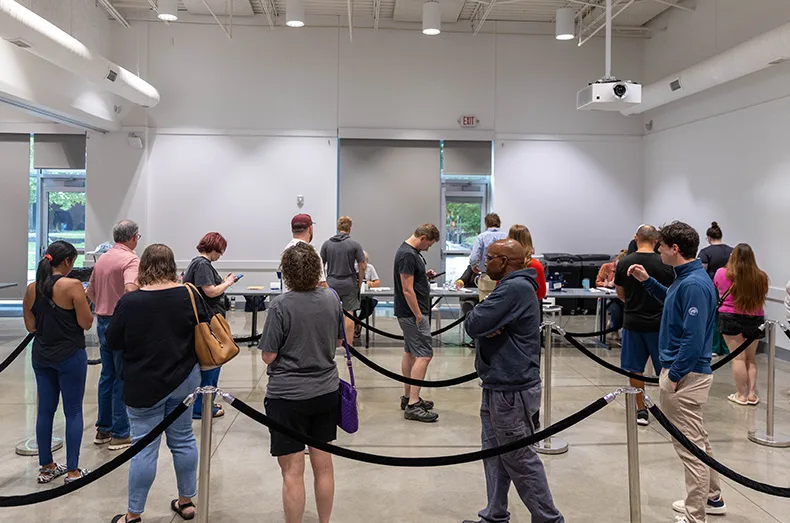
Democrats have steadily made electoral gains in Johnson County in recent years. Still, something happened Tuesday that was unusual:
More Democrats than Republicans voted.
That’s something that hasn’t happened at least going back to 2016, according to archived election data kept by the county election office.
Frankly, it may be something that has never happened in this once reliably red county (where there are still more registered Republicans than Democrats).
Partisan turnout is only tracked by the Johnson County Election Office for primaries, when party registration determines which ballots voters get.
According to unofficial final vote tallies on Tuesday, 81,895 Democrats cast ballots, compared to 74,144 Republicans. Unaffiliated voters totaled 17,826.
Compare that to the 2022 primary, the last even-year, non-presidential election cycle, which saw record turnout because of the “Value Them Both” amendment.
That year, 117,528 Republicans voted in Johnson County, compared to 99,894 Democrats (and 39,447 unaffiliated voters).
Overall turnout after Tuesday, was a shade under 37%, much better than the 2024 primary (which saw 22% turnout) but still well short of that record-setting 2022 cycle, when primary turnout hit 56%.
The 37% turnout figure will tick up as mail-in and provisional ballots are tabulated this week, but it already surpasses turnout in 2016, 2018 and 2020.
That is noteworthy considering the Johnson County Election Office prompted pushback and controversy when it reduced the number of early in-person voting sites this year.
Critics, including some elected officials and groups like the ACLU, warned the closures could dampen turnout, but that doesn’t seem to have happened.
A perfunctory primary for U.S. House
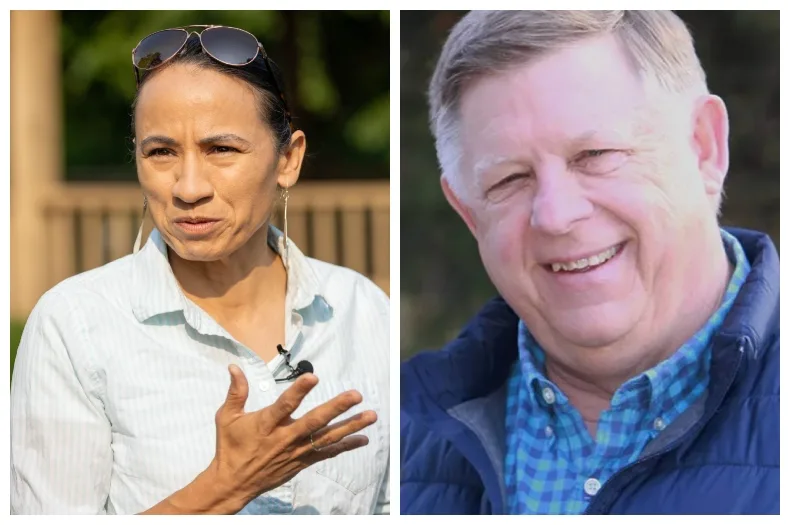
Four-term Democratic U.S. Rep. Sharice Davids had never faced a primary challenge before this year. She survived it handily.
Davids beat Sarah Preu, an IT project manager from Fairway, by an unofficial margin of 83% to 17%.
Preu ran openly to Davids’ left, promoting a platform that supported Medicare for All, codifying Roe v. Wade into law and abolishing ICE.
But she did not capture the same level of energy and attention that other democratic socialist-aligned candidates have in Democratic Party primaries around the U.S. this year (including, again, in Michigan on Tuesday).
After her victory, Davids vowed to continue fighting for the “Kansans who are working hard, budgeting carefully, and doing everything right, but are still getting squeezed by rising costs.”
The Republican primary was just as seemingly pro forma on Tuesday.
Former Shawnee city councilmember Eric Jenkins easily beat Mission Army veteran Chase LaPorte, by a margin of 79% to 21%.
Davids has won all four of her previous general election competitions by double-digit percentage point margins. The Cook Political Report now calls Kansas’ 3rd Congressional District a “Solid D” district.
Throughout the campaign, Jenkins emphasized fiscal responsibility, tax cuts and national security issues. While on the Shawnee City Council, he was also known as a frequent proponent of property tax rate cuts.
A third of JoCo’s Kansas House races are already decided
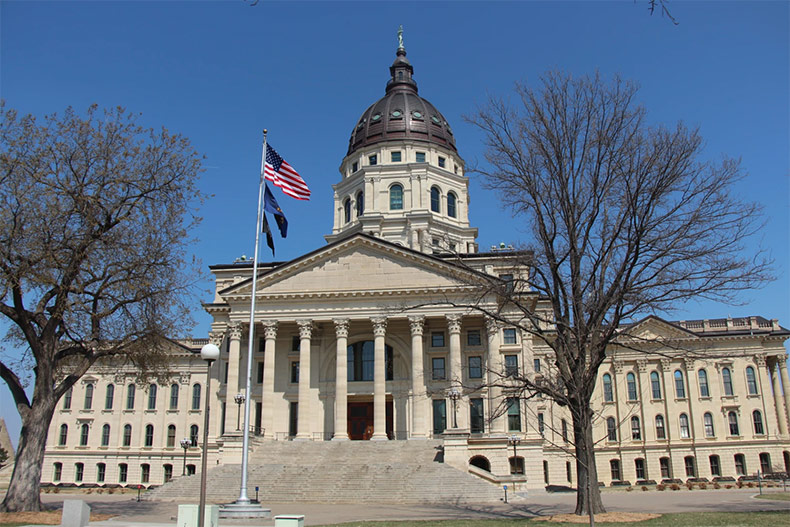
Yes, the general election is still three months away, but 33% of Kansas House districts in Johnson County have already been effectively decided.
That’s because nine of the county’s 27 House districts have only one candidate who filed to run.
These are all districts where a lone Democrat is on the ballot, and they’re mostly concentrated in northeastern Johnson County.
That makes sense, in a way. That area has some of the bluest-voting precincts in Johnson County. Still, no opposition means many voters inside the I-435 loop effectively won’t have a choice for who represents them in the statehouse next term.
It’s not necessarily what these unopposed candidates want.
Democratic Rep. Mari-Lynn Poskin, running unopposed for reelection in District 20 in Leawood, told KCUR this week she’s “not opposed to being opposed.”
“I feel like it’s my job to earn my job and pass what I think of as my job review every two years,” she said.
Poskin won’t get that job review this year, along with fellow incumbent Democratic representatives Linda Featherston, Heather Meyer, Dan Osman, Susan Ruiz, Jerry Stogsdill, Brandon Woodard and Rui Xu, as well as newcomer Reed Krewson.
Can a JoCo candidate win statewide?
Pop quiz: When was the last time a Johnson Countian represented Kansas in the U.S. Senate?
If you said James Pearson, the Prairie Village Republican who served in Washington from 1962 to 1978, bonus points for you.
In fact, Pearson is the only person from Johnson County ever to be a U.S. Senator in Kansas’ 165-year history.
That adds a bit more historical intrigue to Leawood pastor Adam Hamilton’s challenge to Republican incumbent Sen. Roger Marshall. Hamilton entered the primary contest relatively late but far out-raised 10 other Democrats to win Tuesday night.
Will that be enough against Marshall? Kansas’ junior senator has faced criticism for his lack of engagement with constituents (particularly here in Johnson County), but he still has the vocal backing of President Trump, who won Kansas by 16 percentage points in 2024.
Johnson County Democrats are also hoping to break through in another statewide contest this November: governor.
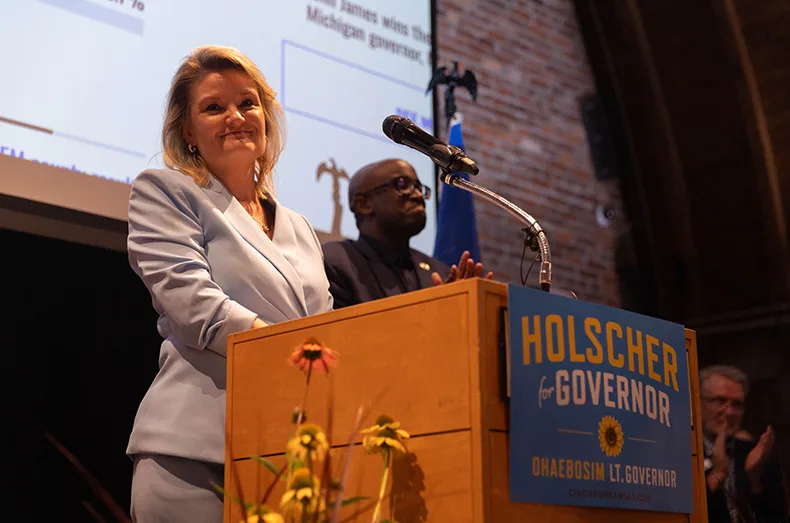
Overland Park state Sen. Cindy Holscher was the victor in an all-Johnson County Democratic primary, running as an anti-establishment progressive who was critical of the Chiefs’ stadium deal and pushing her changed position on a data center moratorium.
She now takes on Trump-endorsed Kansas Senate President Ty Masterson of Andover, who has leaned into his conservative bona fides, touting positions like his votes to ban transgender girls from competing in girls’ sports and to block state universities from running diversity and inclusion programs.
The last time a Johnson Countian was elected governor was more than 50 years ago, when Robert Frederick Bennett of Prairie Village won the office, serving from 1975 to 1979.
To find the last time a Democrat from Johnson County was governor, you have to go back to before World War I. George Hodges, of Olathe, served from 1913 to 1915.
Odds and ends
Here are some other quick observations from Tuesday’s primary results:
- For Curt Skoog, what a difference a year — or nine months, rather — makes. Last November, Skoog was riding high, having cruised to reelection as Overland Park mayor with 70% of the vote. On Tuesday, he finished a distant third in the Democratic primary for governor, garnering just 13% statewide. He entered the race hours before the filing deadline in June, and it appears two months was not enough time for him to get his message going.
- The constitutional amendment question about electing judges drew bipartisan opposition in Johnson County, similar to how the vote for the “Value Them Both” amendment played out in 2022. Four years ago, 69% of voters voted “no” against the push to ensure a right to abortion was not in the Kansas Constitution. This year, again, 69% of voters in Johnson County voted “no” on the question of whether Kansas Supreme Court justices should be elected.
- Just as four years ago, the Johnson County chair race will present a clear choice for voters. Incumbent chair Mike Kelly was the top vote-getter Tuesday by a wide margin. During the primary, he defended the county’s taxation system and its spending during his tenure, while also advocating for solutions to housing affordability. Challenger Karen Crnkovich has advocated for steeper tax cuts and more aggressive cuts to the county budget, a message similar to Kelly’s opponent in 2022, Charlotte O’Hara.
- It wasn’t part of the primary, but there’s a mayoral contest on the November ballot. Prairie Village will elect a new leader after Mayor Eric Mikkelson announced he would not seek reelection. It’s been an interesting and tumultuous few years in that suburb, but a decisive election last year for proponents of a new city hall seems to have lessened the tension, at least outwardly. Current councilmembers Cole Robinson and Inga Selders are facing each other this November for the city’s top job.
You can bet that the Post will be here covering these and all the other races relevant to our Johnson County readers between now and Nov. 3.