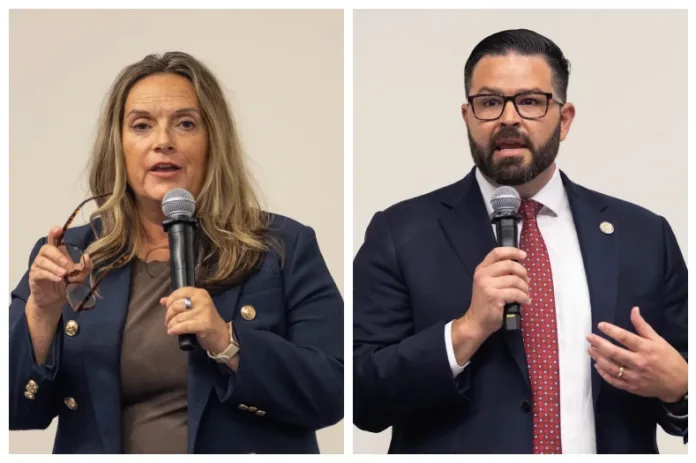
Property taxes and county spending dominated the Johnson County Post’s forum Tuesday night between the two contenders for Johnson County Commission chair.
Though there were a few side trips prompted by audience questions into affordable housing, homelessness and even the candidates’ thoughts on the legalization of marijuana, the candidates spent much of the nearly hour-long session talking about pocketbook issues.
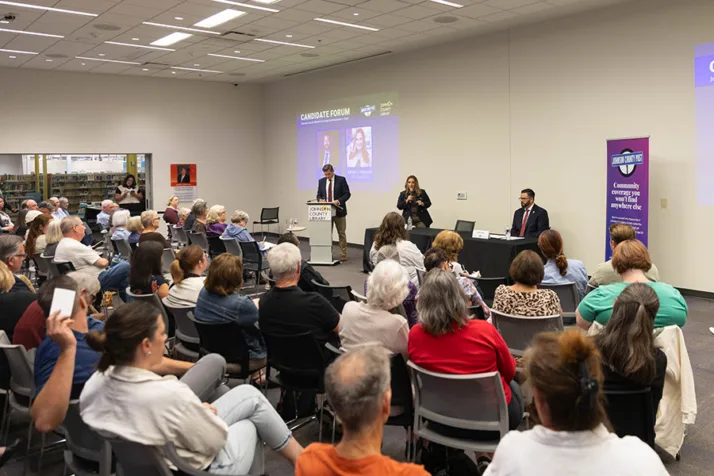
About 130 people attended the one-hour discussion between incumbent Mike Kelly and Karen Crnkovich, who are facing each other in the November 3 general election.
The event, at Central Resource Library in Overland Park was hosted by the Post in partnership with Johnson County Library.
Topics for discussion had been submitted by readers in the weeks beforehand, and editor Kyle Palmer, who moderated the event, also took questions from the live audience.
You can watch the full recording at the Post’s Facebook page, or in the YouTube link below:
Who are the candidates?
The county commission chair leads the seven-member commission and is elected at-large.
The race is nonpartisan, meaning no party labels will appear next to candidates’ names on the ballot.
The candidates are:
- Karen Crnkovich of Olathe, the owner and operator of a heating, cooling and plumbing company. Crnkovich founded Strong Homes, Strong Families, a Kansas City nonprofit providing home repairs to families in need.
- Mike Kelly of Prairie Village, who is nearing the end of his first four-year term as commission chair. Kelly served as mayor of Roeland Park from 2017 to 2022 and founded Climate Action KC, a nonprofit dedicated to reducing greenhouse gases.
Property taxes and the county budget
Much of the forum’s time was devoted to several questions and an extended back-and-forth on the county’s budget. You can watch it at the link below:
Crnkovich pledged at a June primary forum for county chair to advocate to lower the county’s mill levy rate to below the state-defined revenue neutral rate, at which the county would take in the same amount of revenue as the year before, and repeated that call Tuesday.
“The problem is that we are not being judicious with how we spend our budget,” she said.
She maintains that “skyrocketing property taxes” are being driven by excessive spending that has resulted in punishing property tax bills.
She said increases in the county’s budget have outpaced the county’s population growth and the Consumer Price Index.
While the county’s population grew 3.6% from 2021 to 2026 and the CPI increased 21% in the same time frame, the county budget increased 52% — an “alarming increase,” she said.
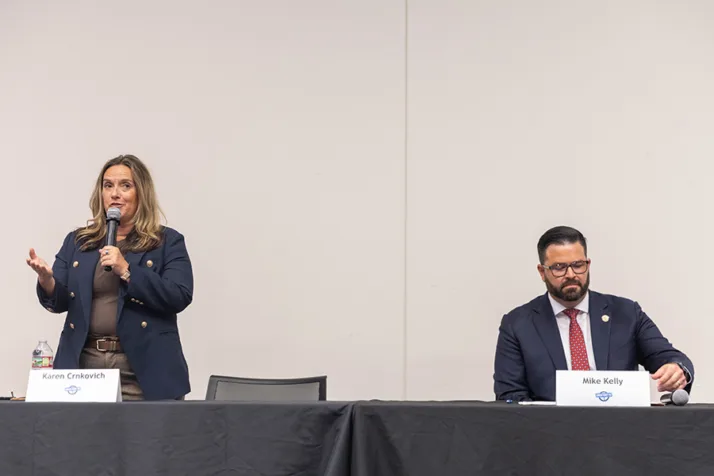
Kelly countered that all commissioners are concerned about rising property tax bills that have continued to rise because of increasing home values, but he said the commission has made efforts to keep bills lower by past reductions in the mill rate, the elimination of employee positions that don’t affect services and by working with state legislators.
He also noted that the Wastewater Department, which is funded through user fees, accounts for about a third of the county budget.
“If you take out wastewater, Johnson County’s government is actually below inflation,” he said.
Should the county dip into its reserves?
There were some sub-categories of the tax and spending discussion, including a back-and-forth over the county’s reserves, which currently sit at more than $530 million, nearly 30% of the county’s 2027 budget.
Watch the reserve exchange below:
Kelly said the reserves are a safety net that the county needs to fund life-saving services “when times get tough.”
He noted that many reserve funds are restricted by law as to what they can be used for.
“The idea of utilizing the reserves for a one-time lowering of property taxes is a sugar high. And we all know what happens after sugar highs. There’s a crash. And then you’re left with a multi-million dollar budget hole and having to raise property taxes right back up the next year,” he said.
Crnkovich was skeptical that the county needs as much in reserve funds as it has budgeted to keep its AAA bond rating. (Bond ratings factor into how much a government pays in interest when it borrows money. The better the rating, the lower the payments are.)
She said the county could still have a good bond rating through “a variety of factors all put together that can be negotiated.”
On a follow-up question, she said individual departments should not keep excessive reserves, with the exception of those trying to save for a large expenditure.
“The problem is that every department has double or even sometimes triple the amount of policy reserves, and that is excess money that is just sitting there, earning interest rather than earning interest for you,” she said.
Should county staff be cut?
Watch the full exchange about staffing and other sources of revenue at the link below:
Crnkovich had said earlier in the forum that county staffing levels have been increasing too fast. Later, she said county leaders should look for synergies and overlaps among some department functions that could be combined or eliminated.
She said county officials were being misleading when they said there were no new employee positions in the county department funded by property tax dollars because there were 18 full-time employees approved in the new budget, which included the park and recreation district and library system.
“All the money that the county spends is taxpayer dollars,” she said.
Kelly said partnerships with the federal government can fund some positions and functions as well.
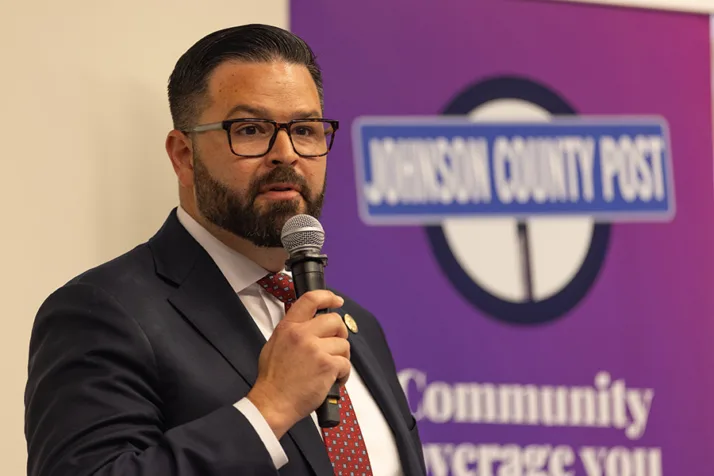
“We all pay federal taxes,” he said. “Would you rather those tax dollars go to Texas or Ohio or Nebraska or Maryland or would you rather have them be spent here in Johnson County?”
“We are a service organization. We don’t make widgets,” he continued. “So if you’re going to cut people that is going to have an impact on services unless you can identify efficiencies.”
At one point, Kelly challenged Crnkovich to put forth more ideas about specific cost savings and alternative revenue sources.
He said he and a coalition of leaders of the five most populous counties have had some success with convincing state legislators to open up a way to fund the motor vehicle registration department, a state-mandated expense that had been insufficient to cover what it cost the county.
He also said tourism has proved to be a draw to Johnson County with the potential to add to its revenues.
In response to Crnkovich’s assertion that staffing levels are too high, he noted that eight positions were recently eliminated from four departments as part of county belt-tightening.
Crnkovich repeatedly asserted that the county could lower taxes without cutting services.
“I am not of the opinion that we need to cut any services,” she said. “What we need to do is be smarter about how we spend our money.”
When asked directly by the moderator, she did not name any alternative ways for the county to raise money if property taxes were lowered.
Affordable housing and homelessness
Watch this exchange in the link below:
In response to a question from the audience about how to get more attainable homes in the county, Kelly said, “We need more housing in Johnson County, full stop, period.”
He added that he’s been a leader in getting more affordable housing through partnerships with Habitat for Humanity and Metro Lutheran Ministries and the Salvation Army.
“But guys, let’s be clear. We still need a housing services center in Johnson County,” because of the rising need.
That was a reference to a plan, pushed by Kelly, to convert a Lenexa hotel into a year-round homeless shelter and services center, that was scuttled two years ago when the Lenexa City Council denied a special use permit for the project.
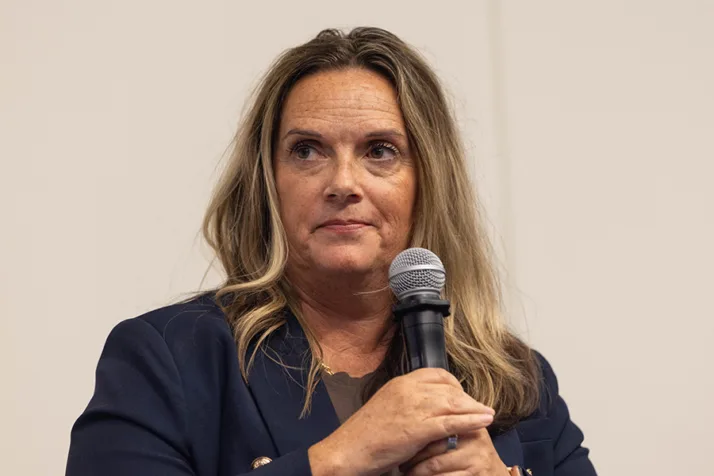
He said a center has the potential to save money in law enforcement costs. Without homeless shelters, unhoused people can end up at the county jail.
Crnkovich said she’d hesitate to put public money into incentives for development of housing at certain price points.
“When we say we want to use more taxpayer dollars that means that somebody has to foot the bill,” she said, adding that there are a lot of nonprofit groups willing to tackle the problem.
“I don’t necessarily agree with the county giving money to one particular sector because then where does it stop?” she said.
The county should convene the conversation and bring groups together, but not necessarily fund their proposals, she added.
Kelly said that finding affordable or unused land is one avenue to explore, and that he’d be open to exploring a revolving loan fund to unlock more development.
“Housing is a crisis across America,” he said. “And if it was a problem that the private sector could solve, it would be solved already.”
Tax incentives for development
Watch this exchange in the link below:
Crnkovich said the commission should be more willing to veto tax increment financing deals that have an adverse effect on the county, like the one recently considered for an assisted living facility in De Soto.
“(Tax increment financing) has been used like handing out candy across the county,” she said, “because the corporate base is not paying their fair share.”
She said the correct use for incentives is when the location is difficult to develop.
Kelly said impact on services should be weighed with economic impact.
“Economic development tools make sense when they bring in unique projects to our community and when they don’t fit we should absolutely say no,” he said.
Legal marijuana
Watch this exchange in the link below:
Although the state legislature, not the county government, decides this issue, commissioners were asked by an audience member whether they’d advocate for legalization of marijuana.
Kelly responded: “We need to look at all the revenue streams that are possible, especially given what’s going on on the east side of the state line,” he said.
He added that the conversation also needs to extend to law enforcement and emergency services.
“But if it’s a revenue stream that could help lower our residential property tax burden, yeah, I think that’s an important conversation,” he said.
Crnkovich said she did not support the legalization of recreational marijuana because there was no good way to measure impairment.
“Until we have technology to measure the level of impairment just as we have with alcohol, I think recreational marijuana is a bad idea.”
But she added that she was open to legalizing medical marijuana.