Earlier this summer, the Post asked our readers what issues you wanted to hear candidates in federal, state and local races address leading up to the Nov. 3 election.
Based on that feedback, we developed a five-item questionnaire centering the issues most important to residents across Johnson County.
Each day this week, we’ll publish the candidates’ responses to one question. So far, we’ve published responses on property taxes and county spending, voting access and license plate readers.
Today, we’re publishing candidates’ responses to the following question:
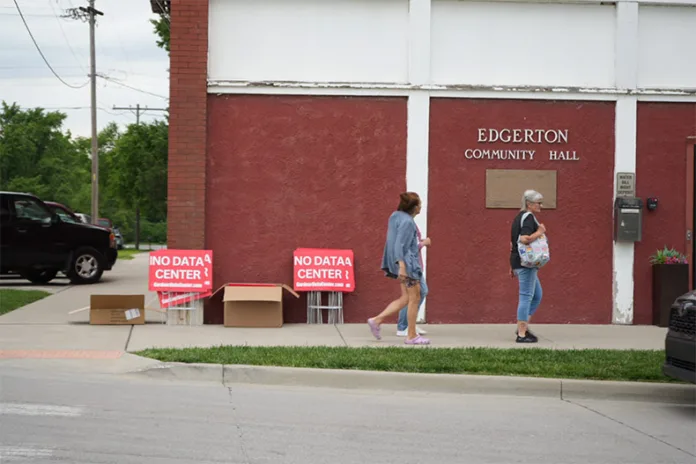
In recent weeks, Edgerton’s city council overrode its own planning commission to approve an $860 million data center over residents’ objections, and a proposed data center project in De Soto has more than doubled in size. These were city decisions — the county directly controls only unincorporated land — but readers still want answers on the impacts data centers could have on water, power and noise. What can the county do when it comes to data centers? Set countywide standards, coordinate with cities or impose a moratorium? What approach do you support?
Below are the answers the Post received from candidates on the issue:
Chair
Mike Kelly (incumbent)
 I’ve heard from residents worried about water, power, noise and their utility bills. Those concerns are fair, and they deserve real answers, not slogans.
The county’s authority is limited to unincorporated land, but we’ll use it fully there: evaluating any economic development project, including data centers, on a case-by-case basis. We are working to adopt clear standards, requiring public disclosure of water and power use, and refusing secret deals.
But a county moratorium wouldn’t stop a single project inside Edgerton or De Soto, so we’ll work with city leaders, through MARC and interlocal agreements, to align on priorities. Streamways don’t stop at our County border. Neither do data center applications. Shared standards give every city a stronger hand. I believe in local control, but it works best when every city starts from a strong baseline. Each project should be judged against those standards, and when one falls short, leaders should say no.
Every project should:
- Fit the community’s adopted development plan.
- Use closed-loop cooling and report water use publicly.
- Cover its own power needs without raising residential rates, which I’ll press state regulators to protect through large-load rate structures.
- Meet enforceable noise limits at the property line.
- Sign a community benefits agreement supporting schools and fire districts.
Economic development helps lower our reliance on residential property taxes, but growth only works if residents can trust the process, and I’ll make sure they can see it. That’s how Johnson County leads on innovation without leaving residents behind.
Karen Crnkovich
 The county cannot dictate land-use decisions inside incorporated cities such as Edgerton or De Soto, but that does not mean it should ignore the cumulative regional impact of data centers.
Recent projects demonstrate why planning matters. Edgerton approved an $860 million project after its planning commission rejected it, while the De Soto project expanded from approximately 1.14 million square feet to nearly 2.9 million square feet.
For unincorporated Johnson County, I support a temporary pause on large data-center approvals while comprehensive standards are developed.
Countywide, I would bring cities, utilities and other stakeholders together to assess cumulative water use, electric-grid capacity, infrastructure, noise and emergency-service impacts.
Future projects should disclose projected water and electricity consumption, demonstrate adequate infrastructure capacity and show measurable community benefit. I am not opposed to development. I am opposed to making billion-dollar decisions without understanding their long-term consequences.
District 1
Becky Fast (incumbent)
 Johnson County does not have the authority to impose a countywide moratorium on data centers within cities, which control their own land use. In unincorporated areas, the County’s rural land- use policies do not accommodate large-scale industrial development, including data centers, given limited infrastructure and the lack of sewer systems beyond septic tanks.
Enforceable guardrails are needed in Kansas to ensure compliance with water and energy use, air emissions, and noise regulations. These measures are critical for safeguarding our environment, power grid, and residents from escalating energy costs. Community benefits agreements should also require developers to demonstrate that they will provide good-paying jobs.
I organized Johnson County’s first Water Summit, bringing together city, county, and state leaders and more than 100 stakeholders to protect water quality and our regional water supply. As development accelerates across Johnson County, we must recognize the strain it can place on our water resources. The loss of rural land and green space also increases stormwater runoff, flooding, and stream pollution.
Our electrical infrastructure faces similar challenges. Northeast Johnson County continues to experience power outages, and aging infrastructure needs modernization. I brought city administrators together to pursue grant funding to assess our electrical system’s condition and capacity. We need regional and statewide assessments of grid reliability and power infrastructure to guide planning and development decisions.
Responsible growth means understanding our infrastructure’s limits before adding demand. We can welcome investment while protecting our water, keeping energy affordable, safeguarding public health, and preserving our quality of life. Growth should benefit our communities, not leave residents paying the price.
Ben Hobert
Did not provide the Post with a response.
District 4
Teresa Erb
 I am still learning about this issue, but at this point I am not convinced that a moratorium on data center projects is necessary. I am inclined to believe that each proposal should be evaluated on its own merits and that the county can negotiate appropriate protections as part of the approval process. The county does not have to approve a project that does not adequately address its concerns.
Protecting our environment has long been important to me, so I would pay particular attention to a proposed data center’s use of water and energy and its broader environmental impact, as well as its effect on infrastructure, neighboring properties, and the surrounding community. I would also want to understand the tangible benefits the project would bring to Johnson County, including jobs, tax revenue, and infrastructure investment. Any agreement should appropriately balance those benefits against the costs and demands the project places on the community.
Although the County Commission’s zoning authority is limited to unincorporated areas, the environmental and infrastructure impacts of data centers can extend beyond city boundaries. I would support working with cities, utilities, and other regional partners to develop consistent standards for evaluating these projects, while respecting the authority of individual municipalities to make their own land-use decisions.
District 5
Greg Mitchell
 Incorporated cities within Johnson County are granted Home Rule status under the Kansas Constitution. This means the cities have autonomy to make decisions about zoning, land use, and economic development. This would not, however, preclude the county and cities from collaborating on standards that limit project scope or create requirements related to power and water consumption and noise restrictions.
Additionally, utilities like WaterOne, Johnson County Wastewater, and (potentially) Evergy must be viewed as important partners in establishing and managing these standards. For instance, I understand there is no statutory limit on the System Development Charges (SDCs) that WaterOne could impose on a development, including data centers. If a design would use too much water or require too much infrastructure build-out, the SDC and water rates should cover those costs.
No doubt hyper-scale data centers can be resource-intensive behemoths. That said, I understand these centers can be engineered to be more efficient and less resource-intensive than the centers we hear about. Local governments and utilities must demand that, if built, they use the least resource-intensive designs, set a ceiling on the amount of power and water used, and have the teeth to incentivize data center operators to comply. Data center projects should require full transparency and early participation from the city or county, the water utility, wastewater utility, and energy provider.
Michael Ashcraft (incumbent)
 The concept of Data Centers can have several different dimensions. For the purposes of this response, I will assume the concerns are focused on Hyperscale centers (HSCs) and not Enterprise, Co-location or Edge centers.
Until and unless developers are able to adequately address the impact on energy and water consumption and noise pollution, residents should be justifiably concerned about their development and placement. Many sources note that the Midwest energy grid is currently strained and aging. HSCs potentially put an oversized burden on that system that potential falls to general service users to remedy and fund.
I would suggest that the County has few realistic tools to control the development of HSCs in cities. One of the few tools would be use exercise the county’s veto power over TIFs if they were being sought to fund an HSC. The BoCC has been reticent to use this tool (See my comments to Question One), and I doubt there would be much support among my peers for such consideration. I will note that this matter has not been discussed by the Commission to date.
While I would favor talking to our sister city governments about the development and management of HSCs, I do not know how the BoCC could set a countywide standard except in maybe some general sense. Such a process would be laborious and time consuming making immediate action more problematic.
Coming up:
Tomorrow, we will publish the candidates’ responses to the following question:
Johnson County’s bus system has struggled for years to draw riders in our car-dependent county. This summer, the county spent $6.8 million, mostly in one-time grants, on free World Cup bus routes that seemed to run well below capacity. Meanwhile, the county’s Transit Fund is expected to end 2026 with about 3% of annual spending in reserve, and more than a dozen buses are past their useful life. Is public transit worth investing more local money in? What should transit in Johnson County look like 10 years from now?
 Thanks for reading! If you value having an independent news outlet keeping tabs on local government, schools and taxes, we're asking you to contribute to our Education Reporting Fund.