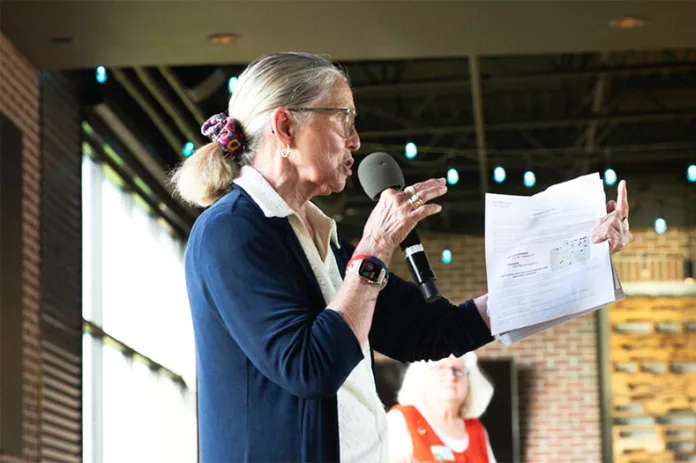
Connie Schmidt, who was appointed to temporarily fill the vacancy created when county Election Commissioner Fred Sherman resigned last December, has been sworn in to officially take over the job of Election Commissioner long-term.
The decision prompted a concerned statement from county commission Chair Mike Kelly, who suggested the process for Schmidt’s selection fell short of requirements laid out in state law.
Kansas Secretary of State Scott Schwab announced the decision Tuesday morning. Schwab lauded Schmidt’s 31 years of election experience, including a previous stint as Johnson County Election Commissioner from 1995 to 2004, and then again temporarily in 2020.
But Kelly released a statement Tuesday evening saying he had concerns about the way the appointment was made.
His concerns revolve around the fact that Schmidt was the only applicant put forward and interviewed by the selection committee. Because the committee had only one candidate to consider, the county’s representatives were unable to recommend anyone for submission, Kelly’s statement said.
Schmidt, contacted Wednesday morning, confirmed she had been sworn in Topeka on Monday following the state canvass of the August primary. The Secretary of State’s office advertised the position in May, and it was posted on the county’s social media page at the same time, she said in an emailed response.
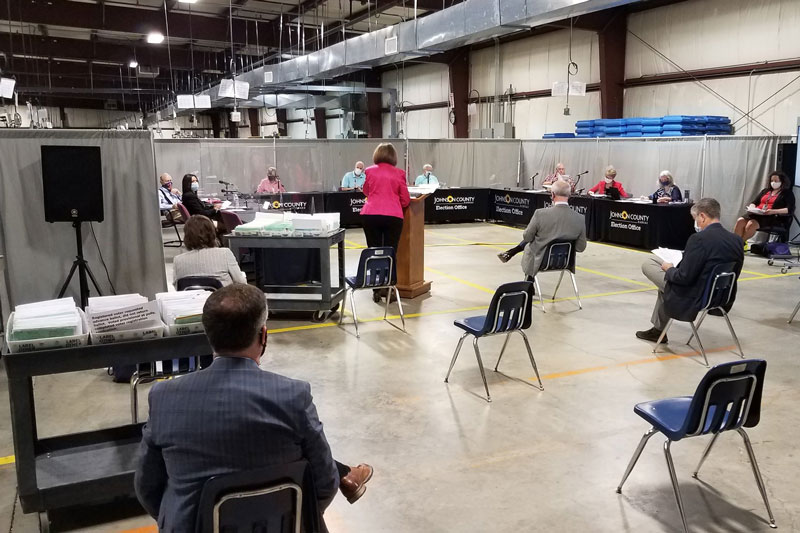
The Secretary of State’s announcement of her appointment is dated Tuesday and does not mention the number of applicants or the review process. Election commissioners serve four-year terms “until a successor is appointed and qualified.”
In Kansas, counties of over 125,000 have election commissioners appointed by the Secretary of State. In smaller counties, the function is typically taken over by a county clerk.
Kansas statute 19-3419 lays out the way appointments are to be made in the larger counties. It says:
The secretary, in consultation with the chairperson of the board of county commissioners for the county where an election commissioner is to be appointed, shall form a search committee to identify, interview and recommend to the secretary at least three candidates for the position of election commissioner. Such search committee shall include the chairperson of the board of county commissioners for such county, or a county commissioner for such county as designated by the chairperson, a representative of such county’s human resources department and three representatives of the secretary of state’s office.
A spokesperson with Schwab’s office said the statute, “does not prohibit the Secretary from appointing an election commissioner unless three applicants have applied, nor require a vacancy to remain unfilled until three qualified applicants are identified.
“This is particularly significant because the Johnson County Election Commissioner oversees the most challenging and demanding election office in Kansas; consequently, the pool of qualified applicants is extremely small, and the number willing to serve is smaller still,” the statement said.
Kelly said he wishes Schmidt well and looks forward to collaborating with her. But, “Trust in our institutions is crucial, especially when it comes to the constitutional right of free and fair elections. I felt we owed a greater duty to the people of Johnson County through this process. But ultimately, the Secretary of State decided to move forward with this appointment.”
Schwab praised Schmidt in his news release for accomplishments on the local and national stage. Schmidt has run an election consulting business and served on national and state boards and certification groups.
“Johnson County is fortunate to have someone with Connie’s experience and expertise leading its elections,” said Schwab in the press release. “She understands what it takes to administer secure, accurate and professional elections, and I look forward to the work she will do for Johnson County.”
Schmidt has been criticized of late for a decision to discontinue eight early voting sites in some of the county’s urban areas.
Some voting rights advocates have said the cuts will make it harder for people to vote who already face obstacles to voting through inadequate public transportation, lack of child care or rigid work schedules. (Two new early voting sites were opened in rural areas of Spring Hill and De Soto, but eight others in more densely populated areas of the county were closed.)
The American Civil Liberties Union called out this decision, and protesters lined the sidewalk outside the election office last week to ask that they be reopened for the general election. The ACLU declined to comment on Schmidt’s permanent appointment to the position.
Primary turnout remained strong with the August election garnering the second highest voter turnout in history statewide, Schwab said.
In Johnson County, turnout for the primary ended up being about 37%, higher than the last even-year primary in 2024 but lower than in 2022, when an abortion amendment drove record turnout.
Schmidt said in August that she was “very pleased” with turnout, though the final figure came up short of her projection of 52% turnout.
Keep reading: Johnson County cut 8 early voting sites — Here’s how turnout compares to 2022 and 2024